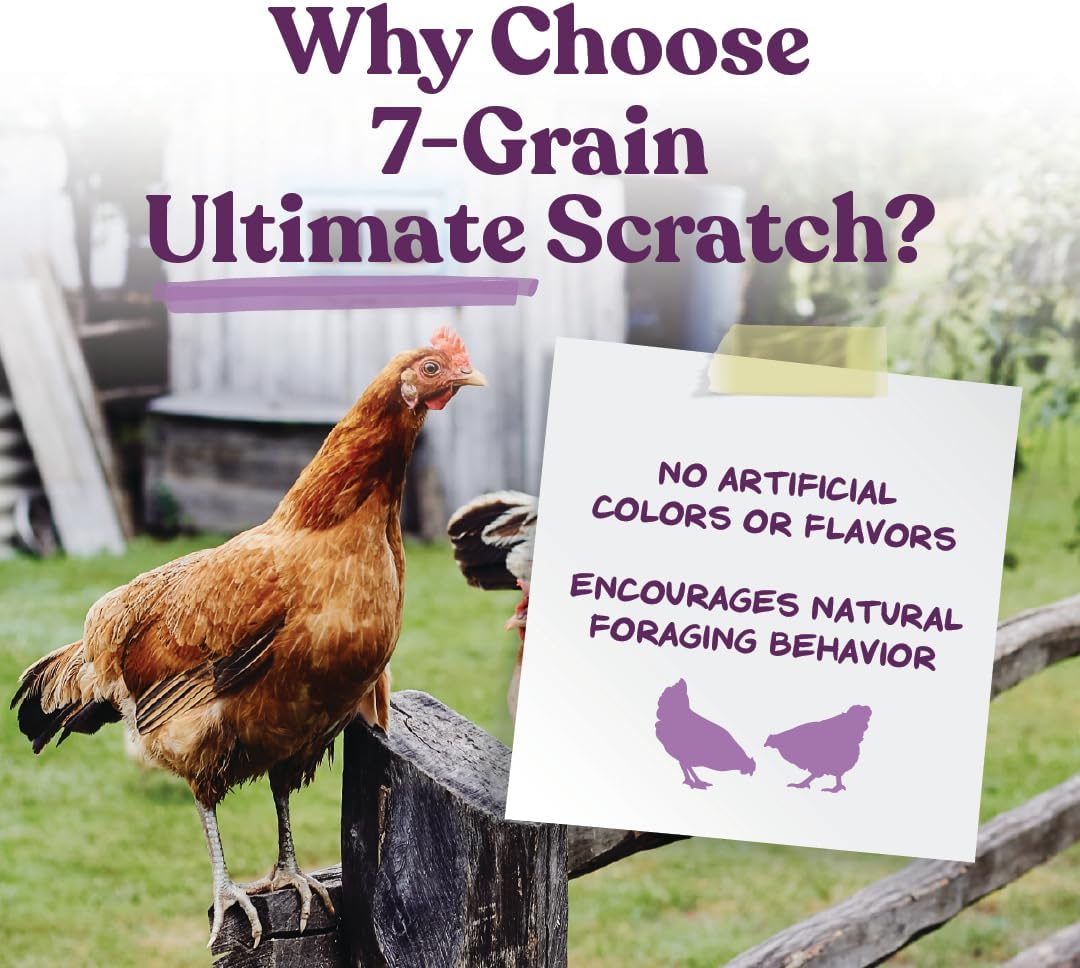
Walk into any feed store and you’ll find a bag of scratch grain near the register, usually in a cheerful burlap-style bag with chickens on the front. It’s a mix of cracked or whole grains — typically cracked corn, wheat, milo, sunflower seeds, and sometimes oats — and chickens lose their minds for it. New keepers often assume it’s the main thing chickens eat. Experienced keepers know better, but sometimes still drift into habits that cause real problems. Scratch grain is a supplement at best and a dietary wrecker at worst, depending entirely on how much you feed and when. This article explains what’s actually in scratch grain versus a complete layer feed, why the difference matters to your hens’ biology, and gives you a clear decision framework for using scratch correctly — without giving it up entirely, because honestly, the enrichment value is real.
| EDITOR'S PICKNew Country Organics | Mid-tierManna Pro Ultimate Chicken Scra… | Budget pickManna Pro Harvest Delight Poult… | |
|---|---|---|---|
| Weight | 25 lbs | 10 lb | 2.25 lb |
| Protein | 9% | — | 14% |
| Feed type | Scratch Feed | Scratch Grain | Treat |
| Target species | Adult Poultry | Chickens & Poultry | Chickens, Ducks & Mixed Flocks |
| Soy-free | ✓ | — | — |
| Organic | ✓ | — | — |
| Price | $43.98 | $14.99 | $11.49 |
| See on Amazon → | See on Amazon → | See on Amazon → |
What Scratch Grain Actually Contains (and What It’s Missing)
A complete layer feed — think Kalmbach Feeds 17% Layer Pellet or Purina Layena — is formulated to meet a laying hen’s full nutritional requirements in a single product. That means it’s balanced for protein (typically 16–18%), calcium (around 4% for shell formation), phosphorus, and a full array of vitamins and trace minerals. The feed manufacturer has done the amino acid math so you don’t have to.
Scratch grain is none of those things. It’s essentially a carbohydrate delivery system. A standard corn-based scratch typically runs:
By the numbers:
- Crude protein: 7–9%
- Calcium: 0.05–0.10%
- Fat: 3–5%
- A laying hen’s daily calcium requirement: ~4 g/day (requires ~4% Ca in diet)
The calcium gap alone tells the story. A hen producing an egg every 24–26 hours deposits roughly 2 grams of calcium into each shell. Per the Merck Veterinary Manual’s nutrition section on poultry, calcium deficiency doesn’t just produce thin shells — it eventually causes the hen to mobilize calcium from her own bones, a condition called osteoporosis or cage layer fatigue, even in free-range flocks that eat too much scratch.
Protein is the other major gap. The amino acids methionine and lysine — the two most critical for egg production — are poorly represented in corn-heavy scratch mixes. Penn State Extension’s backyard flock feeding guide specifically flags scratch as a “treat feed” and recommends it constitute no more than 10% of a flock’s daily intake precisely because of these protein and mineral deficiencies.
What scratch does deliver is energy — fast-burning carbohydrate calories, plus some fat from sunflower and corn. That’s useful in specific circumstances (more on that below), but energy is the one nutrient laying hens rarely run short of if they’re eating a reasonable volume of complete feed.
The 10% Rule and Why It’s Harder to Follow Than It Sounds
The 10% threshold — scratch should not exceed 10% of total daily feed intake — is the consistent recommendation across extension literature, including guidance from Penn State Extension and the USDA National Agricultural Library’s compiled nutrient requirements for poultry. In practice, it’s easy to blow past without realizing it.
Here’s the math on a mid-sized backyard flock:
A standard laying hen eats roughly 0.25 lb (about 113 g) of feed per day. For a flock of 12 hens, that’s approximately 3 lbs of total feed daily. Ten percent of that is 0.3 lbs — about 4–5 oz of scratch across the whole flock. That’s less than a double handful.
The problem is that scratch is used as an enrichment tool, a bribery mechanism, a recall signal, and a winter treat all at once — and keepers tend to free-scoop rather than measure. A full scoop from a standard coffee can runs 12–16 oz easily. Do that twice a day and you’ve replaced 25–30% of your flock’s nutritional intake with essentially junk food.
The dilution effect compounds quietly. The Poultry Site’s feed formulation overview describes how adding any low-nutrient ingredient to a flock’s ration “dilutes” the overall nutritional density — meaning hens may eat their fill of scratch, feel satiated, and undereat their complete feed. The result isn’t dramatic or sudden; it shows up over weeks as declining egg production, softer shells, and occasionally feather quality changes. By the time you notice, the deficiency has been building for a while.
If you’re not measuring, you’re guessing. A kitchen scale and a designated scratch scoop with a marked fill line is a five-dollar fix for a problem that otherwise costs you in production and bird health.
When Scratch Grain Actually Earns Its Place
None of this means scratch is useless — it’s genuinely valuable in the right context. The carbohydrate-to-heat conversion is real poultry science, not folk wisdom. Per ATTRA/NCAT’s organic poultry production guide, feeding a scratch supplement in the late afternoon during cold months causes increased metabolic activity and heat generation overnight, which can meaningfully support flock comfort in uninsulated coops in USDA zones 4–6.
The specific timing matters: scratch fed 1–2 hours before roost time gives hens something to digest overnight, when their digestive systems are otherwise idle. Scratch fed at noon in July in a hot climate does the opposite — it adds a thermal load to birds already managing heat stress, potentially suppressing feed intake and egg production. The same product, used differently, produces opposite outcomes.
Scratch also has legitimate behavioral enrichment value. Scattering it in a run or deep-litter system drives foraging behavior — scratching, pecking, turning litter — which is genuinely good for flock welfare and litter management. The ATTRA guide specifically notes that scratch-stimulated foraging in deep litter systems helps maintain litter aeration and reduces ammonia buildup. Used for this purpose, a small, measured amount does real work beyond the calories.
Here’s where scratch does and doesn’t belong in your management system:
Use scratch when:
- Temperatures drop below 20°F and you want to support overnight metabolic heat — feed a measured ration 1–2 hours before roost
- You’re using deep litter management and want to drive foraging behavior that turns the bedding
- You’re training flocks to recall or move between paddocks (small amounts as a reward)
- You’re supplementing a genuine free-range system where hens are getting meaningful insect and forage protein to offset the scratch’s protein deficit
Avoid scratch when:
- Ambient temperatures are high (summer, hot climates) — the thermogenic effect works against you
- Your flock is already showing soft shells, declining lay rate, or feather quality issues — fix the base diet first
- You’re feeding pullets still in development — their protein requirements are even higher than laying hens, and diluting their grower ration with scratch delays sexual maturity
- You’re sourcing premium complete feeds (Scratch and Peck Feeds Cluck’n Sea Organic at ~$55/bag, Modesto Milling Organic Poultry Grower, or similar) — you’re paying for formulation precision; scratch undermines the investment
Reading the Label: Complete Feed vs. Scratch Side by Side
If you want to see the gap in black and white, put a complete layer feed tag and a scratch tag next to each other and look at three lines: crude protein, calcium, and the ingredient list.
A quality layer pellet like Kalmbach Feeds 17% Layer will show: crude protein minimum 17%, calcium minimum 3.8–4.2%, and an ingredient panel led by soybean meal, corn, and calcium carbonate (limestone or oyster shell). The USDA National Agricultural Library’s nutrient requirements for poultry confirm that 16–18% crude protein, with a methionine + cystine floor around 0.58% and lysine around 0.73%, represents the established baseline for laying hen performance.
A typical corn-based scratch: crude protein minimum 7–9%, calcium 0.05% or lower, ingredient panel that’s essentially cracked corn, wheat, and milo with no mineral or vitamin supplementation noted. That calcium figure isn’t a rounding artifact — it’s genuinely near zero.
The ingredient list also tells you whether the scratch contains any amino acid fortification (almost none do) or added vitamins (almost none do). It is grain. Full stop.
Owners of premium organic flocks sometimes gravitate toward “organic scratch” options with comparable price-per-pound to entry-level complete feeds — which is a particularly expensive way to under-feed your hens. The organic certification doesn’t change the protein or calcium math.
The Decision Framework: If X, Then Y
If your flock’s lay rate is steady and shells are firm, and you’re already measuring scratch at under 10% of daily intake — you’re fine. Keep the enrichment, watch the seasonal timing, and continue.
If you’re in a cold climate and want the overnight thermogenic benefit — feed scratch once daily, measured, 1–2 hours before roost. Cut it back or eliminate it entirely from May through September.
If you’re running a premium organic complete feed — Scratch and Peck, Modesto Milling, or similar — consider whether scratch belongs at all. At $50–$55/bag for precision-formulated organic pellets, diluting the ration with unfortified grain undercuts the product you’re paying a premium for. Enrichment can be delivered other ways: hanging vegetables, deep litter foraging, or purpose-formulated flock blocks that maintain the nutritional baseline.
If you’re noticing declining production, soft or thin shells, or feather quality decline — remove scratch entirely, audit your complete feed freshness (lipid oxidation in stored grain degrades nutritional value over time), and give your flock 4–6 weeks on undiluted complete feed before reassessing. Per the Merck Veterinary Manual’s poultry nutrition guidance, recovery from calcium and protein deficiency takes several weeks of corrected feeding to show up in shell quality and production metrics.
If you have pullets approaching point-of-lay (around 18–20 weeks for most dual-purpose and laying breeds) — hold off on scratch until they’re consistently laying and transitioned to layer feed. Protein requirements during the final weeks of development are high, and scratch during this window delays readiness.
The bottom line is simple: scratch grain is a behavioral and thermal management tool that happens to be made of grain. It is not feed. Used within a 10% ceiling, with attention to season and timing, it earns its bag space. Used as a free-choice staple, it quietly dismantles the nutritional foundation your complete feed is trying to build.