Rabbits look simple to feed — a bag of pellets, a water bottle, maybe a carrot — but the gap between an adequate rabbit diet and a genuinely good one is wide enough to cause real health problems over time. A pellet is a compressed, shelf-stable feed disk made from ground hay, grains, vitamins, and minerals. The best ones are built around a hay base (typically timothy or orchard grass) and provide a nutritionally complete meal in a form that’s easy to measure and portion. The worst ones are essentially candy in disk form. And then there’s a whole middle category — the muesli mix — that looks wholesome but actively works against your rabbits’ long-term health. This guide walks through what separates a quality pellet from a problematic one, how to match formula to life stage, and how to make a clear-eyed buying decision between the major options on the market right now. If you’re running 20 does or 50, or if you’ve already started comparing guaranteed analyses on feed tags, this piece will give you a decision framework you can apply at the shelf or in a bulk-order conversation.
| EDITOR'S PICKPurina Rabbit Food Complete Pel… | Mid-tierOxbow Animal Health Organic Bou… | Budget pickOxbow Essentials Rabbit Food | |
|---|---|---|---|
| Weight | 25 lb | 3 lb | — |
| Life Stage | — | — | Young |
| Hay Type | — | — | Alfalfa |
| Organic | — | Organic | — |
| Complete Diet | Complete | — | — |
| Price | $35.49 | $13.49 | $11.04 |
| See on Amazon → | See on Amazon → | See on Amazon → |
Why the Hay-Base Question Matters More Than Any Other
The single most important line on a rabbit pellet label isn’t protein — it’s crude fiber, and specifically what the fiber source is.
Rabbits are hindgut fermenters. Their digestive systems are built to process large volumes of long-strand plant fiber, mainly hay. Their gut motility — how fast food moves through the digestive tract — depends on constant fiber intake. When fiber drops or the fiber source is low-quality, you get GI stasis, a slowdown or full stop of gut movement that is one of the leading causes of emergency vet visits and death in domestic rabbits. The Merck Veterinary Manual, in its chapter on Nutrition in Rabbits, identifies inadequate dietary fiber as a primary driver of GI stasis and cautions that pelleted diets should not be treated as a substitute for free-choice hay access.
A quality pellet uses timothy hay or orchard grass hay as its first or second ingredient. Timothy is lower in calcium than alfalfa — important for adult rabbits, whose kidneys can be stressed by excess dietary calcium over time. The USDA National Agricultural Library’s publication on Rabbit Nutrition and Nutrient Requirements notes that calcium-to-phosphorus ratios in adult rabbit diets should remain near 2:1 or lower, and alfalfa-heavy pellets frequently push past that threshold.
The fiber floor to know: Adult maintenance rabbit pellets should show a minimum crude fiber of 18%. Anything below 15% in an adult formula is a flag. Growing kits under 6 months and lactating does are a different case — they have higher protein and calorie needs, and alfalfa-based formulas with higher protein (16–18%+) are appropriate during those life stages.
Crude fiber and protein benchmarks by life stage:
| Life Stage | Min. Crude Fiber | Crude Protein Target |
|---|---|---|
| Adult maintenance | 18% | 12–14% |
| Growing kit (under 6 months) | 14–16% | 16–18% |
| Lactating doe | 14–16% | 16–18% |
| Pregnant doe (final 2 weeks) | 14–16% | 16–18% |
The Muesli Mix Problem, Explained Plainly
Walk into any pet chain and you’ll see colorful bags full of pellets, dried corn, seed pieces, dehydrated vegetable bits, and sometimes small fruit chunks. This is the muesli mix — and it is not a supplemented pellet. It is a mixture of different components with wildly different nutritional profiles, and the core problem is selective feeding.
Rabbits given a muesli mix will pick the calorie-dense, sweet, or crunchy pieces and leave the plainer pellets behind. The result is a rabbit eating a high-sugar, low-fiber diet that appears to come from a “complete” bag. The House Rabbit Society’s care documentation — specifically its guide titled Suggested Vegetables and Treats for Rabbits — has flagged muesli-style feeds as a contributor to obesity, dental disease, and cecal dysbiosis, which is an imbalance in the specialized bacteria that live in the rabbit’s cecum and help ferment fiber. A true pellet is uniform: every disk has the same nutritional profile. If you open a bag and it looks like trail mix, it is a muesli product regardless of what the front panel claims.
Comparing the Major Pellet Options by Tier
Premium Tier: Oxbow Essentials Adult Rabbit Food
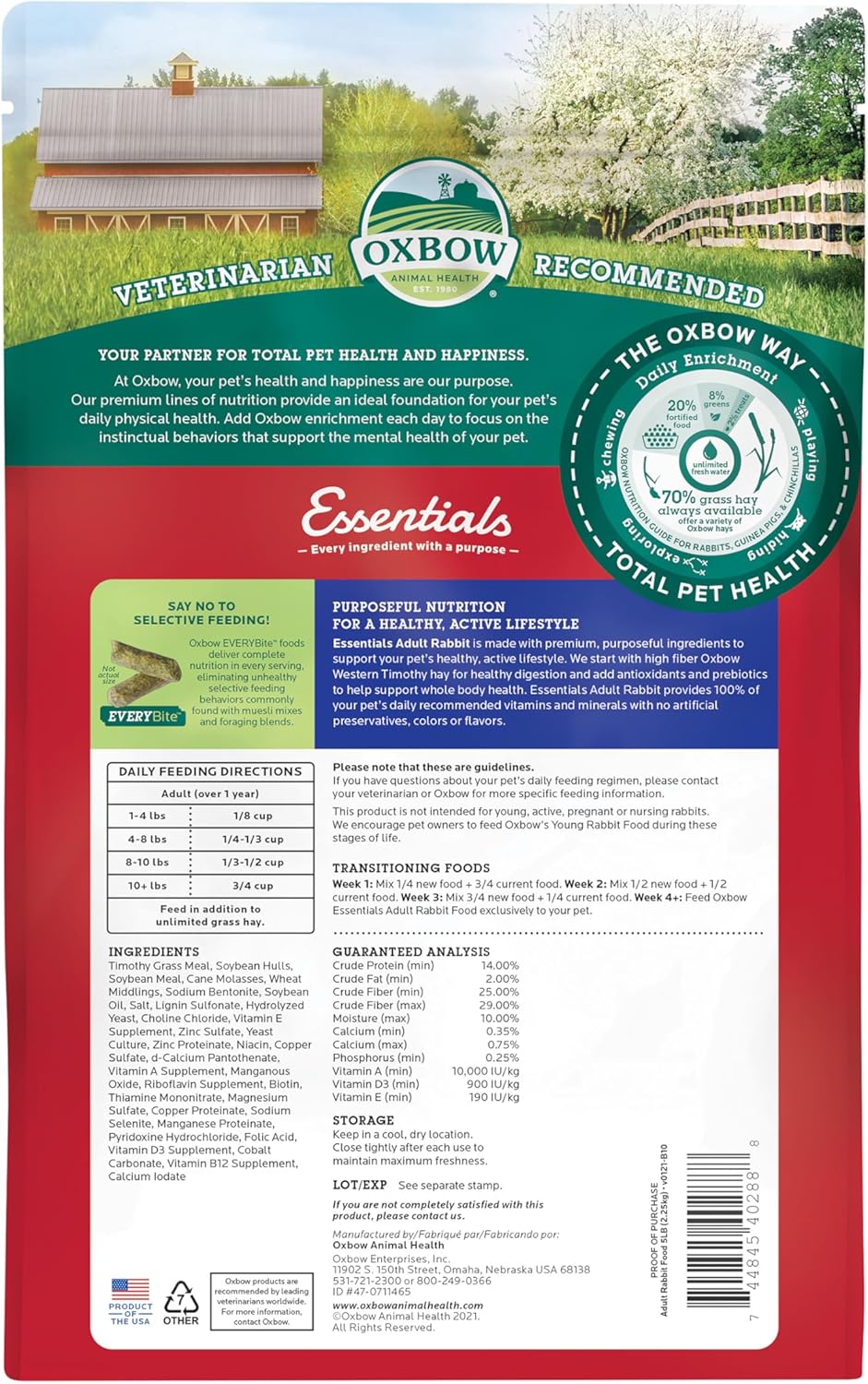
Oxbow Essentials Adult Rabbit Food is the reference standard in the premium rabbit-pellet segment. Per Oxbow Animal Health’s published product specification sheet, the adult formula leads with timothy hay, lists crude fiber at 25% minimum, and holds crude protein to 14% — appropriate for a maintenance diet. Oxbow uses no artificial preservatives, colors, or added sugars, and the pellet is uniform throughout. Bag sizes run from 5 lb to 25 lb, with 25 lb bags pricing around $40–$50 depending on channel as of mid-2026. Chewy Autoship tends to run 5–10% below standard shelf price in the current market.
This product is the correct choice when rabbits have limited hay access — either by management design or keeper habit — because its 25% crude fiber minimum is doing real nutritional work that lower-fiber options cannot replicate. It is also the appropriate choice for operations where dental and kidney health history in the herd makes calcium management a priority.
Purina
$35.49
In stock on Amazon
Check price on AmazonMid-Tier: Kaytee Timothy Complete Rabbit Diet
Kaytee Timothy Complete is the credible mid-tier alternative. Per Kaytee’s published product label and guaranteed analysis, it is a uniform pellet — not a muesli mix — with a timothy hay base, crude fiber around 20% minimum, and crude protein near 14%. That fiber minimum is lower than Oxbow’s 25% but squarely within the acceptable range for adults, especially in operations where rabbits have ad libitum hay access throughout the day.
Pricing runs approximately $1.28–$1.60 per pound at Tractor Supply and similar agricultural retailers as of mid-2026, compared to Oxbow’s $1.80–$2.20 per pound range. For a small rabbitry running 15–25 does where per-animal feed cost matters, the savings are meaningful. Note that Kaytee also produces the Fiesta line, which is a muesli-format product — these are different products under the same brand, and the Fiesta line should not be used as a primary feed for the selective-feeding reasons described above.
Oxbow
$13.49
In stock on Amazon
Check price on AmazonBudget Tier: Purina Complete Rabbit and TSC Dumor Rabbit
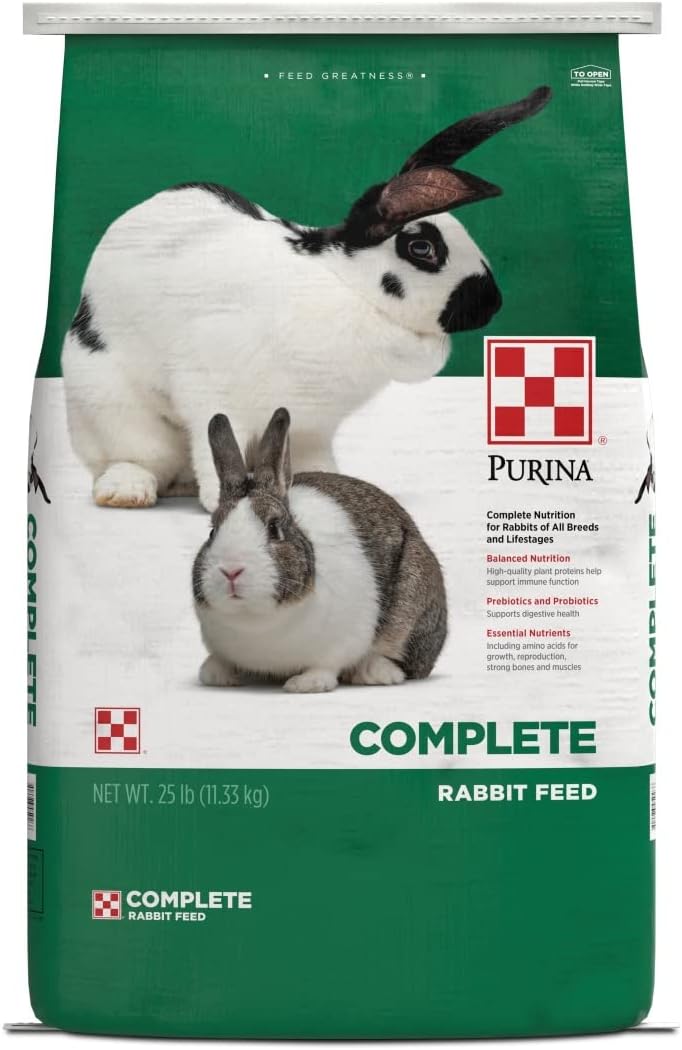
Purina Complete Rabbit rounds out the budget tier. Its published guaranteed analysis shows a crude fiber minimum of approximately 15%, which sits at the low edge of acceptable for adult maintenance and assumes strong hay supplementation alongside it. Pricing runs approximately $1.10–$1.20 per pound at Tractor Supply in 25 lb bags. For commercial operations watching margin closely, this product is workable provided rabbits receive genuine free-choice hay access at all times. For a backyard operation where the keeper assumes pellets are “complete enough” and limits hay, Purina’s fiber floor is too tight.
Tractor Supply’s house-brand Dumor Rabbit runs in a similar range. The formula has shifted in recent production years, and current Dumor Rabbit guaranteed analyses show crude fiber minimums around 15–16%, placing it in the same workable-with-hay-access tier as Purina. Worth a label read each time you purchase, since house-brand formulations can change without front-panel notice.
Oxbow
$11.04
In stock on Amazon
Check price on AmazonCost-Per-Pound Summary
| Product | Bag Size | Approx. Price (mid-2026) | Cost/lb | Min. Crude Fiber |
|---|---|---|---|---|
| Oxbow Essentials Adult | 25 lb | ~$47 | ~$1.88 | 25% |
| Kaytee Timothy Complete | 25 lb | ~$32 | ~$1.28 | 20% |
| Purina Complete Rabbit | 25 lb | ~$28 | ~$1.12 | 15% |
| Dumor Rabbit (TSC) | 25 lb | ~$27 | ~$1.08 | 15–16% |
Life Stage Matching: The Decision Most Keepers Get Wrong
The single most common formulation error in backyard rabbitries is feeding adult pellets to breeding does and kits, and sometimes the reverse — continuing to feed alfalfa-based growth pellets to adult spayed or neutered pet rabbits indefinitely.
Birth to 12 weeks (kits with doe): Kits eat primarily mother’s milk plus any hay or pellets the doe is consuming. Do not restrict doe access to a high-protein, alfalfa-based formula during lactation. The ATTRA / NCAT publication Small-Scale Rabbit Production notes that lactating does may consume 2–3 times their normal maintenance feed intake, and caloric restriction during this period directly reduces kit growth rates and survival.
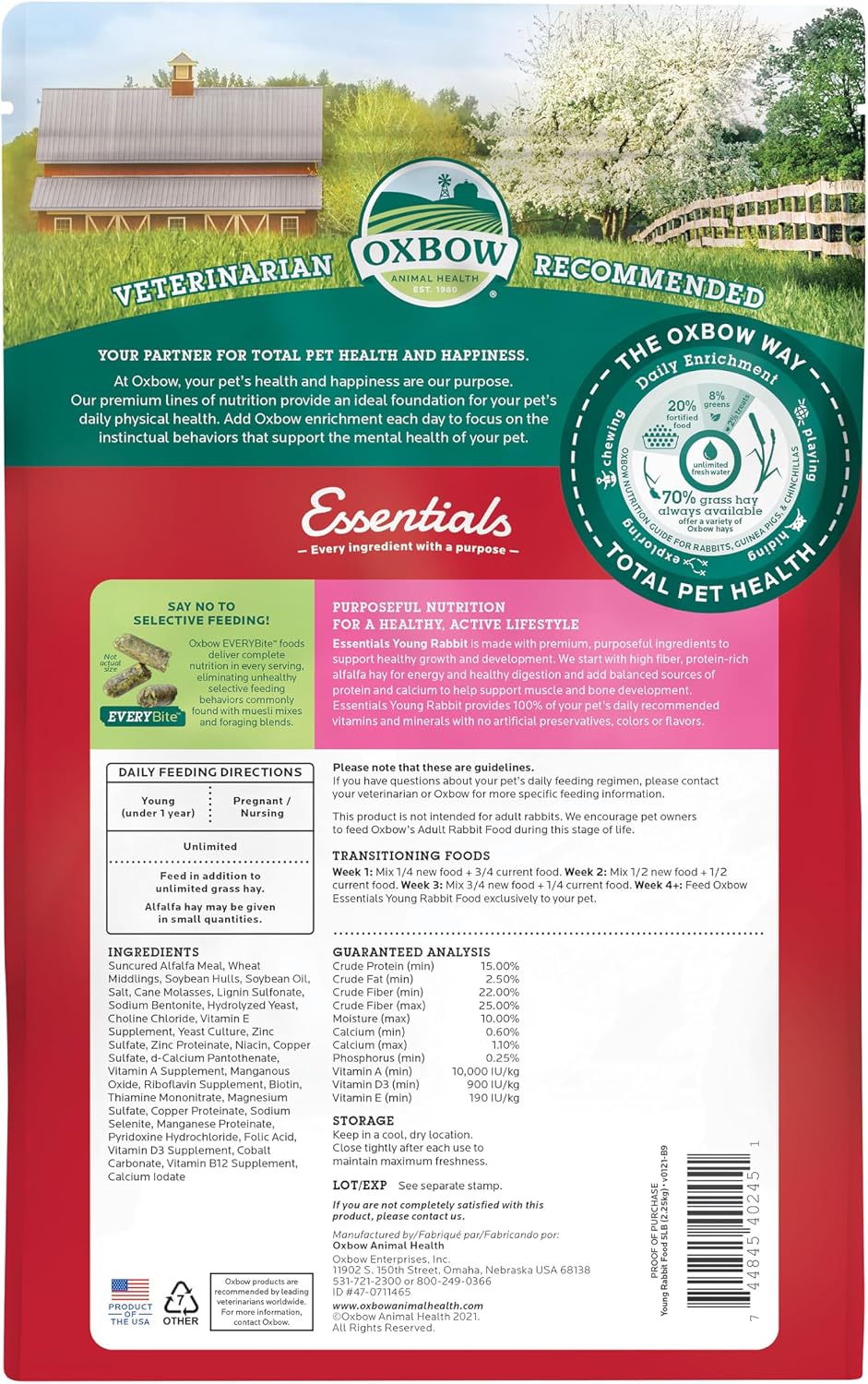
3–7 months (junior rabbits): This is the growth phase. Alfalfa-based pellets with higher protein (16–18%) and higher calcium are appropriate here, since calcium supports bone development in growing animals. Oxbow’s Young Rabbit formula and similar junior products are designed specifically for this window. Do not rush the transition to adult formula.
7 months and beyond (adult maintenance): Switch to timothy-based, lower-calcium adult pellets. The Merck Veterinary Manual’s chapter on Nutrition in Rabbits is explicit that excess calcium in adult rabbits is a documented risk factor for urinary sludge and kidney calcification over time. This transition is not optional for long-term kidney health.
Pregnant does: Return to high-protein, alfalfa-based pellets for the final two weeks of gestation and continue through lactation. Once kits are weaned, return the doe to adult maintenance formula. The USDA National Agricultural Library’s Rabbit Nutrition and Nutrient Requirements publication confirms that energy and protein demands during late gestation and lactation are substantially higher than adult maintenance requirements.
If you’re running a small commercial rabbitry and buying in bulk, this means stocking two formulas: a growth and breeding formula and an adult maintenance formula. The operational overhead is real, but feeding adult pellets through gestation and nursing is a false economy — you will pay it back in kit survival rates and doe body condition.
Sourcing Strategy: Where to Buy and When to Switch Channels
For hobbyists running under 10 rabbits, Chewy Autoship on Oxbow 25 lb bags is hard to beat on convenience and cost per pound. For rabbitries running 30 or more animals, the math shifts toward agricultural suppliers.
Tractor Supply Company stocks Kaytee Timothy Complete, Purina Complete Rabbit, and Dumor Rabbit reliably in most markets and offers the most consistent availability for mid-volume buyers.
Regional feed mills are worth a phone call if you’re pulling 200 or more pounds per month. Manna Pro and similar regional formulators sometimes offer commercial accounts with price breaks at rabbit-specific volume thresholds that are not advertised publicly. Ask specifically about rabbit pellet volume pricing — not all counter staff will volunteer it.
Azure Standard, which operates drop-route distribution across most of the continental United States, carries Oxbow in bulk and periodically runs price events on larger orders. Pricing has been variable in the 2025–2026 period as their logistics network has expanded, so check routing schedules and current pricing each quarter rather than assuming a consistent rate.
The Decision Rule
If your rabbits have unlimited hay access at all times and you’re managing feed cost across a medium-sized operation (15 or more animals): Kaytee Timothy Complete or Purina Complete Rabbit with a genuine hay-first feeding program is defensible. Monitor body condition — you should feel ribs but not see them — and watch dental wear over time.
If your rabbits have limited hay access: do not compromise on pellet fiber. Oxbow Essentials Adult at 25% crude fiber minimum is carrying nutritional load that lower-fiber options cannot replicate on their own.
If you’re running breeding does and kits: stock two formulas and match them to life stage. The cost of the second bag is lower than the cost of poor kit survival or a doe that enters her next breeding cycle in poor condition.
And if a bag has colored bits, fruit chunks, or seed pieces mixed in with the pellets: put it back on the shelf. The selective feeding math does not change because the packaging looks like a farmer’s market product.