Pellets are the compact, pressed-feed portion of a pet or production rabbit’s daily diet — think of them as a concentrated delivery system for fiber, protein, vitamins, and minerals, designed to fill nutritional gaps that hay alone doesn’t cover. For a single backyard pet rabbit, choosing between a $12 bag and a $22 bag might feel like a minor decision. But if you’re running 50 or more breeding does, managing a rescue, or trying to get a pregnant doe through a healthy kindling (the term for a rabbit giving birth), the brand you pick has real downstream consequences — feed conversion, litter survival, coat condition, and reproductive consistency all hinge on what’s in that pellet. This article breaks down five formulas across three brands — Oxbow Essentials, Oxbow Garden Select, Oxbow Organic Bounty, Kaytee Timothy Complete, and Purina Rabbit Chow — so you can match the right product to your actual situation, budget, and herd.
| EDITOR'S PICKPurina Rabbit Food Complete Pel… | Mid-tierOxbow Animal Health Organic Bou… | Budget pickOxbow Essentials Rabbit Food | |
|---|---|---|---|
| Weight | 25 lb | 3 lb | 5 lb |
| Life stage | — | Adult | Adult |
| Hay base | — | Organic | Timothy |
| Made in USA | — | — | ✓ |
| Organic | — | ✓ | — |
| Vitamins/minerals | — | — | ✓ |
| Price | $35.49 | $13.49 | $12.40 |
| See on Amazon → | See on Amazon → | See on Amazon → |
What the Label Is Actually Telling You: Fiber, Protein, and the Timothy vs. Alfalfa Divide
Before comparing brands head-to-head, two numbers on any rabbit pellet label matter most: crude fiber and crude protein. Adult rabbits need high fiber — the Merck Veterinary Manual, in its chapter “Nutrition in Rabbits,” puts minimum crude fiber at 18% for maintenance adults, with many practitioners preferring 20–25%. Protein should run 12–14% for adults; too high drives weight gain and can stress the kidneys over time. For does in late gestation or nursing, protein requirements climb — more on that in the FAQ.
The other foundational split is the base forage: timothy hay-based pellets versus alfalfa-based pellets. Alfalfa is a legume hay — higher in calcium and protein, appropriate for young growing rabbits (under 7 months) and breeding or nursing does, but too rich for maintenance adults. Timothy-based pellets are grass hay-derived, lower in calcium and protein, and better suited for the typical spayed or neutered adult house rabbit or grow-out doe. Most premium brands have shifted toward timothy as their adult base; alfalfa formulas now wear “junior” or “young rabbit” labels, which is the right call for sound nutrition management.
Adult formulas compared by guaranteed analysis:
| Brand / Formula | Crude Fiber (min) | Crude Protein (min) | Base Forage | Price Tier |
|---|---|---|---|---|
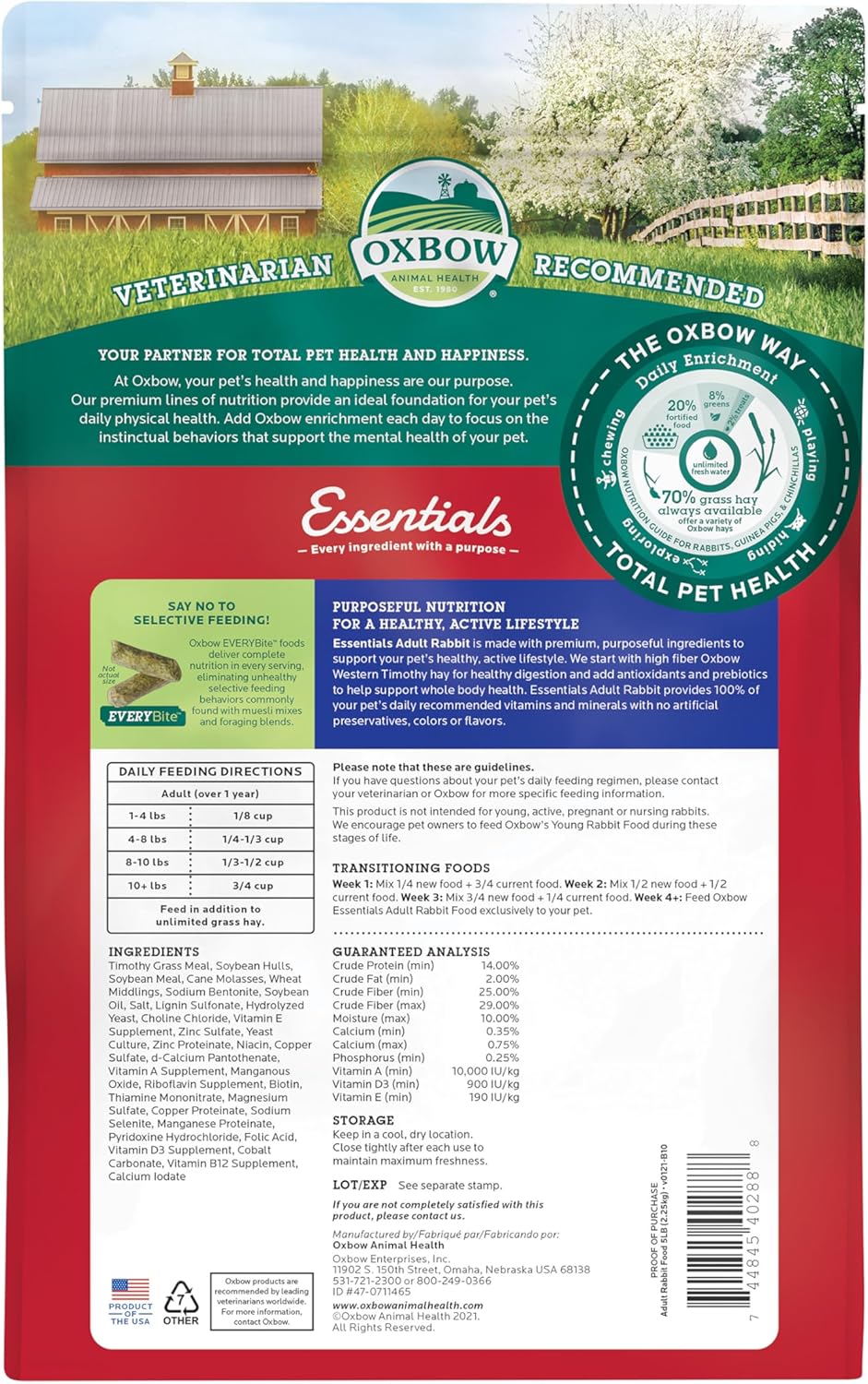
| Oxbow Essentials Adult | 25% | 14% | Timothy | Mid |
| Oxbow Garden Select Adult | 25% | 14% | Timothy blend | Mid-premium |
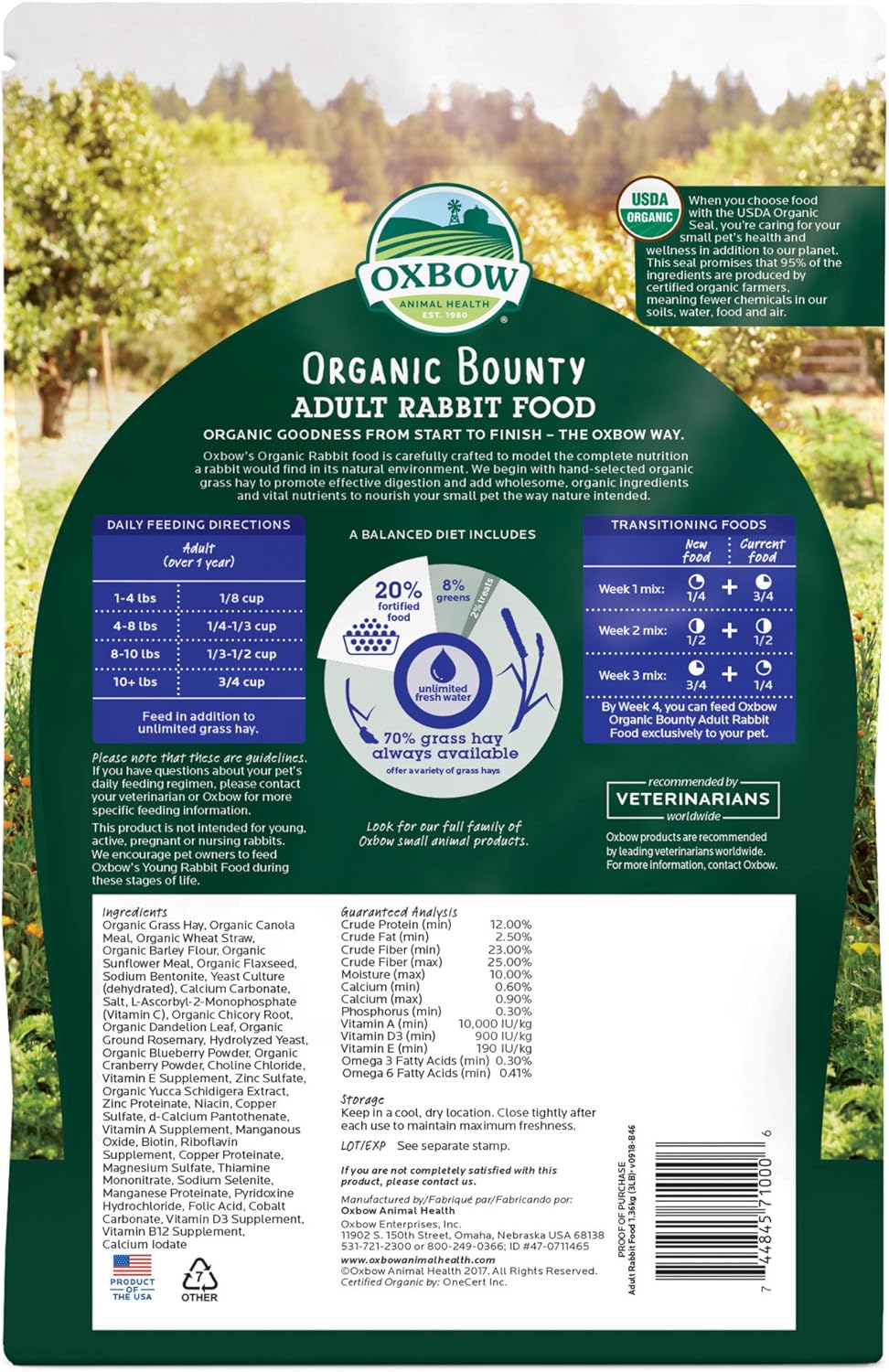
| Oxbow Organic Bounty | 25% | 13% | Timothy (organic) | Premium |
| Kaytee Timothy Complete | 20% | 14% | Timothy | Value-mid |
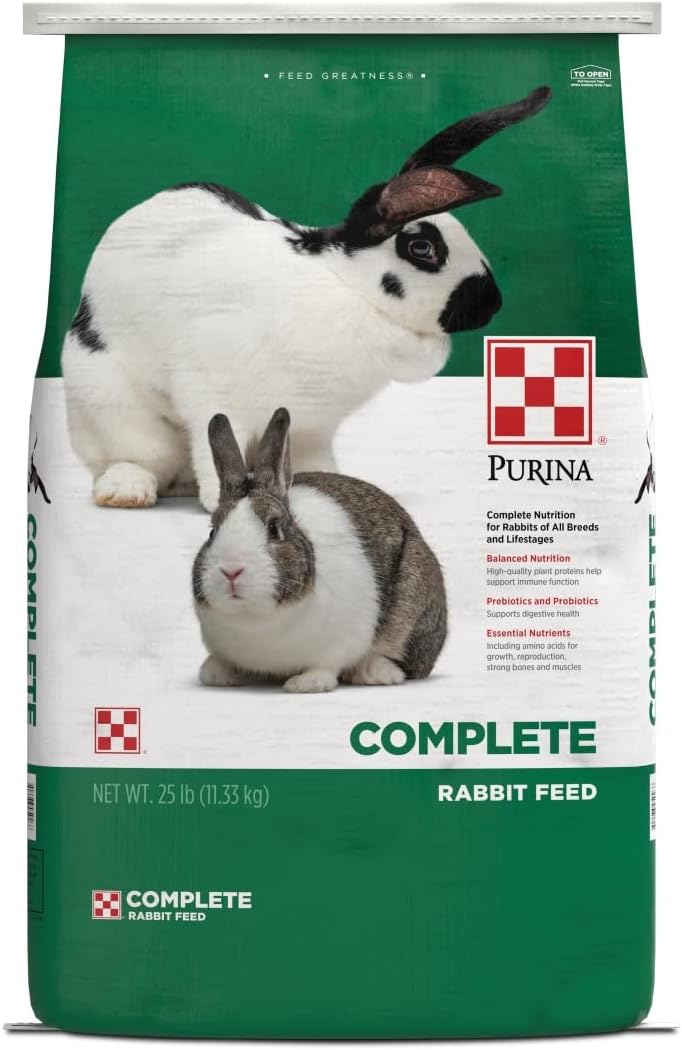
| Purina Rabbit Chow Complete | 15% | 16% | Alfalfa/grain | Value |
The Purina fiber number is the most telling data point in this table: at 15% crude fiber, it falls below what the Merck Veterinary Manual recommends for adult maintenance. The protein at 16% exceeds what most adult rabbit nutritionists recommend for non-breeding animals. This is a legacy alfalfa-grain formula that has not moved to the modern timothy-first paradigm. That is not a disqualifying flaw for young rabbits or active breeders, but it is a material mismatch for a spayed adult house rabbit.
Brand-by-Brand Breakdown
Oxbow Essentials: The Baseline That Earns Long-Run Loyalty
Oxbow Essentials is where most rabbit keepers who have moved past starter-bag thinking land first, and a meaningful percentage never leave. The owner testimonial pool for this formula is unusually deep — reviewers describing 20-plus years of rabbit keeping, rescue operations, and multi-doe breeding setups all cite consistent outcomes: coat condition, stable energy levels, and reliable stool quality (an underrated health indicator in rabbits, whose digestive systems are sensitive to formulation changes).
One pattern that surfaces repeatedly in aggregated owner feedback involves the rabbit that cycled through three or four competing brands before accepting Essentials — a useful signal that palatability here is not just about additives or flavoring but about a consistent flavor profile that rabbits learn to trust. For production operations, palatability consistency matters because a rabbit that is off feed even two days a week is losing growth frame and the doe is losing body condition.
The guaranteed analysis holds steady across production runs, which sounds like a low bar but matters: quiet label reformulations — ingredient swaps that do not change the product name — are endemic to the pet food industry. Owners running Essentials over multi-year periods do not report the kind of palatability disruption that typically signals a formula change.
Oxbow
$13.49
In stock on Amazon
Check price on AmazonOxbow Garden Select: Is the Upgrade Meaningful?
Garden Select is Oxbow’s botanicals-forward adult formula, incorporating a blend of grasses and plant ingredients beyond straight timothy. The fiber and protein targets match Essentials on paper, but the ingredient panel reads more varied: multiple grass sources, added botanicals.
Owner feedback on Garden Select tends to split between rabbits who prefer it and rabbits who are indifferent relative to Essentials. The realistic verdict from aggregated reviews: if your rabbit is already thriving on Essentials, Garden Select is a sideways move, not a meaningful nutritional upgrade. Where it earns its keep is in multi-rabbit households where one animal shows boredom with single-ingredient monotony, or where an owner wants botanical diversity for enrichment purposes. For production breeders focused on cost-per-unit nutrition, Essentials wins on simplicity and price.
Oxbow Garden Select’s ingredient variety also makes it a reasonable rotational option — some experienced keepers alternate between Essentials and Garden Select across bag cycles to provide ingredient breadth without committing to one formula indefinitely.
Oxbow
$13.49
In stock on Amazon
Check price on AmazonOxbow Organic Bounty: Certification Value and the Palatability Trade-Off You Need to Know
Organic Bounty is Oxbow’s USDA-certified organic formula, and for homestead operations that are themselves organic-certified — or owners who are managing feed inputs carefully for personal or market reasons — the certification carries genuine weight. The USDA National Organic Program, codified under CFR Title 7 Part 205, prohibits synthetic pesticides, synthetic fertilizers, and non-organic additives in certified livestock feed, which is the structural reason this formula’s ingredient list reads leaner than conventional alternatives.
That leaner list creates a real-world transition challenge worth flagging directly. Owners switching rescues from Purina or other additive-forward formulas report that Organic Bounty has lower initial palatability — specifically because it lacks the dried papaya, fruit pieces, and palatability enhancers that some prior-formula rabbits have come to expect. Rabbits transitioning from sweeter or additive-rich baselines typically accept Organic Bounty over a 10–14 day gradual introduction period, but the bridge period requires patience. The practical takeaway: do not switch cold. Mix Organic Bounty in at 25% for four to five days, then 50%, then 75%, over a full two weeks, especially for any rabbit coming from a legacy formula.
For operations that are already sourcing organically throughout and whose rabbits have no prior additive-feed history, this transition friction essentially disappears — the rabbit eats what it is offered from the start without a flavor-contrast reference point.
Purina
$35.49
In stock on Amazon
Check price on AmazonKaytee Timothy Complete: Honest Value, Honest Limits
Kaytee Timothy Complete sits in the value-to-mid tier, and the owner review pattern for this formula tells a consistent story: people buy it because it is available, reasonably priced, and fresh when purchased from high-turnover retailers. What Kaytee’s reviews almost never contain is the outcome-based language that defines the Oxbow testimonial pool. Coat shine improvements, energy changes, litter survival rates, reproductive consistency — these markers are largely absent from Kaytee reviews. Instead, the discourse centers on value and freshness.
That observation is worth noting without overstating it: absence of outcome testimony is not proof of nutritional inferiority, but it is a meaningful contrast to a brand where multi-decade keepers describe observable health trajectories tied to the formula. The fiber floor at 20% is above the Purina baseline but sits five points below Oxbow’s 25% guaranteed minimum. For production does or rabbits with GI-sensitive histories, that gap in guaranteed minimum fiber is worth weighing against the price differential.
At the price advantage Kaytee typically holds, it makes sense for breeders managing cost-per-doe-per-year tightly who have not observed condition problems, and as a transitional feed when Oxbow is temporarily unavailable through local suppliers.
Oxbow
$12.40
In stock on Amazon
Check price on AmazonPurina Rabbit Chow: The Palatability Fallback, Understood Correctly
The most notable Purina use case in the owner review landscape involves a rabbit that would accept Purina and nothing else. That is a real, niche-valid scenario. For a rabbit with an established Purina preference — especially an elderly animal where the stress of transition outweighs nutritional optimization — maintaining the familiar formula is a defensible management decision, not a failure of husbandry.
But it is important to position Purina accurately: the formula’s strongest claim is palatability persistence among previously-converted rabbits, not nutritional leadership among adult maintenance formulas. The fiber percentage sits below what the Merck Veterinary Manual identifies as adequate for adult maintenance, and the alfalfa-grain base drives calcium intake above what most adult rabbits need long-term. The National Agricultural Library (USDA NAL) nutrition resources for small animals support the principle that high dietary calcium over time poses risks for adult rabbits not in reproductive status.
Rescue organizations and experienced breeders generally use Purina as a bridge or palatability fallback rather than a primary long-term formula. If Purina is the only formula a given rabbit will accept, pairing it with unrestricted access to timothy hay offsets some of the pellet-fiber shortfall.
Oxbow
$12.40
In stock on Amazon
Check price on AmazonDecision Framework: Matching Formula to Situation
The practitioner’s decision tree here is fairly clean:
If you’re managing adult spayed or neutered rabbits at pet or hobby scale: Oxbow Essentials is the default. It meets fiber targets, earns long-run palatability loyalty, and does not generate reformulation surprises. Garden Select adds ingredient variety without adding meaningful nutritional lift over Essentials.
If your operation is organic-certified or you’re making organic sourcing decisions throughout: Oxbow Organic Bounty with a planned two-week transition protocol. Budget time for the palatability bridge period if any animals have prior additive-feed history.
If you’re running 50-plus does and cost-per-pound is the primary lever: Kaytee Timothy Complete is defensible if your herd is not showing condition or reproductive issues. Monitor closely — the lower fiber floor means less buffer if a production batch runs below label spec.
If you have a rabbit that has historically rejected all alternatives: Purina is a legitimate palatability fallback. Pair it with unrestricted timothy hay to compensate for the lower pellet-fiber floor, and reassess transition readiness every six months.
If you’re feeding young rabbits under 7 months or nursing does: Alfalfa-based or high-protein formulas are appropriate here. The Merck Veterinary Manual’s chapter on rabbit nutrition explicitly notes that nursing does and young rabbits have elevated calcium and protein requirements that timothy-based adult pellets undersupply. Check each brand’s junior or young-rabbit SKU rather than feeding any adult formula above.
Frequently Asked Questions
What is the difference between Oxbow Essentials and Oxbow Garden Select, and is the upgrade worth it? Both formulas hit the same fiber and protein targets on their guaranteed analyses. Garden Select adds botanical and multi-grass variety to the ingredient panel. For most rabbits already doing well on Essentials, the upgrade is not nutritionally meaningful — it is an enrichment and variety decision. For production operations where consistency and price matter most, Essentials typically wins.
My rabbit is rejecting the new pellets I switched to — how do I transition a finicky rabbit? Cold switches almost always fail. The standard protocol: start at 75% old formula and 25% new formula for four to five days, then 50/50 for another four to five days, then 25/75, then full transition. For rabbits with a strong prior-brand preference — especially additive-rich formulas — allow 10–14 days total. Ensure unlimited hay is available throughout. A rabbit eating fewer pellets during transition should be compensating with more hay, not less food overall. If the rabbit goes completely off feed for more than 24 hours, slow the transition pace rather than pushing through.
Does Oxbow Organic Bounty have lower palatability because it lacks additives? In documented owner accounts, yes — particularly for rabbits transitioning from formulas that include dried fruit, papaya, or other palatability enhancers. USDA National Organic Program certification under CFR Title 7 Part 205 restricts synthetic additives and many flavoring agents, so the pellet has a plainer taste profile by design. Rabbits with no prior additive-feed history typically accept it without issue. Transitioning animals from sweeter baselines should follow the gradual protocol above, with extra patience built in.
How much of a rabbit’s daily diet should be pellets versus hay? The House Rabbit Society, in its educational resource “Suggested Vegetables and Fruits for a Rabbit Diet,” aligns with most veterinary nutrition guidance in recommending that grass hay — timothy or orchard grass — comprise approximately 80% of an adult rabbit’s diet by volume and be available unlimited at all times. Pellets function as a supplement, not a staple. A commonly cited guideline is roughly one-quarter cup of pellets per six pounds of body weight per day for adult maintenance rabbits. For production does or growing rabbits, pellet allocation increases, but hay access should never be restricted.
Is there a meaningful nutritional difference between Kaytee Timothy Complete and Oxbow Essentials? The most concrete difference is the fiber floor: Oxbow Essentials specifies a 25% minimum crude fiber, while Kaytee Timothy Complete specifies 20%. For the typical adult house rabbit paired with unlimited hay, either formula provides adequate nutrition. For GI-sensitive animals or production does where digestive consistency matters, the higher fiber floor in Oxbow provides a meaningful safety buffer. Outcome-based owner testimonials are substantially richer for Oxbow, though that reflects brand community depth as much as pure nutritional causality.
Can I feed Oxbow adult pellets to a rabbit that is pregnant or nursing? No. The adult timothy-based formulas are calibrated for maintenance, not reproduction. Pregnant does in late gestation and nursing does need elevated protein, calcium, and energy density that adult maintenance formulas do not deliver. The Merck Veterinary Manual, in its chapter on rabbit nutrition, recommends switching does to a higher-protein, alfalfa-inclusive formula from the final week of gestation through weaning. Use the brand’s junior or young-rabbit formula, or a dedicated breeder formula, for this window, then transition back to adult formula after weaning is complete.