Organic Corn-Free Layer Feed at the Premium Tier: Scratch and Peck vs. New Country Organics vs. Small Pet Select vs. Mile Four
If you’ve been keeping chickens for a season or two, you already know that “layer feed” is the catch-all term for the complete diet — pellets, crumbles, or mash — formulated to give egg-laying hens everything they need: protein for body maintenance, calcium for strong shells, and a full suite of vitamins and minerals. Most bags at farm stores contain corn and soy, the two cheapest ways to hit protein and energy targets. But a growing category strips both out — organic, corn-free feeds that use grains like wheat, peas, lentils, and oats instead. They cost more. Sometimes a lot more. The question this article answers is whether any of the four leading brands in that category — Scratch and Peck Feeds, New Country Organics, Small Pet Select, and Mile Four — are worth the premium, and which one fits your flock specifically. We’ll name the tradeoffs, show the label math, and give you a clear decision rule at the end.
Why Corn-Free and Organic? The Actual Tradeoff You’re Making
Before comparing brands, it helps to understand what you’re buying — and what you’re giving up — when you go organic and corn-free at the same time.
Organic certification is governed by the USDA National Organic Program, administered by the Agricultural Marketing Service. The NOP’s feed requirements are explicit: all feed for certified organic livestock must itself be certified organic, with no synthetic pesticides, fertilizers, or additives in the production chain. If your goal is an organic egg label — or simply minimizing pesticide residue in your flock’s diet — the certification matters and there is no workaround.
Corn-free is a separate decision. Corn is the dominant energy grain in conventional poultry rations because it’s cheap and energy-dense. Keepers who switch away from it typically cite two motivations: a perceived sensitivity in their birds (loose stools, feather quality concerns) and the belief — supported anecdotally but not conclusively in peer-reviewed literature — that corn contributes to pale egg yolks. Penn State Extension’s publication “Feeding Chickens for Egg Production,” from the Penn State College of Agricultural Sciences, notes that xanthophylls — pigment compounds present in corn and marigold — directly influence yolk color, which explains why corn-free flocks often produce lighter yolks initially before stabilizing on whatever pigment sources the alternative formula provides.
Combine organic and corn-free and you are paying for sourcing constraints that are genuinely more expensive to meet. The ATTRA National Sustainable Agriculture Information Service’s report “Organic Poultry Production in the United States,” published by the National Center for Appropriate Technology, documents that the premium on certified organic grain typically runs two to three times conventional commodity prices at the farm level — and that cost passes through to every bag on the shelf.
The Four Brands: Head-to-Head Comparison
Scratch and Peck Feeds Cluck’n Sea Organic Layer
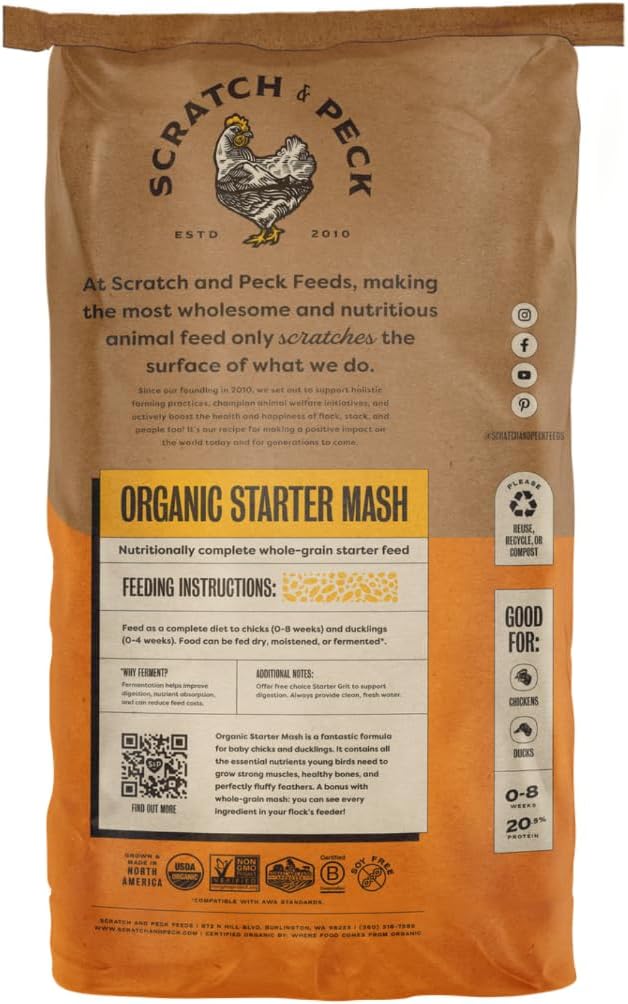
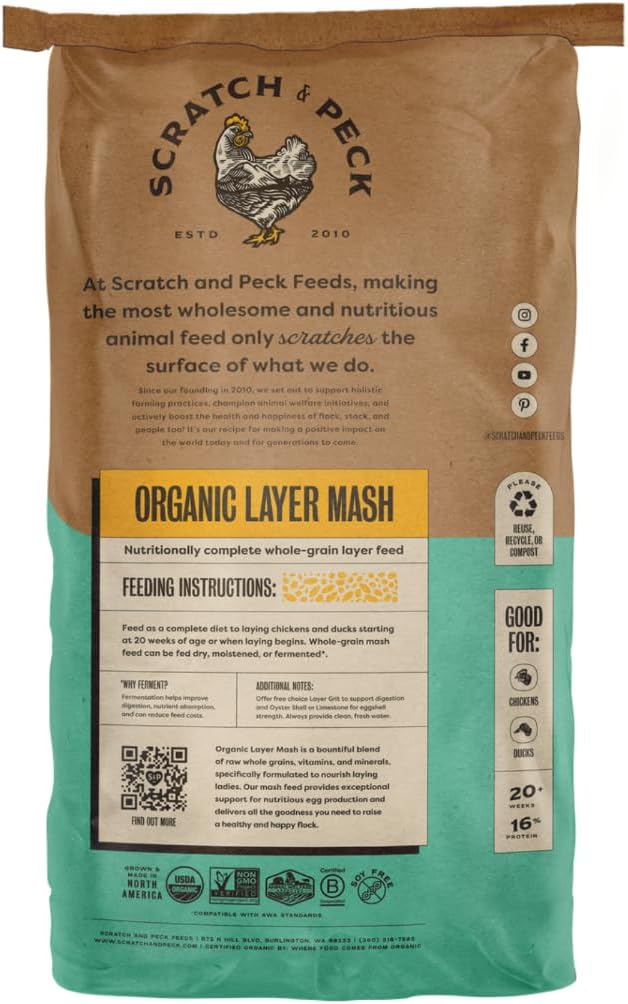
Scratch and Peck is the category anchor. Available in both mash and pellet formats, it is certified USDA Organic and Non-GMO Project Verified. Its protein sits at approximately 16–17% — respectable for a formula that leans on fish meal, field peas, and wheat as its primary protein contributors rather than corn or soy.
The most compelling signal in aggregated buyer reviews is a switched-away, then switched-back pattern. Multiple reviewers explicitly describe trialing another organic corn-free feed, watching egg production decline over two to four weeks, and returning to Scratch and Peck — at which point production recovered. This is real-world validation that carries weight even though it is self-reported and not controlled. Egg production drops can have a dozen causes, but when the pattern repeats across independent reviewers who changed only the feed variable, it is worth taking seriously.
The mash format is the brand’s flagship and is better suited to fermentation than the pellet version. The tradeoff: mash produces more waste in standard trough feeders because hens bill through it, tossing fines. Reviewers who switched to the pellet form report less waste but note that fermentation works differently with processed pellets.
Scratch
$71.99
In stock on Amazon
Check price on AmazonNew Country Organics Layer Feed
New Country Organics positions itself as a small-operation, regional-mill alternative with a comparable organic, corn-free profile. The guaranteed analysis on their layer formula shows protein in the 17% range, on par with Scratch and Peck.
The most consistent complaint in NCO reviews is thin or fragile eggshells. Multiple buyers described shells that cracked more easily than expected, and the fix most settled on was adding free-choice oyster shell alongside the feed. The Merck Veterinary Manual’s “Nutrition: Poultry” chapter specifies that laying hens require approximately 4 grams of calcium per day at peak production, with requirements rising under heat stress or late in the lay cycle. Guaranteed analysis calcium figures represent minimums, not batch averages, so individual lots can run at the lower end of specification. The practical answer — separate free-choice oyster shell — is one every serious keeper should employ regardless of brand; this is less a disqualifier than a reminder.
NCO bags can also contain meaningful fines (powdered grain that settles to the bottom). At $50 or more per bag, reviewers find waste costly. Mitigation strategies appear in the FAQ section below.
Scratch
$64.99
In stock on Amazon
Check price on AmazonSmall Pet Select Layer Hen Feed
Small Pet Select entered the layer feed market from a small-animal background — rabbit and guinea pig nutrition — and their layer formula is certified USDA Organic and corn-free with a competitive protein specification. The nutritional profile is solid on paper.
The standout complaint in reviews, however, is a packaging inconsistency that buyers at this price point find difficult to accept: several purchasers received feed in a plain clear plastic bag sealed with a zip tie rather than the branded, resealable bag shown in product photography. At $55–$65 per order, that signals fulfillment variability that matters beyond aesthetics — an improper seal on a bag of premium feed allows moisture ingress, degrading both palatability and nutritional integrity. For buyers who need reliable, repeatable supply — small pastured-poultry operations running consistent flock sizes — that variability is a genuine risk factor. The brand draws few nutritional complaints and reviewers praise customer service responsiveness, but the packaging inconsistency is the kind of variable a practitioner-level buyer must factor into total cost of ownership.
Scratch
$64.99
In stock on Amazon
Check price on AmazonMile Four Layer Feed
Mile Four is the newest and most intentionally values-driven brand in this comparison. Their marketing explicitly foregrounds USA-grown grain sourcing and small-family-mill identity, and reviewers respond with an emotional engagement unusual even for the premium segment. Buyers describe feeling that their purchase aligns with broader supply-chain values — a signal that the brand’s transparency commitment is landing with its target audience.
That transparency is not merely marketing: a mill that names its grain sources is making a verifiable commitment. Mile Four’s published guaranteed analysis shows protein in the 17–18% range in a pellet format that reviewers of small and mixed flocks have flagged as manageable for most standard and mid-size bantam breeds.
The practical tradeoff is distribution and price. Mile Four is the least widely available of the four brands and tends to run at the upper end of the price range — closer to $65–$75 per 25-pound bag in 2025–2026 pricing depending on channel. For buyers who can source it reliably and absorb the cost-per-pound, the nutritional and sourcing story holds up. For buyers where it is available only through single retailers or arrives after extended shipping, supply reliability becomes the limiting factor before price even enters the discussion.
Scratch
$71.99
In stock on Amazon
Check price on AmazonLabel Specs at a Glance
| Brand | Protein (min.) | Calcium (min.–max.) | Format Options | Certification | Scratch — $71.99 |
|---|---|---|---|---|---|
| Scratch and Peck | ~16–17% | ~3.5–4.5% | Mash, Pellet | USDA Organic, Non-GMO | Scratch — $71.99 |
| New Country Organics | ~17% | ~3.0–4.5% | Pellet, Crumble | USDA Organic | Scratch — $64.99 |
| Small Pet Select | ~17% | ~3.5–4.5% | Pellet | USDA Organic | Scratch — $64.99 |
| Mile Four | ~17–18% | ~3.8–4.5% | Pellet | USDA Organic, Non-GMO | Scratch — $71.99 |
Guaranteed analyses are minimums and ranges per published product labels as of 2025. Verify against the current bag — formulas are occasionally revised without prominent notice.
The Decision Rules: If X, Then Y
This is where the comparison resolves into action.
If egg production consistency is your primary metric and you’ve already been burned by a feed switch: Scratch and Peck is the defensible choice. The switched-away-and-back pattern in the review record is the closest thing to real-world validation this category produces, and the mash format’s fermentability gives you a management tool to boost palatability and digestibility when you need it.
If you want a comparable nutritional profile and are comfortable supplementing calcium separately: New Country Organics is a legitimate alternative, especially if it is available at lower cost-per-pound through a regional distributor. Commit to free-choice oyster shell as a non-negotiable — not an afterthought — and the thin-shell complaint largely disappears.
If supply-chain reliability and packaging consistency matter as much as the formula: Small Pet Select needs to resolve its fulfillment quality-control issue before it earns a primary-feed role for production-scale buyers. It is not a disqualifier for small backyard flocks ordering occasionally, but it is a real flag for anyone placing monthly orders at volume.
If USA-grown sourcing and small-mill accountability are criteria you weight heavily — and you can absorb top-of-market pricing: Mile Four is the most values-aligned choice in the comparison and its nutritional profile justifies the premium on specification alone. Solve for supply reliability before committing to it as your primary feed source.
Frequently Asked Questions
Why did my egg production drop when I switched from Scratch and Peck to another organic brand? Any feed transition can stress a flock’s digestive microbiome and disrupt laying for two to four weeks even when the new feed is nutritionally equivalent on paper. Beyond transition lag, the protein source matrix matters — amino acid availability, especially methionine and lysine, varies with ingredient combinations, not just total protein percentage. Penn State Extension’s “Feeding Chickens for Egg Production” notes that apparent protein percentage can mask real differences in amino acid digestibility depending on the ingredient combination used to reach the target. If production does not recover after four weeks on the new feed, the formula is likely the issue, not the transition period.
Do I still need to offer oyster shell separately if I’m feeding a premium organic layer feed? Yes, as a general best practice — even when the label shows adequate calcium. The Merck Veterinary Manual’s “Nutrition: Poultry” chapter notes that calcium requirements increase in hot weather and late in a hen’s lay cycle. Guaranteed analysis calcium figures are minimums, and individual hens have individual needs. Free-choice oyster shell costs almost nothing relative to the feed budget and removes a variable you would otherwise have to troubleshoot after shells deteriorate.
Is Scratch and Peck mash or pellets better for fermentation? Mash, clearly. Fermentation — soaking feed in water for 24 to 72 hours to activate beneficial bacteria and increase digestibility — works best with whole and cracked grain particles that rehydrate and metabolize readily. Pellets are already processed and bound; they break down in water but do not ferment the same way. If fermented feed is part of your management protocol, the Scratch and Peck mash format is the appropriate tool. Expect 20–30% less daily intake by volume since fermented feed is more nutrient-dense per cup — reduced consumption volume is normal, not a sign the birds are rejecting it.
Does Mile Four’s pellet size work for bantams and smaller breeds? Reviewers of mixed flocks — including both standard and bantam breeds — report that Mile Four’s pellet dimensions are manageable for most bantams. Very small breeds such as Seramas or Silkies may do better with a crumble or mash format. Contact Mile Four directly to confirm current pellet sizing before placing a large order if you run a bantam-heavy flock.
How do I deal with the powder and fines in a bag of New Country Organics without wasting expensive feed? Three practical approaches: (1) Mix fines into fermented feed batches where moisture binds them into a palatable mass. (2) Dampen fines lightly and offer as a separate wet mash — hens that ignore dry powder will typically eat a wet version readily. (3) Sift fines into a separate container and mix with water to create a supplemental paste offered in a shallow dish. At $50 or more per bag, treating fines as a waste stream rather than a usable feed resource is an expensive habit.
What does egg yolk color actually tell me about feed quality? It tells you what pigment compounds your hens are consuming — specifically xanthophylls and carotenoids from ingredients such as marigold extract, alfalfa, grass access, and in conventional feed, corn. A deep orange yolk signals high xanthophyll intake. Reviewers across all four brands use yolk color as their primary informal feed quality proxy, and it is a real signal — but an incomplete one. Yolk color reflects pigment intake, not protein quality, amino acid balance, or overall nutritional completeness. A pale yolk on a corn-free formula transitioning away from corn-based pigment sources does not mean the feed is deficient; it means the pigment source has changed. The ATTRA National Sustainable Agriculture Information Service’s “Organic Poultry Production in the United States” notes this adjustment period as a normal characteristic of corn-free transition. Evaluate your feed over a full 30-day window using egg production rate, shell thickness, and flock body condition as a complete picture — yolk color is one data point among several, not a standalone verdict.