If you’ve been keeping chickens for more than a season, you already know that feed is the single biggest variable in egg quality — more than breed, more than coop design, more than how many treats you’re sneaking them. Organic layer feed is exactly what it sounds like: a complete diet formulated for egg-laying hens, made from ingredients grown without synthetic pesticides or GMOs, and certified by a USDA-accredited certifier. “Complete” means it’s designed to meet all of a hen’s nutritional needs without you having to puzzle together a dozen supplements. The premium organic category — feeds running $40 to $70 or more for a 25–50 lb bag — has expanded substantially in the last five years, and the gap between brands is real and worth understanding before you commit to a pallet.
This article compares four brands that consistently come up in serious flock-keeper conversations: Scratch and Peck Feeds, New Country Organics, Small Pet Select, and Mile Four. We’ll walk through what owners report, where the tradeoffs live, and give you a decision framework that matches your specific situation.
| EDITOR'S PICKScratch and Peck Feeds | Layer… | Mid-tierNew Country Organics | Budget pickScratch and Peck Feeds | Layer… | |
|---|---|---|---|
| Protein | 16% | 17% | 16% |
| Form | Mash | — | Pellets |
| Size | 40 lb | 25 lbs | 25 lb |
| Corn-free | ✓ | ✓ | — |
| Soy-free | ✓ | ✓ | — |
| Organic | ✓ | ✓ | — |
| Price | $64.99 | $46.98 | $44.99 |
| See on Amazon → | See on Amazon → | See on Amazon → |
What You’re Actually Paying For at the Premium Tier
Before the brand-by-brand breakdown, it helps to understand what separates a $22 conventional layer pellet from a $55 organic one. The answer isn’t just the USDA Organic seal — though that matters and carries real regulatory teeth. The USDA National Agricultural Library’s Agricultural Marketing Service guidance document “Organic Livestock Requirements” (available at nal.usda.gov) specifies that certified organic feed must contain no prohibited synthetic substances and must come from certified organic sources throughout the supply chain.
What you’re also paying for at the premium tier, as documented in the ATTRA — National Sustainable Agriculture Information Service publication Organic Poultry Production in the United States (NCAT, available at attra.ncat.org), typically includes:
- Corn-free and/or soy-free formulations — relevant for hens with sensitivities, or keepers who want the yolk color and flavor profiles associated with non-corn diets
- Traceable ingredient sourcing — small-mill or single-origin grain networks rather than commodity grain pools
- Format flexibility — mash, crumble, and pellet options from the same brand, often within the same bag line
Penn State Extension’s poultry nutrition fact sheet “Feeding Laying Hens” (Penn State College of Agricultural Sciences, extension.psu.edu) notes that the guaranteed analysis on a feed label — the box listing minimum crude protein, minimum crude fat, maximum crude fiber, and maximum moisture — is the legal floor, not the ceiling. Two feeds can show identical guaranteed analyses and have very different amino acid profiles, ingredient quality, and palatability. That’s where premium brands earn — or don’t earn — their price.
The Four Feeds, Head to Head
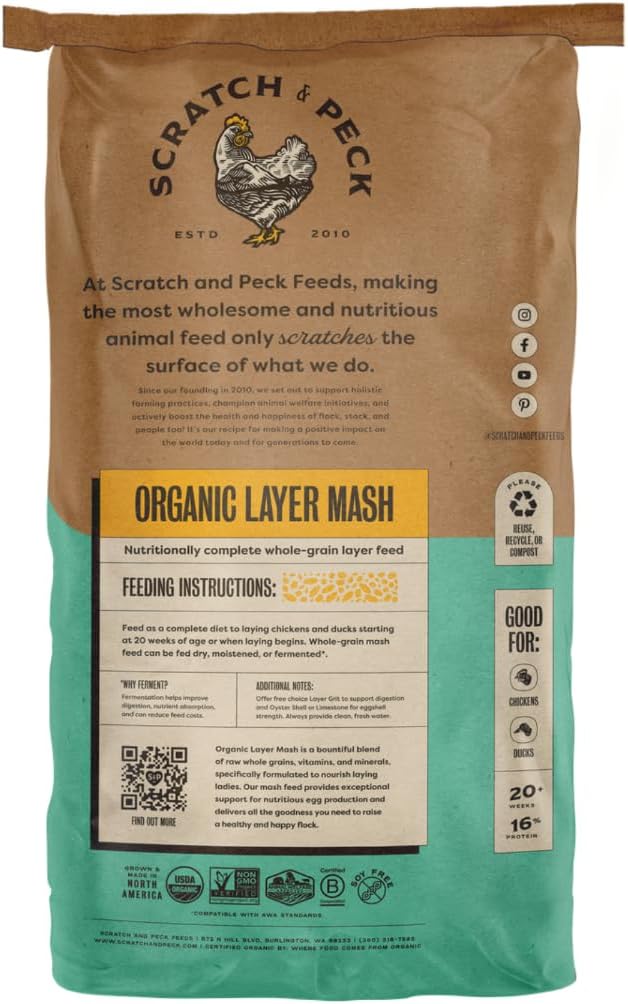
Scratch and Peck Feeds Cluck’n Sea Organic Layer
Scratch and Peck is the brand most likely to prompt the phrase “I switched away and then switched back.” Owners in long-run reviews consistently describe a measurable pattern: they move to a less expensive option, observe a decline in production or egg quality over six to twelve weeks, and return. That kind of loyalty, repeated across independent reviewers, is meaningful signal.
The Cluck’n Sea line is corn-free and soy-free, certified organic, and formulated around fishmeal as a primary protein source — which contributes to the high methionine and lysine numbers that owners credit for yolk depth and shell integrity. Published guaranteed analysis specs put crude protein at 16–17%, which is solidly within the range Penn State Extension’s “Feeding Laying Hens” fact sheet (extension.psu.edu) identifies as appropriate for peak-production layers.
The honest tradeoff: Price. At approximately $55 per 35 lb bag as of mid-2026, Scratch and Peck is among the most expensive options per pound in this comparison. For a flock of six to eight hens consuming roughly a quarter pound per bird per day, feed cost runs around $8–$10 per week before any supplemental scratch or treats. If you’re selling eggs, the math can close. If you’re feeding a purely personal flock, this is a deliberate lifestyle spend — and most owners who make it report they’ve decided it’s worth it.
Scratch
$64.99
In stock on Amazon
Check price on AmazonNew Country Organics Layer Feed
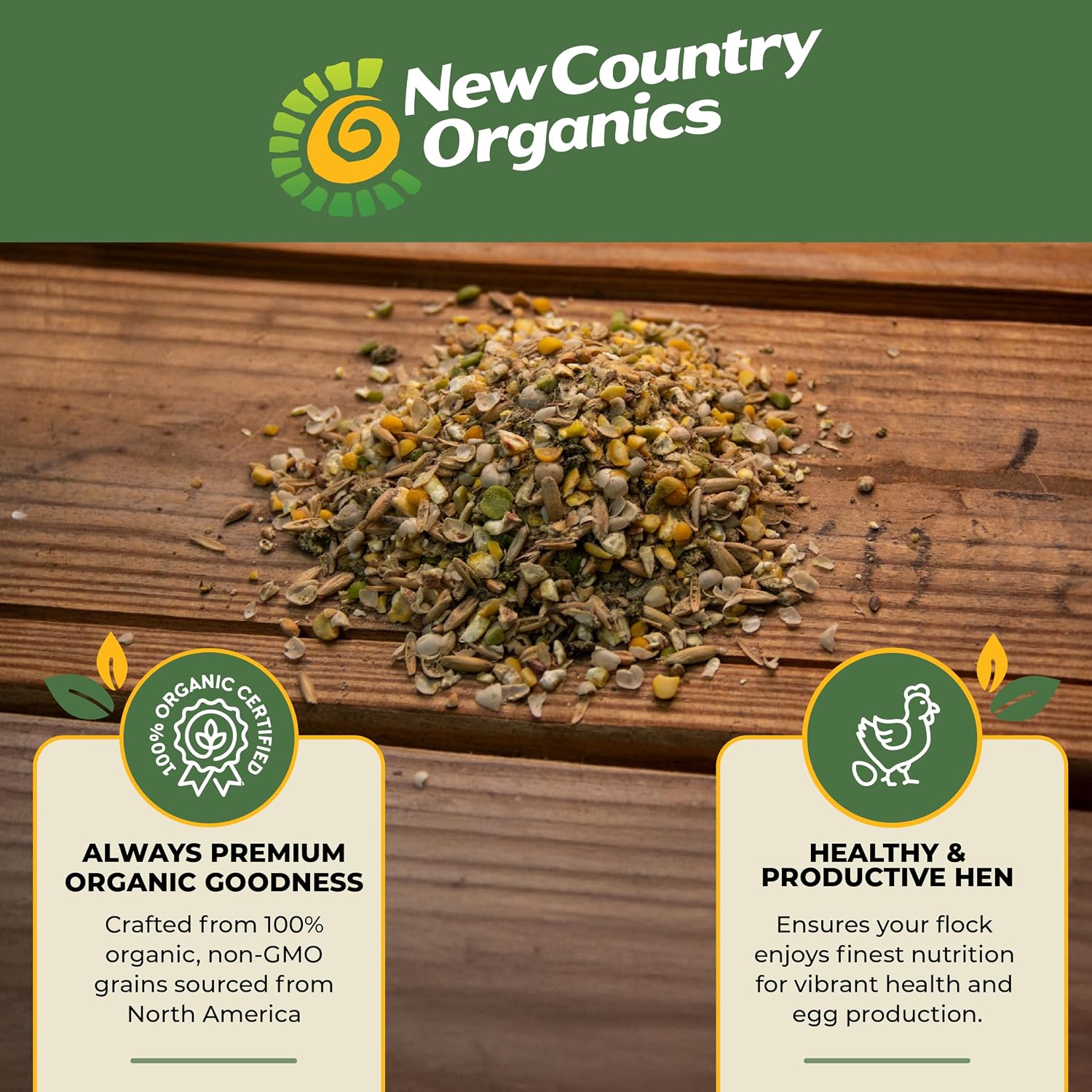
New Country Organics draws a genuinely split picture in owner reviews, and both sides are worth taking seriously. The praise is real: ingredient quality is consistently noted, and flock keepers who ferment their feed — soaking it in water to encourage beneficial bacterial activity, which increases digestibility and reduces waste — report excellent fermentation results with this mash-format feed. The ATTRA publication Organic Poultry Production in the United States (NCAT, attra.ncat.org) notes that fermented feed can improve feed conversion in layers, and mash formats are the most practical starting point for that workflow.
The persistent complaint, equally consistent, is fines — the powdery residue at the bottom of a bag that hens often refuse to eat. At $30–40 per bag when purchased locally, fines waste is an annoyance. When you’re paying freight to ship organic feed, that waste becomes a genuine cost problem. Buyers outside the brand’s regional distribution footprint in the Mid-Atlantic and Southeast will face a substantially higher effective price per pound once freight is included.
The honest tradeoff: New Country Organics is one of the best options if you can source it locally and are committed to the fermentation workflow. If you’re ordering online and paying freight, run the per-pound landed cost math before committing to a 50 lb bag.
New
$46.98
In stock on Amazon
Check price on AmazonSmall Pet Select Organic Layer Feed
Small Pet Select built its reputation in the rabbit and small animal space before expanding into poultry, and the freshness-first culture from that side of the business appears to have carried over. Reviewers are notably enthusiastic about two things specifically: yolk quality and feed freshness on arrival.
The brand sells primarily direct-to-consumer through e-commerce, which means their supply chain is oriented around fast turnover — bags aren’t sitting in a distributor warehouse for months. For a product where rancidity of fats and vitamin degradation are real concerns, fresher bags matter more than the label implies. The USDA National Agricultural Library’s guidance document “Organic Livestock Requirements” (nal.usda.gov) notes that fat-soluble vitamins degrade with time and heat exposure, making supply chain speed a genuine quality variable, not just a marketing claim.
The honest tradeoff: Small Pet Select is a solid online-first choice for flock keepers in areas with no local premium feed dealer, particularly if yolk quality is your primary benchmark. Shell quality reports are more mixed, which aligns with a broader pattern across corn-free soy-free feeds discussed in the shell quality section below.
New
$46.98
In stock on Amazon
Check price on AmazonMile Four Organic Layer Feed
Mile Four is the newest entrant of the four and leans into its family-mill sourcing story and non-GMO credentials. Owner reviews are enthusiastic about ingredient transparency and the brand’s willingness to communicate about their supply chain. The non-GMO positioning — the feed is organic, which by definition excludes GMOs, but the brand emphasizes this in their marketing — resonates with buyers who’ve become skeptical of certification-only claims.
One flagged issue worth knowing before you order: pellet size. Multiple reviewers note the pellets run larger than expected, which created problems for bantam chicks. If you’re feeding standard-size laying breeds, this is a non-issue. If you’re keeping Silkies, Seramas, or other bantam varieties, confirm pellet dimensions before ordering a full bag.
The honest tradeoff: Mile Four is a strong option for standard-breed flocks where sourcing story and ingredient transparency matter as much as pure performance metrics. The brand is still building its review volume, so the confidence interval on owner experience is narrower than Scratch and Peck’s long track record.
Scratch
$64.99
In stock on Amazon
Check price on AmazonBy the Numbers
| Feed | Approx. Price (mid-2026) | Protein % | Corn/Soy Free | Format Options |
|---|---|---|---|---|
| Scratch and Peck Cluck’n Sea | ~$55 / 35 lb | 16–17% | Yes (both) | Mash, Crumble |
| New Country Organics Layer | ~$30–40 local / higher shipped | 16% | Soy-free options | Mash, Pellet |
| Small Pet Select Organic | ~$45–55 / 25–40 lb | 16–17% | Yes (both) | Pellet, Crumble |
| Mile Four Organic | ~$40–55 / bag | 17% | Yes (both) | Pellet |
Prices reflect mid-2026 market conditions and vary by region and channel. Always verify current pricing at point of purchase.
The Shell Quality Problem in This Category
Shell quality emerges as the most consistent weak point across the corn-free soy-free organic segment — and it’s worth addressing directly because it catches owners off guard. The Poultry Site’s technical review “Calcium and Shell Quality in Laying Hens” (thepoultrysite.com) is clear on the underlying biology: laying hens require approximately 4 grams of calcium per day at peak production, and most complete layer feeds are formulated to deliver this through their guaranteed analysis. But bioavailability varies by ingredient source and individual hen, and high-production hens can outpace what a feed alone delivers.
The practical implication: if you’re on any of these four feeds and seeing soft or thin shells, the feed is rarely the only variable. Supplemental calcium — typically oyster shell offered free-choice in a separate container, so hens self-regulate intake — is standard practice across serious flock keepers at this tier, regardless of which premium brand they’re running. Consider it part of the system, not a sign that your feed is failing.
Frequently Asked Questions
Why are my hens getting soft or thin shells even on a premium organic layer feed? Premium organic feeds are formulated to meet calcium requirements, but individual hens vary in absorption, and high-production periods create higher demand. Always offer free-choice oyster shell alongside any complete layer feed. Also verify that your birds are drinking adequate water — calcium metabolism is water-dependent. The Poultry Site’s technical review “Calcium and Shell Quality in Laying Hens” (thepoultrysite.com) provides a useful overview of the factors that affect shell formation beyond dietary calcium alone.
Is there a meaningful nutritional difference between mash, crumble, and pellet formats of the same feed? For the same recipe, the guaranteed analysis is essentially identical across formats. The practical differences are in consumption efficiency and waste. Pellets produce the least waste and are easiest to use in treadle or tube feeders. Mash produces the most waste if fed dry but is the best format for fermentation. Crumbles split the difference. Penn State Extension’s “Feeding Laying Hens” fact sheet (extension.psu.edu) notes that feed conversion efficiency can vary by format even with identical nutrition on the label.
How do I calculate whether the premium price is justified by my egg output? Divide your weekly feed cost by the number of eggs produced. At $55 for 35 lbs, a flock of eight hens consuming roughly 14 lbs per week costs about $22/week. If those hens produce 40–48 eggs weekly, your feed cost per dozen runs roughly $5.50–$6.60. If you’re selling at $8–$12/dozen at a farmers market or farm stand, the margin is real. If the flock is personal-use only, this is a quality-of-life decision, not a financial optimization.
Which of these feeds ferments most easily and what does fermentation actually add? Mash formats ferment most easily — New Country Organics and Scratch and Peck mash are the most cited for this workflow. Fermentation (soaking feed in water for 24–72 hours to encourage lacto-fermentation) increases the bioavailability of nutrients and reduces anti-nutritional factors in grains. The ATTRA — National Sustainable Agriculture Information Service publication Organic Poultry Production in the United States (NCAT, attra.ncat.org) notes that fermented feed can improve feed conversion in layers. Pellets can be fermented but break down quickly; crumbles are intermediate.
How much powder waste should I expect from a high-quality feed, and is it normal? Some fines are present in any bag that’s been handled in transit. A high-quality mash will always have powder by design — that’s the format. For pellets and crumbles, fines exceeding roughly 10–15% of bag weight by the time you reach the bottom are worth flagging. Hens typically refuse fine powder, so it represents direct cost waste. New Country Organics specifically has more owner-reported fines than the other three brands in this comparison.
Can I order these feeds online without paying freight premiums that erase the value? Yes, but only if you’re strategic. Scratch and Peck ships from the Pacific Northwest; buyers in the Southeast and Midwest absorb meaningful freight. Small Pet Select’s direct-to-consumer model is oriented toward e-commerce and tends to be more freight-efficient nationally. New Country Organics is notably regional — the price differential between local purchase and shipped purchase is the largest of the four brands reviewed here. If you’re more than a day’s freight from a brand’s distribution hub, always calculate the per-pound landed cost, not the sticker price.
The Decision Rule
If you want the most validated long-run performer and shell integrity matters to you: Scratch and Peck is the choice most backed by owner experience, and the loyalty pattern in reviews is the strongest signal available short of controlled feeding trial data.
If you’re within local purchase range of a New Country Organics dealer and committed to fermentation: New Country Organics delivers genuine ingredient quality at a price that works — but only sourced locally. Online with freight, the value equation breaks.
If you’re ordering online, prioritize freshness, and track yolk quality as your primary benchmark: Small Pet Select is built for that use case.
If you’re keeping standard-size laying breeds and ingredient transparency and sourcing story are your primary purchasing criteria: Mile Four is worth a trial bag. Build your confidence before ordering in bulk.
For all four: add free-choice oyster shell. It’s not optional at the premium tier — it’s part of the system.