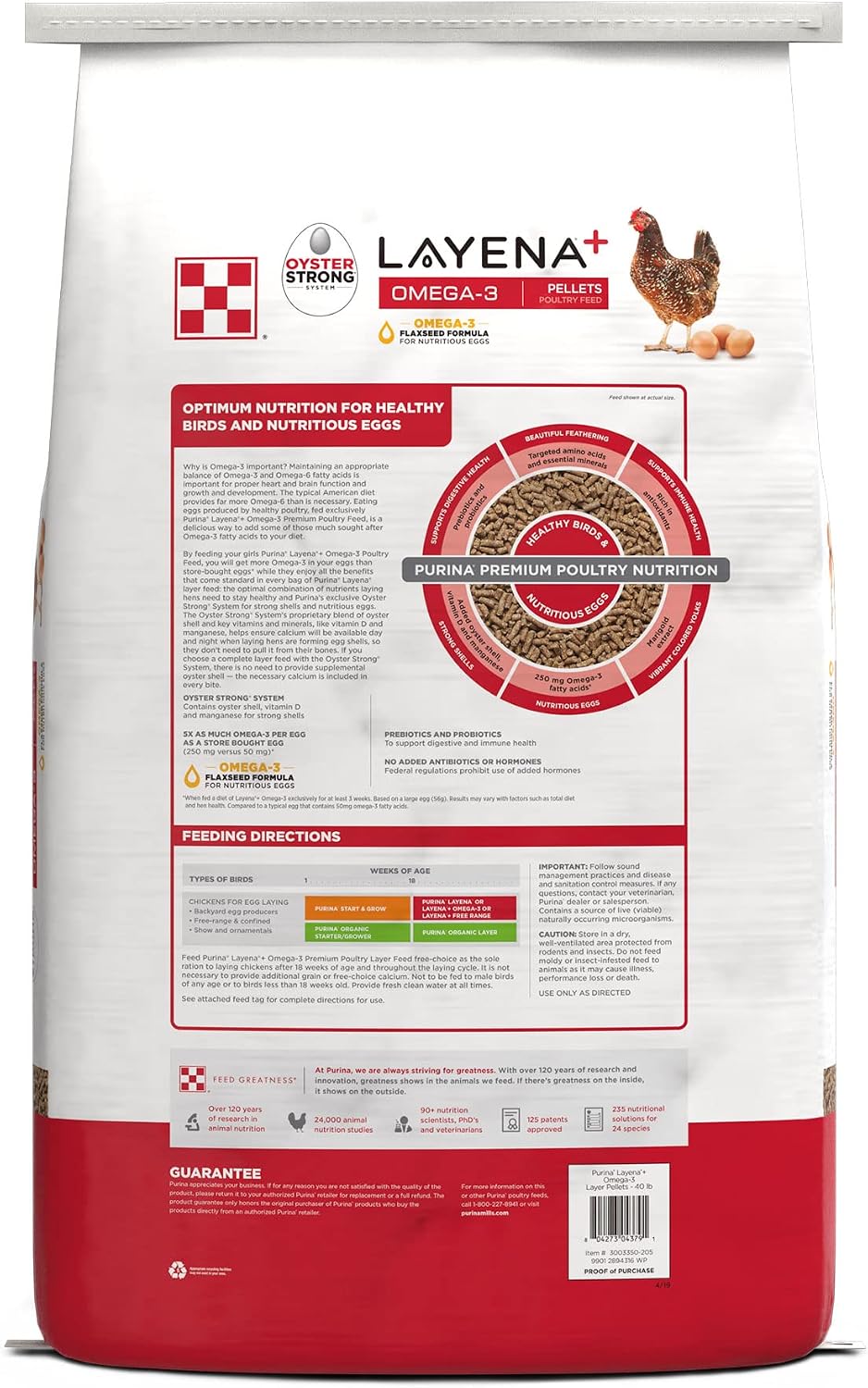
If you’ve ever cracked open an egg from a neighbor’s backyard flock and noticed how startlingly orange the yolk looked compared to what came out of a grocery store carton, you’ve already seen omega-3 enrichment at work — even if nobody used that phrase. Omega-3 fatty acids are a family of fats (the most important being ALA, EPA, and DHA — more on those distinctions in a moment) that the body can’t make from scratch on its own. Eggs are one of the few practical ways to get them into a diet, and what a hen eats directly determines how much ends up in her eggs. That’s the whole premise behind omega-3 enriched layer feeds: if you feed the fatty acids in, the hen deposits them in the yolk. Simple idea. But the label on the bag makes it look a lot more straightforward than it actually is — and the gap between what’s printed and what lands in your egg basket is exactly what this article is about.
If you’re at the stage where you’re weighing something like Scratch and Peck Feeds Cluck’n Sea Organic Layer Pellets against a conventional 17% layer pellet and wondering whether the $30-per-bag premium is buying you real nutritional difference or just marketing, this breakdown is for you.
The Three Omega-3s on the Label — and Why Only Two Really Count
Most omega-3 layer feed labels will mention flaxseed, flaxseed meal, or fish meal as an ingredient, and some will print an omega-3 percentage in the guaranteed analysis panel — usually expressed as “minimum percent omega-3 fatty acids.” That number sounds definitive. It isn’t.
Here’s why: the omega-3 family includes three nutritionally distinct compounds.
- ALA (alpha-linolenic acid): Plant-derived. Found abundantly in flaxseed. The cheapest and most common source in layer feeds. ALA is a legitimate omega-3, but humans convert it to the more biologically active forms (EPA and DHA) at a notoriously poor rate — the FAO’s expert consultation on fats and fatty acids puts that conversion efficiency at roughly 5–10% for EPA and under 1% for DHA under typical conditions.
- EPA (eicosapentaenoic acid) and DHA (docosahexaenoic acid): The long-chain omega-3s. These are the ones associated with cardiovascular and cognitive benefits in human nutrition research. Fish meal, algae meal, and direct marine ingredients are the primary dietary sources for poultry.
When a bag says “enriched with omega-3s” and the only relevant ingredient is flaxseed meal, you are buying ALA enrichment. The hen converts some of that ALA to EPA and DHA — hens are modestly better converters than humans, but still not efficient ones. Per The Poultry Site’s overview of omega-3 fatty acids in poultry nutrition, flax-fed hens do elevate EPA and DHA in the yolk above baseline, but the transfer ratio is low. Fish meal or algae meal inclusion is the most reliable route to meaningful DHA in the finished egg.
The practical read: If DHA enrichment is your goal, look past the omega-3 claim and find the ingredient. “Fish meal,” “whole dried anchovies,” “algae meal,” or “DHA-rich microalgae” anywhere in the ingredient list is what you want. Flaxseed or flax meal alone = ALA enrichment. That’s not worthless, but it’s a different product.
What the Guaranteed Analysis Panel Does and Doesn’t Show You
The guaranteed analysis is the mandatory nutrition table on every feed label — it lists minimum crude protein, minimum crude fat, maximum crude fiber, and maximum moisture. Some feeds add an omega-3 line. What it cannot tell you:
1. Which omega-3. A minimum 0.5% omega-3 fatty acid claim doesn’t specify whether that’s ALA, EPA, DHA, or a blend. Two feeds can post identical omega-3 minimums from completely different ingredient mixes with meaningfully different outcomes for yolk DHA.
2. Whether the number reflects what’s actually in the bag this month. Feed mills reformulate. Ingredient costs shift. Flaxseed prices in 2025 ran notably higher than 2024 averages, and several brands that were historically more generous with inclusion rates quietly adjusted. Penn State Extension’s feeding guidance notes that the omega-3 content of eggs is highly sensitive to current feed composition — which means a label printed six months ago may not reflect today’s bag off the shelf.
3. Inclusion rate versus label minimum. A “minimum” guarantee means the product meets that floor — it may exceed it, or it may sit barely above it. Brands with strong ingredient sourcing transparency (Scratch and Peck publishes sourcing documentation; Modesto Milling Organic is another example in the premium segment) give you more confidence that the number printed reflects real formulation intent, not a floor set for label compliance.
The quick label audit to run in the store aisle:
- Find the omega-3 line in the guaranteed analysis. Does it exist at all?
- Flip to the ingredient list. What is the omega-3 source — flax only, fish meal, algae, or a combination?
- Where does that ingredient appear in the list? Ingredients are listed by weight. If flaxseed meal is ingredient #8, the inclusion rate is modest. If it’s #3 or #4, you’re getting a meaningful dose.
By the Numbers: Typical DHA in Eggs by Feed Type
| Feed type | Typical yolk DHA (mg per egg) | Primary omega-3 source |
|---|---|---|
| Conventional layer (no enrichment) | 30–50 mg | None — incidental |
| Flax-enriched layer | 100–150 mg | ALA conversion |
| Fish meal / marine-ingredient layer | 150–300 mg | Preformed DHA |
| Algae-meal enriched layer | 130–250 mg | Preformed DHA |
| Certified pasture-raised (seasonal) | 80–200 mg | Mixed forage, variable |
Figures synthesized from USDA National Nutrient Database data and published poultry nutrition research via The Poultry Site and FAO documentation. Individual results vary by inclusion rate, hen age, and breed.
The grocery store “omega-3 egg” benchmark (often around 125–150 mg DHA per egg) is achievable with a good flax-enriched feed run consistently. Getting above 200 mg reliably requires a marine or algae ingredient source in the mix.
The Pasture Variable — and Why It Complicates Brand Comparisons
If your hens have meaningful pasture access — not a small run, but actual rotational paddock time on diverse forage — they are sourcing some omega-3s independently of your bagged feed. Insects, green plant matter, and especially clover are ALA sources; bug protein contributes EPA. ATTRA’s organic and pasture-based poultry production documentation consistently notes that pasture-raised egg omega-3 profiles are higher and more variable than confinement-raised eggs on identical feeds.
This creates a real comparison problem: if you’re benchmarking Scratch and Peck Cluck’n Sea against Kalmbach 17% and your flock runs on good pasture, you are not running a clean test. The pasture is inflating both results and potentially closing the gap between the premium and the conventional feed.
The inverse is also true and worth naming: if you’re running a winter flock in confinement with limited forage access, the omega-3 feed you choose matters more, not less, because there’s no supplemental foraging input to compensate.
Decision frame:
- Heavy pasture access + healthy forage? The conventional 17% feed at $22/bag may deliver yolks nearly as enriched as the $55 premium, especially in spring and summer.
- Confinement or year-round limited forage? The marine- or algae-sourced premium feed is doing work the environment can’t do for you. The premium gap earns more of its price here.
Freshness, Storage, and the Oxidation Problem Nobody Puts on the Label
Omega-3 fatty acids are chemically unstable. They oxidize — essentially, they go rancid — when exposed to heat, light, and air. This is true in the bag and true in the egg after lay.
What this means practically:
- Feed storage matters more with omega-3-enriched feeds. A flax-heavy or fish-meal-containing feed stored in a sunny barn in a poorly sealed bin for six weeks is delivering degraded product. Lipid oxidation doesn’t just reduce the nutritional value — it can produce off-flavors in eggs and, at high oxidation levels, may create compounds with their own health implications per FAO fatty acid nutrition documentation. Metal or hard-sided airtight containers, stored cool and dry, are not optional accessories with these feeds. They’re part of the ROI.
- The egg itself has a freshness window for omega-3 retention. Eggs stored at room temperature for 2+ weeks show measurable DHA degradation. Refrigerated storage preserves the profile significantly better. If you’re selling omega-3-enriched eggs at a farmers market, storage handling between lay and sale is part of your product quality chain.
- Milling date versus sell-by date. Some premium brands print a milling date. If the bag doesn’t show one, ask your feed store how long that SKU typically sits in their warehouse. A fish-meal-containing feed that’s 90+ days post-mill before it reaches your bin is not the same product the label analysis describes.
The If-X-Then-Y Decision Rules
You’ve read the label. You know your setup. Here’s where it resolves:
If you’re on full or heavy pasture rotation (spring through fall), forage is diverse, and you’re price-sensitive: A quality conventional layer at 16–17% protein with a modest flax inclusion (check for flaxseed or flax meal in the top 10 ingredients) is likely delivering a solid yolk profile. Save the premium spend for winter or confinement periods.
If you’re in confinement, winter housing, or on limited/bare runs: Prioritize a feed with a named marine ingredient — fish meal, anchovies, or algae meal — in the top half of the ingredient list. The flax-only omega-3 feeds are doing partial work here; you’re buying conversion efficiency losses you can’t recoup from forage.
If your market or customers are paying a premium for demonstrably high-DHA eggs: Marine or algae-sourced feeds are your only reliable path to consistently hitting 200+ mg DHA per egg. Flax alone won’t get you there consistently enough to build a market claim on.
If you’re evaluating two feeds at significantly different price points: Run the per-egg math, not the per-bag math. A $55 bag at 50 lbs feeding a flock consuming 0.25 lbs/bird/day for 20 birds runs out in 10 days. At $22 for the same volume, the daily feed cost difference is $3.30. If you’re getting a meaningful DHA premium in the egg and selling those eggs at $7–$9/dozen versus $5, the math can close. If you’re not selling, the question is what the nutritional premium is worth to your household.
The label is a starting point, not a verdict. Ingredient sourcing, storage practices, forage access, and season are doing at least as much work as the omega-3 percentage printed in small type on the back of the bag. Now you know where to look.