A nano tank is any small aquarium — typically ten gallons or under — stocked with tiny fish, invertebrates like shrimp and snails, or a complex mix of both. Feeding a nano tank sounds simple until you realize that a standard fish pellet is often bigger than your fish’s mouth. The wrong food doesn’t just go uneaten; it dissolves into a murky, ammonia-spiking soup that can crash water quality in hours. For hobbyists keeping community tanks — setups where multiple species share the same water — the stakes get higher still: you need a food small enough for the smallest resident, nutritious enough for the largest, and stable enough in water that it doesn’t foul the tank before every fish gets a turn. This article compares three foods that consistently surface at the top of the nano-feeding conversation: Fluval Bug Bites Small Fish Formula, Ultra Fresh nano foods, and New Life Spectrum Small Fish Formula. If you have a feeding decision pending — a new tank setup, a species you’re struggling to condition, or a water-clarity problem you’ve been chasing — here’s the framework to make it.
Why Particle Size Is the Real Decision Driver — And Why That’s Only Half the Story
When serious hobbyists dig into reviews of nano fish food, the conversation almost always starts with size — specifically, whether the granule is small enough for the fish in question. That’s understandable, but it leaves money and animal health on the table.
The FAO Fisheries and Aquaculture Department, in its technical paper “Feeds and Feeding Practices in Aquaculture,” notes that amino acid completeness — particularly the balance of essential amino acids like lysine, methionine, and arginine — drives growth rate and immune competence in ornamental fish just as it does in food-fish species. A pellet that fits in the fish’s mouth but is nutritionally incomplete will produce fish that survive but don’t thrive: pale color, slow growth, reduced disease resistance.
The practitioner’s frame is to treat particle size as the threshold qualifier and nutritional profile as the differentiator. If a food doesn’t pass the size screen, nothing else matters. Once it does, you’re comparing formulations.
Published guaranteed analyses — representative per manufacturer labeling:
| Food | Crude Protein | Crude Fat | Primary Protein Source |
|---|---|---|---|
| Fluval Bug Bites Small Fish Formula | 40% min | 8% min | Black soldier fly larvae |
| Ultra Fresh Micro Pellets | 45–48% min (varies by SKU) | 6–8% min | Fish meal + krill |
| New Life Spectrum Small Fish Formula | 34% min | 5% min | Whole Antarctic krill, squid |
The Three Contenders, Compared
Fluval Bug Bites Small Fish Formula — Best All-Around Community Pick
New
$12.17
In stock on Amazon
Check price on AmazonFluval Bug Bites earns its editorial lead from one of the most credibly documented cross-species feeding accounts in the nano category: bettas, pea puffers, corydoras, kuhli loaches, shrimp, and snails all actively consuming from the same feeding session. That’s a complex community with wildly different feeding behaviors, body sizes, and locomotive styles — pea puffers hunt, kuhli loaches scavenge the substrate, corydoras bottom-feed, shrimp graze on leftovers, and snails clean up whatever remains. For that full list to accept one food means the granule size, buoyancy behavior, and palatability are hitting a very wide target simultaneously.
The protein source matters. Fluval Bug Bites are built primarily around black soldier fly larvae (BSFL). The ATTRA National Sustainable Agriculture Information Service, in its publication “Sustainable Aquaculture Feeds,” identifies insect-derived proteins including BSFL as high-bioavailability alternatives to fishmeal, with a favorable essential amino acid profile suited to omnivorous species. BSFL also carries a naturally occurring fat profile that skews toward lauric acid, which has preliminary associations with pathogen resistance — though peer-reviewed evidence in ornamental species is thinner than in food-fish aquaculture.
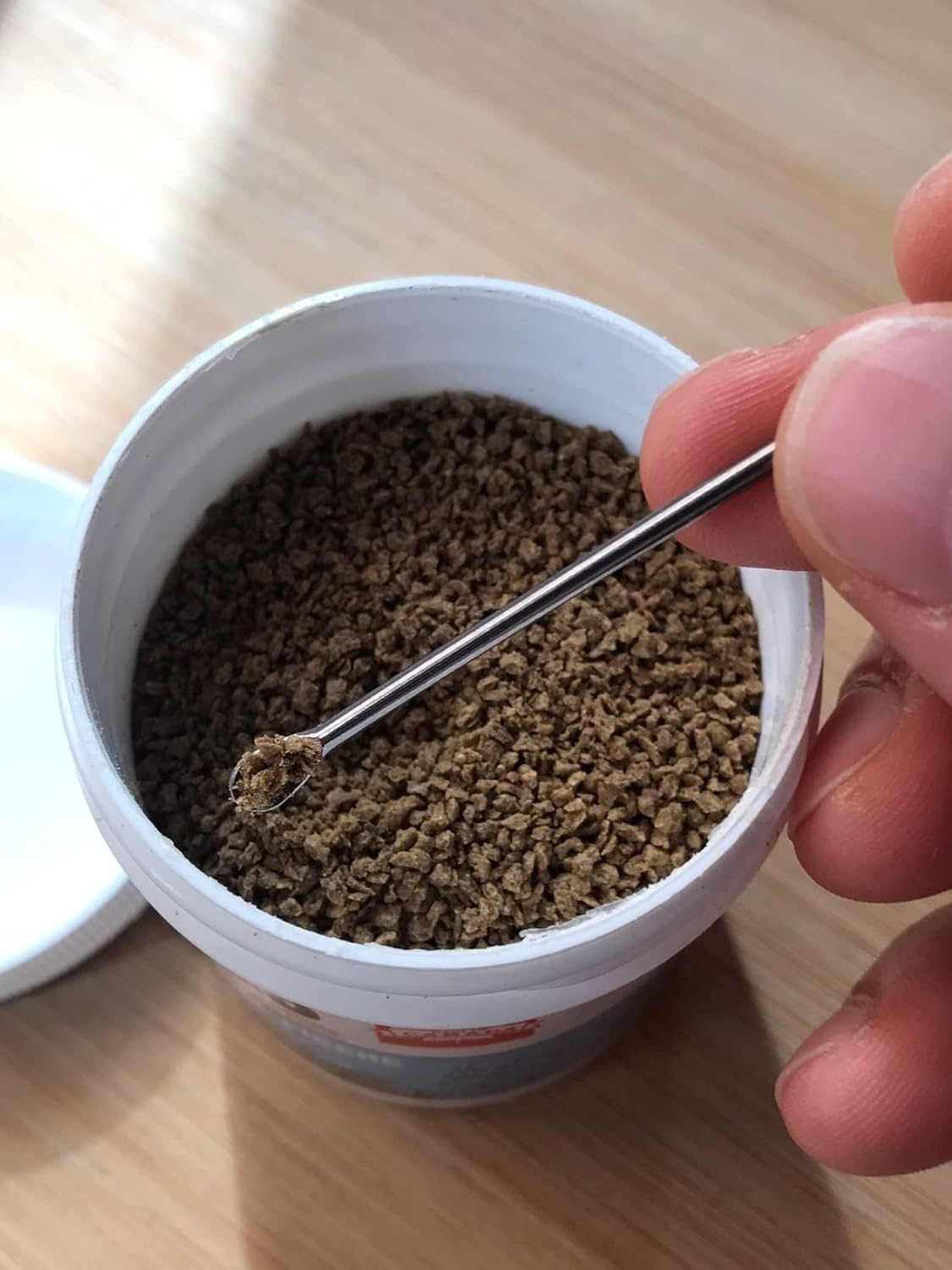
Owners consistently report strong color enhancement over time and near-total acceptance even in fish that were previously finicky on flake. Water clarity reviews are positive but not exceptional — the granules hold together well and don’t immediately leach color, but Fluval Bug Bites is rarely cited as the cloud-prevention hero of a tank.
One critical warning: the brand makes multiple pellet sizes under the same “Bug Bites” branding, and the size difference between the Small Fish Formula and the Cichlid Formula is dramatic enough to have caused real problems. Reviewer accounts document ordering the wrong size within the same brand line — one buyer resorted to trying to break cichlid-size pellets with a hammer before ultimately donating the container. In a nano tank context, that’s not just money wasted; pellets too large to be consumed will foul water fast. When ordering Fluval Bug Bites, confirm you are selecting “Small Fish Formula” or the specific granule size labeled for fish under one inch.
New
$12.17
In stock on Amazon
Check price on AmazonUltra Fresh Nano Pellets — Best for Breeding Colonies and Water Clarity
Mile
$55.99
In stock on Amazon
Check price on AmazonUltra Fresh’s nano-format foods compete on two fronts: a high protein ceiling (some SKUs reaching 48% crude protein per label) and a water-clarity reputation that reviewers mention with unusual emphasis.
The longevity claim that anchors the editorial case for Ultra Fresh comes from a documented account of a thriving least killifish colony maintained in a 3-gallon tank for six years using this food as the primary staple. Least killifish (Heterandria formosa) are among the smallest vertebrates in the aquarium hobby — adults rarely exceed an inch — and their fry are nearly microscopic. A six-year thriving colony, in a 3-gallon system, on one food, is a credible stress test that no guaranteed-analysis comparison can replicate. The USDA National Agricultural Library, Aquaculture Information Center, in its feed and nutrition resources, notes that reproductive success across multiple generations is one of the strongest practical indicators of dietary completeness in small fish species. That benchmark is cleared here.
The water clarity story is equally notable. Hobbyists report going extended periods with reduced water-change frequency after switching to Ultra Fresh, attributing the change entirely to reduced waste load from the food. The Merck Veterinary Manual, in its section “Nutrition in Fish,” identifies excess dissolved organics from uneaten feed as a primary driver of water quality degradation in small closed systems. A food that dissolves slowly and is consumed completely before it breaks down is not a cosmetic feature — it’s a tank-health variable. Foods with lower soluble carbohydrate filler and tightly compressed micro-granules tend to hold together longer in water, reducing the dissolved organic compounds (DOC) that feed bacterial blooms and cause cloudiness.
Ultra Fresh’s ingredient sourcing skews toward marine-origin proteins (fish meal, krill), which produces a higher crude protein percentage and a complete marine amino acid profile. For freshwater species this is generally fine — essential amino acids are essential regardless of origin — but it’s worth distinguishing from a true “marine formula” (see FAQ below).
Mile
$55.99
In stock on Amazon
Check price on AmazonNew Life Spectrum Small Fish Formula — Best Granule-Size Benchmark for the Smallest Fish
Fluval
$5.94
In stock on Amazon
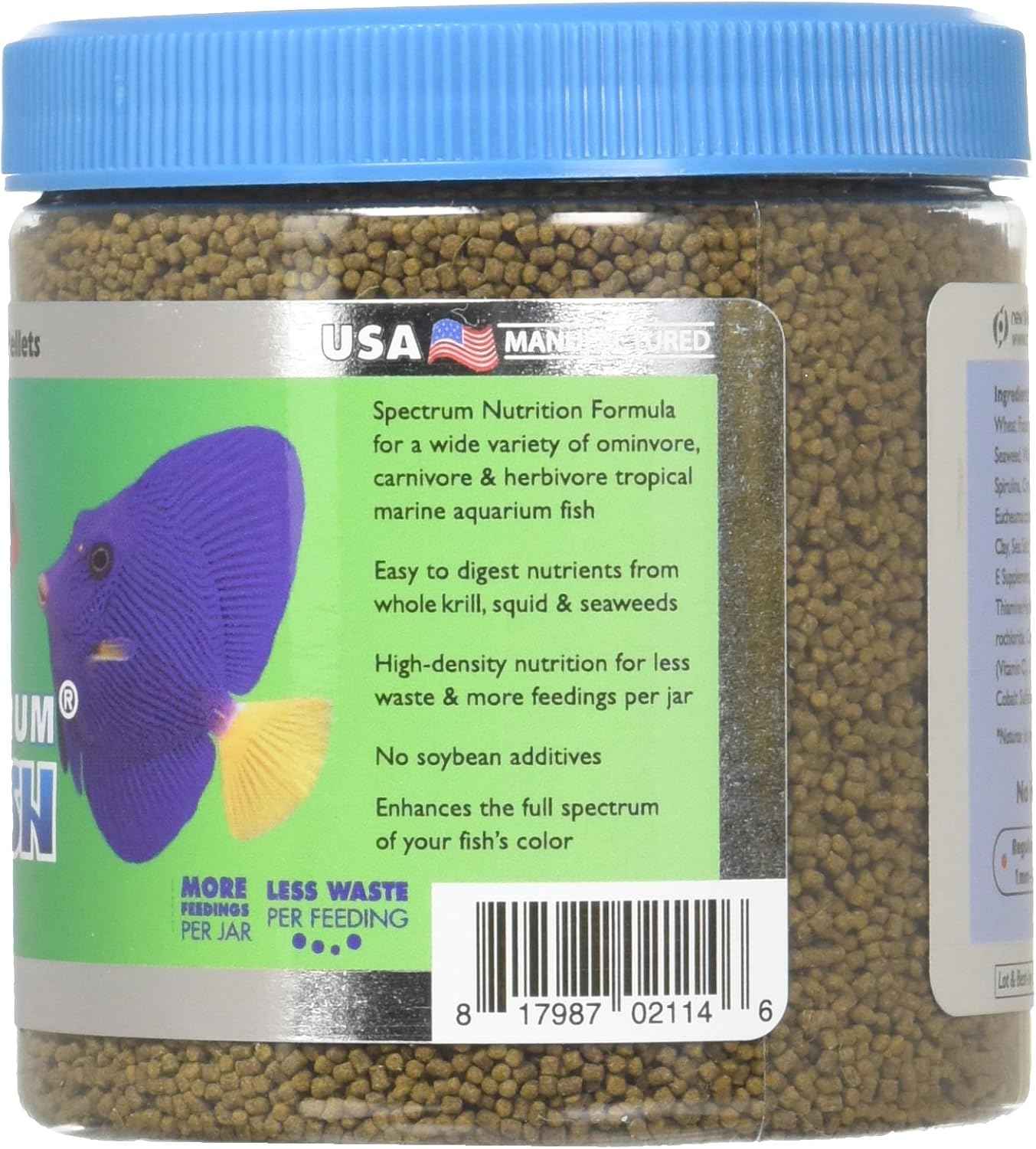
Check price on AmazonNew Life Spectrum’s small-fish formulas occupy a specific niche: the absolute smallest granule size available from a mainstream manufacturer with documented nutritional guarantees. For fish like pea puffers (which rarely exceed an inch and require prey-sized items to trigger feeding responses) and least killifish fry, NLS Thera+A Small Fish Formula is often the only mainstream option small enough to physically enter the fish’s mouth.
The nutritional tradeoff is worth naming clearly. At 34% minimum crude protein per published label, NLS Small Fish Formula is formulated for a broad freshwater omnivore audience rather than for high-protein specialist feeding. The FAO Fisheries and Aquaculture Department’s technical paper “Feeds and Feeding Practices in Aquaculture” notes that protein requirements vary significantly by species metabolic rate and life stage, with carnivorous and nano species generally requiring 40–50% dietary protein for optimal growth. NLS lands below that range — though it closes some of the gap with its whole-prey ingredient philosophy (Antarctic krill, squid, whole herring), which delivers a more complete micronutrient matrix than isolated protein concentrates.
NLS’s Thera+A line includes a proprietary garlic and vitamin supplement blend that manufacturer documentation associates with immune support and appetite stimulation in finicky feeders. Hobbyists confirm the palatability claim: fish that won’t accept other foods frequently accept NLS, which suggests the attractant profile is genuinely effective.
For the practitioner making a current feeding decision: NLS earns the start position for any tank containing fish under three-quarters of an inch, and it’s the benchmark for triggering feeding responses in new or stressed fish. It should not, however, be the sole long-term staple for species with elevated protein requirements.
Fluval
$5.94
In stock on Amazon
Check price on AmazonFrequently Asked Questions
1. What is the smallest granule size available for pea puffers and least killifish? New Life Spectrum Thera+A Small Fish Formula is consistently cited as producing the smallest granule size among mainstream commercial options. Fluval Bug Bites Small Fish Formula is a close second. For least killifish fry specifically, Ultra Fresh fry-formula SKUs and NLS are the two options with the strongest documented track records at that scale.
2. Do Fluval Bug Bites work for shrimp and snails, not just fish? Yes — accounts explicitly document shrimp and snails consuming Fluval Bug Bites Small Fish Formula alongside fish in complex community setups. The granule sinks over time, making it available to substrate-dwelling invertebrates. No dedicated invertebrate dietary claim is made by the manufacturer, but community-tank acceptance across invertebrate species is well-documented.
3. Which of these foods will cloud my nano tank the least? Ultra Fresh is the most consistently praised for water clarity. Owners attribute this to tight granule compression and lower soluble filler content. Fluval Bug Bites also performs well. NLS is less frequently cited for water clarity specifically, though its whole-prey formulation produces relatively low waste compared to flake alternatives.
4. Should I use a marine formula in a freshwater tank? Generally no, but the reason matters. Marine formulas are calibrated for saltwater species’ osmoregulatory needs and often include sodium levels inappropriate for long-term freshwater use. Ultra Fresh’s marine-origin proteins (krill, fish meal) are not the same as a “marine formula” — the protein sources are marine, but the formula is balanced for freshwater species. Read the label: if it says “for marine aquarium fish,” keep it out of freshwater tanks.
5. How do I order the correct Fluval Bug Bites size so I don’t get pellets too large for my fish? Search specifically for “Fluval Bug Bites Small Fish Formula” — not just “Fluval Bug Bites.” The brand line includes Cichlid Formula pellets that are dramatically larger and will not work in nano tanks. Confirm the product title includes “Small Fish” before purchasing.
6. Is it worth rotating two or three foods rather than feeding just one staple? For most nano and community tanks, yes — and the reasoning is nutritional insurance, not variety for its own sake. No single commercial food has a perfectly complete micronutrient matrix for every species in a mixed community. The USDA National Agricultural Library, Aquaculture Information Center, supports dietary variety as a standard practice in ornamental fish nutrition. Rotating Fluval Bug Bites (insect protein, cross-species acceptance), Ultra Fresh (high marine protein, water clarity), and NLS (smallest granule, appetite stimulation) covers more of the amino acid and micronutrient space than any one food alone. The practical approach: use NLS or Bug Bites as your daily staple, and rotate Ultra Fresh two to three times per week.
The Decision Rule
If your tank has fish under three-quarters of an inch or you’re struggling to trigger feeding in a new arrival, start with New Life Spectrum Small Fish Formula as your on-ramp food. If you’re running a complex community with multiple species and want the best odds of one food working across the board, Fluval Bug Bites Small Fish Formula is the pick — but confirm the granule size before you order. If water clarity is your active problem, or you’re trying to support a breeding colony over the long haul, Ultra Fresh’s formulation and its documented six-year least-killifish track record make it the strongest case for a primary staple. For any tank you take seriously, rotating at least two of these three foods is the professional standard — and it costs less per month than most hobbyists expect.