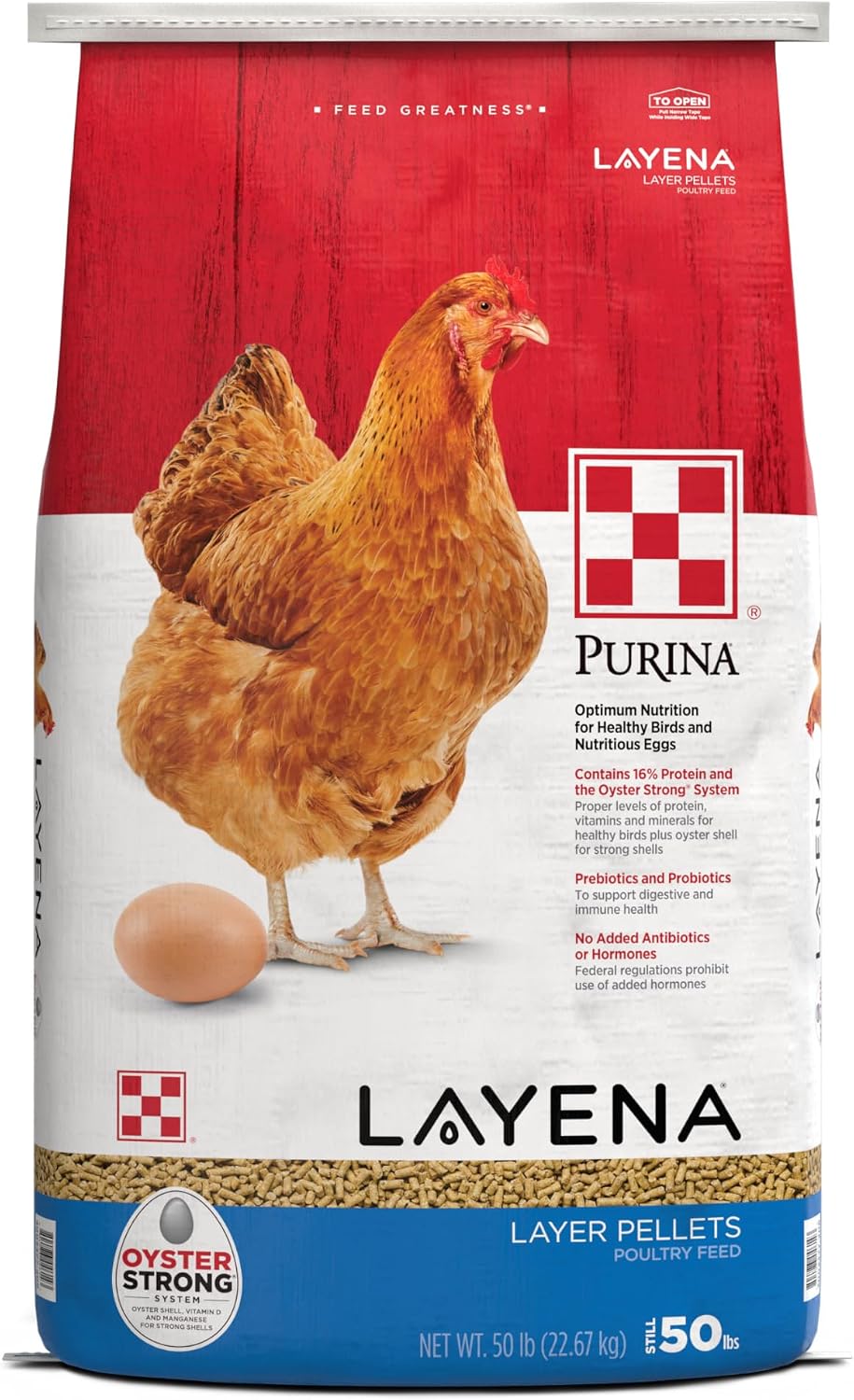
Walk into any feed store and the shelf is a blur of bags with bold numbers on them — 16%, 17%, 18%. Those percentages refer to crude protein, the total amount of protein in the feed expressed as a share of the bag’s weight. Higher sounds better, right? Not always. What actually matters for your flock’s long-term health and your wallet is how much usable protein you’re buying per dollar spent — not just what the front of the bag claims. This article walks through exactly that math, comparing several widely available layer feeds side by side. By the end, you’ll have a simple framework for picking up any bag, doing a two-minute calculation, and knowing whether that premium price is justified or just good marketing.
If you’ve already moved past starter bags and you’re actively comparing formulations, this one is for you. We’re going beyond the percentage on the label and looking at ingredient order, amino acid completeness, and what the real cost-per-gram of protein works out to across price tiers.
| EDITOR'S PICK[New Country Organics](https://www.amazon.com/dp/B0CDD6KZ34?tag=greenflower20-20) | Mid-tierPurina | Budget pick[Manna Pro Layer Pellets Chicken](https://www.amazon.com/dp/B01N7OKO5S?tag=greenflower20-20)… | |
|---|---|---|---|
| Protein % | 17% | — | 16% |
| Bag Size | 25 lbs | 50 lbs | — |
| Organic | ✓ | — | — |
| Non-GMO | ✓ | — | — |
| Corn-Free | ✓ | — | — |
| Probiotics | — | — | ✓ |
| Price | $46.98 | $45.99 | $17.50 |
| See on Amazon → | See on Amazon → | See on Amazon → |
Why the Bag Price Tells You Almost Nothing
A 50 lb bag of Kalmbach Feeds 17% Layer Pellet runs roughly $22 at Tractor Supply as of mid-2026. A 35 lb bag of Scratch and Peck Feeds Cluck’n Sea Organic Layer Pellets runs roughly $55 from Azure Standard or a regional natural foods co-op. On the surface, that looks like an easy call — Kalmbach is dramatically cheaper.
But that comparison is apples-to-pears. The bags are different weights, the protein percentages differ, and the ingredient philosophy differs entirely. To put them on the same plane, you need to calculate cost per gram of crude protein — how much money you’re spending for every gram of protein delivered in a given bag.
Here’s the formula:
Cost per gram of protein = Bag price ÷ (Bag weight in grams × Protein percentage as a decimal)
That’s it. Let’s run the numbers on a set of commonly stocked layer feeds.
The Numbers: Five Feeds, Same Unit
To make the math reproducible, all weights are converted to grams (1 lb = 453.6 g) and protein percentages are pulled from published guaranteed analyses on manufacturer websites and feed labels as of early 2026.
| Feed | Bag Size | Bag Price (approx.) | Crude Protein | Cost / gram of protein |
|---|---|---|---|---|
| Purina Layena Pellets | 25 lb (11,340 g) | $18 | 16% | $0.0099/g |
| Kalmbach 17% Layer Pellet | 50 lb (22,680 g) | $22 | 17% | $0.0057/g |
| Nutrena NatureWise Layer 16% | 40 lb (18,144 g) | $26 | 16% | $0.0090/g |
| Modesto Milling Organic Layer | 50 lb (22,680 g) | $48 | 16% | $0.0132/g |
| Scratch and Peck Cluck’n Sea Organic | 35 lb (15,876 g) | $55 | 16% | $0.0217/g |
By the numbers:
- Cheapest protein per gram: Kalmbach at ~$0.006/g
- Most expensive: Scratch and Peck at ~$0.022/g — roughly 3.8× Kalmbach’s rate
- Modesto Milling sits at about 2.3× Kalmbach’s rate
- Purina Layena and Nutrena NatureWise cluster close together near $0.009–0.010/g
So if raw protein delivery were the only metric, the answer would be simple: buy Kalmbach and call it a day. But that’s where the conversation has to get more interesting.
What the Percentage Doesn’t Tell You: Amino Acid Profile and Ingredient Quality
Crude protein is a chemical measurement — it counts nitrogen in the feed and estimates protein from there. It does not tell you whether that protein contains the right amino acids (the individual building blocks proteins are made of) in proportions that laying hens can actually use.
Penn State Extension’s guide on feeding chickens for egg production emphasizes that methionine and lysine — two essential amino acids that laying hens cannot synthesize on their own — are often the limiting factors in flock performance, not total protein percentage. A feed with 17% crude protein built on corn and soybean meal may deliver adequate methionine. A feed formulated around whole-grain wheat, peas, and fishmeal might deliver superior methionine at 16% crude protein — with better biological availability.
Here’s what to look for on the guaranteed analysis panel:
- Methionine: The USDA National Agricultural Library’s nutrient requirements data for laying hens puts the minimum methionine need at roughly 0.30–0.35% of diet dry matter. Any label listing methionine below that threshold is a flag.
- Lysine: Target minimum is approximately 0.65–0.75% of diet dry matter for peak lay.
- Crude fiber: Tells you something about grain composition. High fiber often signals whole-grain formulations; very low fiber can indicate finely milled, highly processed grain fractions.
The Merck Veterinary Manual’s poultry nutrition overview notes that deficiencies in methionine specifically show up as reduced egg size and poor feather quality before they show up in lay rate — meaning a feed can look “fine” on production numbers while silently underperforming on bird health.
This is where Scratch and Peck’s higher cost-per-gram starts to earn its keep for some flocks. Their Cluck’n Sea line includes fishmeal (a complete amino acid source) as a named protein ingredient, with whole grains listed first. Owners running the feed in long-term flock comparisons consistently report better feather condition and lower pick-pecking incidents — both indicators of adequate methionine status, per the amino acid research.
That said, the Merck Veterinary Manual is clear that synthetic methionine added to conventional feeds is bioavailable and functional. Kalmbach’s conventional formula almost certainly uses supplemental methionine to hit its guaranteed analysis targets. Paying 3.8× more per gram of protein is not automatically justified by “natural sources only” — but it may be justified by certification requirements, personal sourcing values, or specific flock health goals.
Reading Ingredient Order: The Information the Percentage Hides
Feed ingredients are listed in descending order by weight, just like a food label. This is where experienced label readers find the real story.
Red flags in ingredient lists:
- “Grain by-products” or “plant protein products” listed early without naming the grain or plant. These are commodity catch-all terms that can shift from batch to batch — the ATTRA publication on organic and pasture-based poultry production specifically flags these as transparency concerns for producers making marketing claims.
- Soybean meal appearing before a named whole grain in a product marketed as “whole grain”
- No named vitamin/mineral premix or chelated minerals listed — chelated minerals (you’ll see terms like “zinc proteinate” or “copper lysinate”) are more bioavailable than oxide forms
Green flags:
- First three ingredients are named whole grains (corn, wheat, oats, barley, milo)
- A named legume or fishmeal as protein source
- Calcium carbonate or aragonite listed (not just “calcium supplement”) — matters for shell quality
- Methionine and lysine listed individually in the guaranteed analysis, not just inferred from crude protein
Kalmbach’s 17% label lists corn, soybean meal, and wheat middlings in the top three positions — a conventional, cost-efficient base that performs reliably. Scratch and Peck lists whole oats, whole barley, whole wheat, peas, and fishmeal before you hit any by-product fractions. Different philosophies, both functional, at very different price points.
Modesto Milling Organic Layer — USDA-certified organic, milled in California — sits at the middle of our cost table and lists certified organic corn, organic soybean meal, and organic wheat as its base. For homestead operations with organic certification requirements, that middle-ground pricing (~$0.013/g) may represent the practical ceiling before economics get difficult.
Channel Arbitrage: The Same Feed at Different Prices
One variable the cost-per-gram calculation can’t fully capture is channel pricing — where you buy matters almost as much as what you buy.
As of mid-2026, a few patterns worth knowing:
- Tractor Supply Co. stocks Kalmbach and Purina reliably but runs periodic Neighbor’s Club member promotions (typically 10–15% off selected feeds) that can shift the math meaningfully on large purchases.
- Chewy Autoship prices on Purina Layena and Nutrena NatureWise have been running roughly 5–8% below MSRP with auto-delivery discount layered on top. For 25–50 lb bags, shipping cost offsets some of that savings unless you’re ordering multiple bags.
- Azure Standard is a strong channel for Scratch and Peck and Modesto Milling — their drop-point distribution model brings regional shipping costs down significantly for buyers in the western and intermountain US. Quarterly order consolidation can reduce your effective per-bag cost by $4–8 on premium organic SKUs.
- Direct from mill (Modesto Milling ships direct; some regional mills offer farm-pickup pricing) can cut 10–20% off retail on 50+ lb orders, but requires planning around order minimums and pickup logistics.
The Poultry Site’s coverage of layer feed economics notes that for small-scale producers running 25–100 hens, feed represents 60–70% of total production cost. On that basis, channel optimization on a feed you’ve already vetted nutritionally is worth the friction.
The Decision Rule: If X, Then Y
Here’s the framework, built directly from the math and ingredient analysis above:
If you’re running a backyard flock of 6–20 hens and price is the primary constraint: Kalmbach 17% Layer Pellet at ~$0.006/g is the most protein-efficient conventional option in wide distribution. Supplement with free-choice oyster shell and confirm your regional dealer’s lot freshness (pellets older than 90 days lose vitamin potency).
If you’re producing eggs for sale and making any “natural” or “non-GMO” label claim: Nutrena NatureWise or a comparable non-GMO certified option closes the gap between conventional and organic at a mid-tier price point. Verify the non-GMO certification documentation before putting claims on your packaging — state ag departments are increasingly scrutinizing this.
If your operation holds or is pursuing USDA organic certification: Modesto Milling Organic Layer or a certified regional equivalent is likely your practical ceiling on cost-per-gram without exceeding what organic egg price premiums can support at small scale. The ATTRA organic poultry guide recommends verifying that your feed supplier maintains a current NOP (National Organic Program) certificate, not just “made with organic ingredients” labeling.
If feather condition, flock longevity, and amino acid completeness are the primary drivers and budget allows: Scratch and Peck Cluck’n Sea Organic’s higher cost-per-gram reflects real ingredient differences — whole grains, fishmeal, no catch-all by-product terms — and owner reports consistently support better long-term bird condition. For show flocks, breeding stock, or heritage breeds with longer productive lifespans, the premium is more defensible than it looks at the shelf.
If you’re buying in bulk for 50+ hens: Run the cost-per-gram math fresh every quarter. Feed pricing has been volatile, and the rank order of these feeds has shifted at least twice in the past 18 months. The framework holds even when the specific numbers move.
The label is telling you a story. Once you know how to read it — crude protein percentage as a starting point, amino acid profile as the real test, ingredient order as the transparency signal, and channel pricing as the multiplier — every bag on that feed store shelf stops being a guessing game. Pick it up, do the math, and buy accordingly.