If you keep ornamental fish or stock a farm pond, you’ve probably stood in a feed aisle — or scrolled a product page — wondering why one bag of pond pellets costs twice as much as the one next to it. Pond fish food (pellets or granules formulated specifically for fish kept in outdoor ponds) isn’t a one-size-fits-all product. The protein percentage, the ingredient source, and even the pellet’s buoyancy all change how well your fish grow, how healthy they stay, and whether your water stays clear or turns into pea soup. This article breaks down four brands that come up consistently among serious pond keepers — Kaytee, Blue Ridge Fish Food, Purina AquaMax, and Natural Waterscapes Game Fish Food — on the numbers that actually matter. By the end, you’ll have a clear decision frame for whichever situation you’re in.
What the Label Is Actually Telling You (and What It Isn’t)
Every pond fish food bag carries a guaranteed analysis — a mandatory listing of minimum crude protein, minimum crude fat, maximum crude fiber, and maximum moisture. These numbers are the floor of the conversation, not the ceiling.
Crude protein is the metric most buyers anchor to, and for good reason. According to the FAO Fisheries and Aquaculture Department, Technical Paper 522 on finfish nutritional requirements, warmwater ornamental species like koi and goldfish perform well across a protein range of 28–36% during active growing seasons, but protein source quality — specifically the amino acid completeness of that protein — determines whether fish convert feed efficiently or simply pass excess as waste. A 32% protein pellet built on quality fish meal and soy protein concentrate will outperform a 36% pellet built on feather meal or corn gluten in measurable growth outcomes.
Water cloudiness is the signal most buyers use to evaluate ingredient quality in practice, and they’re not wrong to use it. Poorly digestible fillers and fine-particle binders leach into the water column as fish feed, reducing dissolved oxygen and spiking ammonia. ATTRA National Sustainable Agriculture Information Service, in its Aquaculture Overview published by NCAT, notes that feed conversion ratio (FCR — the pounds of feed required to produce one pound of fish growth) is the most reliable long-term quality signal for producers. For backyard pond keepers, water clarity serves as a reasonable real-world proxy: if your pond clouds within hours of feeding and clears slowly, the feed is a likely contributor.
Pellet buoyancy matters more than it seems. Floating pellets let you observe feeding behavior — a classic health-monitoring technique — and allow you to remove uneaten feed before it sinks and decomposes. Sinking pellets may suit bottom feeders or certain setup configurations, but for koi and goldfish, which are surface and mid-column feeders, floating formulas are the default recommendation.
The Four Feeds: Formulation and Field Patterns
Kaytee Koi’s Choice Premium Fish Food
Kaytee’s Koi’s Choice is the most widely distributed of the four, available across major retail channels and positioned as an accessible premium in the ornamental pond segment. The formulation lists fish meal and shrimp meal as early protein contributors — a stronger starting point than plant-protein-first competitors at similar price points.
The most specific performance pattern in buyer accounts involves a keeper who purchased 100 koi at approximately one inch in length and tracked growth to over eight inches across six months of consistent feeding. That’s a documented growth trajectory, not a vague impression about healthy-looking fish, and it anchors the brand’s credibility in the growth phase. The Merck Veterinary Manual, in its fish nutrition guidance, notes that growth rate in juvenile fish is the most sensitive dietary indicator of protein and energy adequacy — which makes six-month growth tracking a more useful evaluation frame than color alone.
Water clarity reports from Kaytee buyers are largely positive, consistent with the fish meal-forward ingredient order. Buyers running mixed koi and goldfish ponds report no selective feeding issues — both species accept the pellet readily.
Kaytee
$24.90
In stock on Amazon
Check price on AmazonBlue Ridge Fish Food
Blue Ridge earns a different kind of loyalty. Where Kaytee buyers talk about growth, Blue Ridge buyers talk about color and long-term health — specifically, fish kept across multiple years with active spawning noted as a background health indicator. Spawning behavior in captive koi and goldfish is a meaningful welfare signal: fish under chronic stress or nutritional deficiency typically suppress reproduction.
Blue Ridge formulations include color-enhancing carotenoid sources — astaxanthin and spirulina appear across various SKUs — which directly support red, orange, and yellow pigment deposition in koi skin. The FAO Fisheries and Aquaculture Department, Technical Paper 522, identifies carotenoids as non-synthesizable by fish, meaning the animal cannot produce them internally and must consume them through feed. A formulation without a carotenoid source will produce progressively duller coloration in ornamental varieties over a season, regardless of how clean the water stays.
Buyers also report favorable water clarity outcomes with Blue Ridge, consistent with its formulation profile. For the serious koi keeper thinking about long-term color development and planning to keep fish for five or more years, Blue Ridge’s repeat-purchase loyalty pattern and the specific health signals buyers volunteer — active breeding, multi-year retention — make it the strongest ornamental choice in this comparison.
Purina
$72.99
In stock on Amazon
Check price on AmazonPurina AquaMax
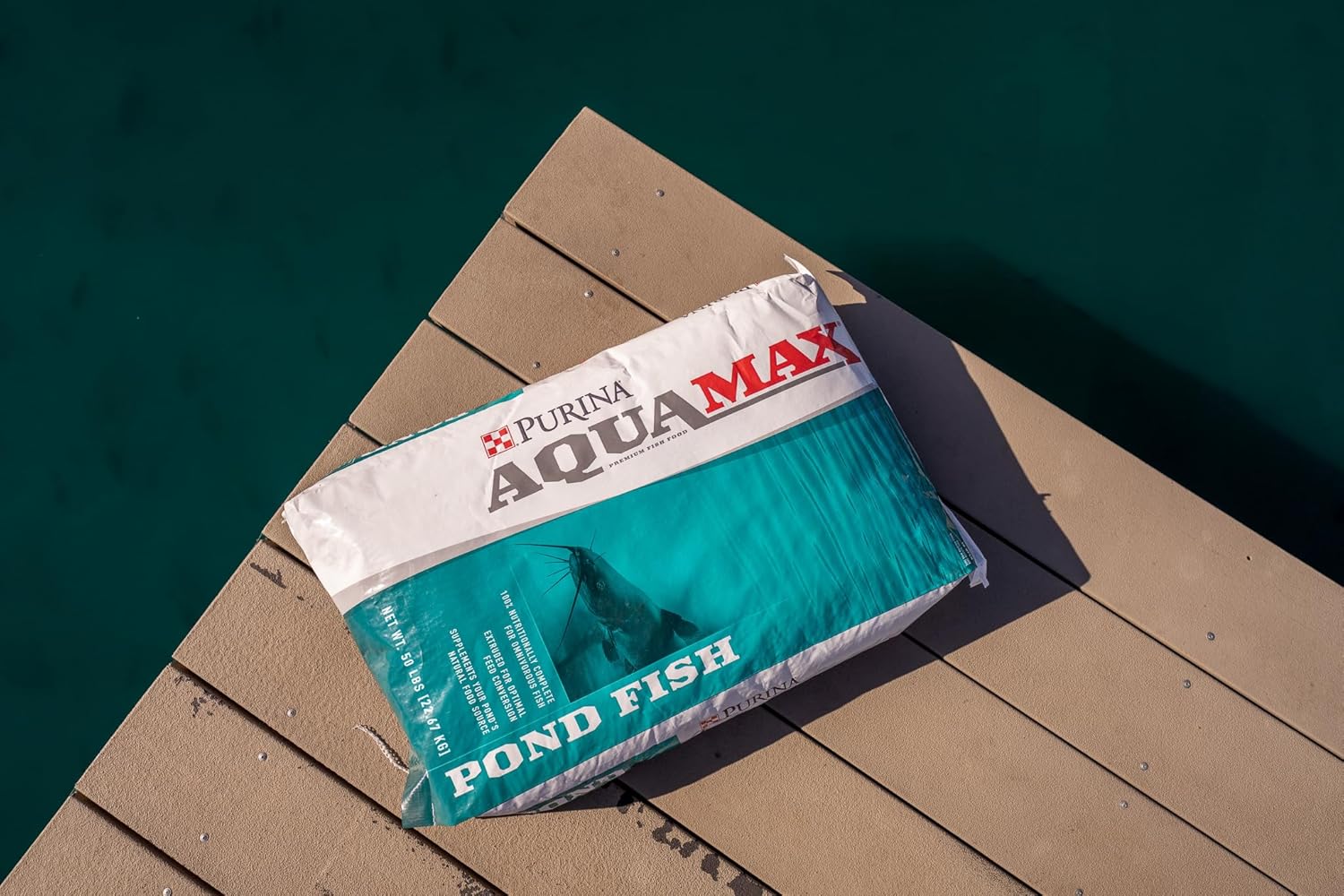
Purina AquaMax occupies a distinct niche: it is the formulation most explicitly designed for production aquaculture (the commercial-scale farming of fish), and the spec sheet reflects that engineering. AquaMax products carry published digestibility and FCR data — a level of nutritional documentation that ornamental brands do not typically provide.
The National Agricultural Library (NAL), USDA, in its documentation on aquatic animal feeds and feeding, notes that production-grade feeds are formulated to minimize nutrient loading in water — particularly phosphorus and nitrogen output — as much as to support growth. This matters in aquaculture settings where water quality has density or regulatory implications. For a backyard pond keeper with 30–50 koi, AquaMax is overbuilt in some respects and appropriately specified in others. If you’re running a serious grow-out program — fingerlings to market or display size — AquaMax’s FCR credentials become genuinely relevant. If you’re feeding 20 decorative koi in a backyard water garden, ornamental-specific formulations from Blue Ridge or Kaytee will give you better color outcomes at comparable or lower cost.
AquaMax floating pellets maintain surface buoyancy consistently, and the formulation produces minimal water cloudiness across buyer reports. The product line spans multiple protein percentages — 32%, 35%, and 41% by SKU — giving producers the flexibility to shift formulation by life stage, which is addressed further in the FAQ section below.
Natural
$74.97
In stock on Amazon
Check price on AmazonNatural Waterscapes Game Fish Food
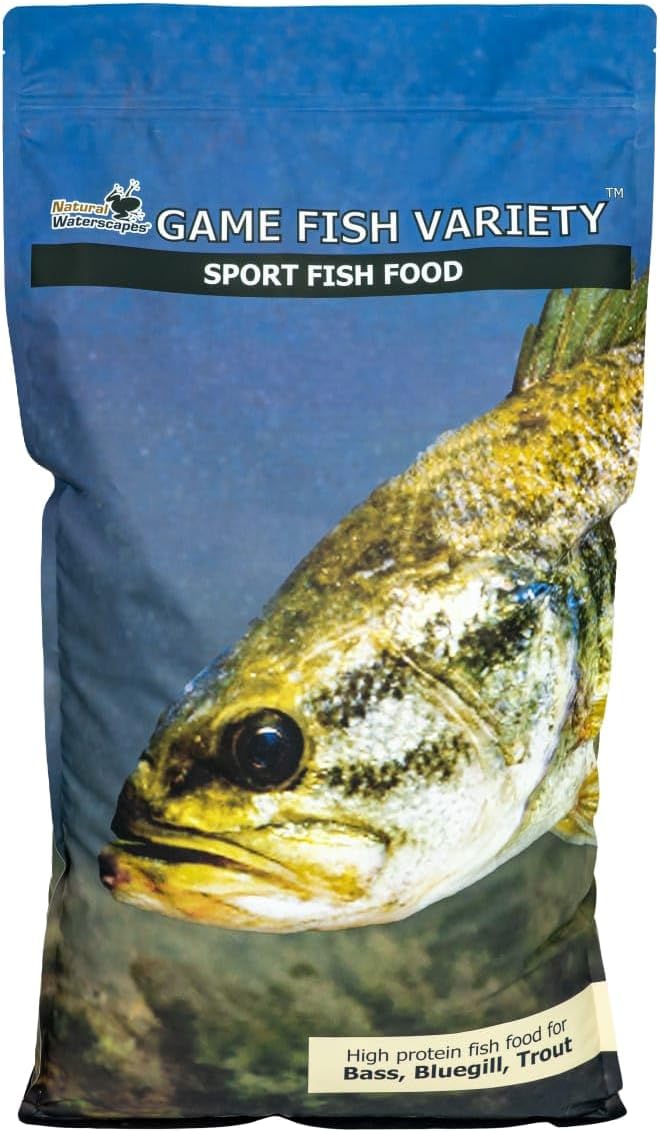
Natural Waterscapes draws a meaningfully different buyer: the mixed-species pond keeper stocking bass, bluegill, sunfish, and bream alongside or instead of ornamental koi. This is a management-pond or farm-pond context rather than a water-garden context, and the formulation reflects it.
The 32% crude protein positioning makes it competitive for fast-growing game species that have higher protein demands during active growing season than decorative koi in maintenance mode. ATTRA National Sustainable Agriculture Information Service, Aquaculture Overview (NCAT), notes that centrarchids — the sunfish family, which includes bluegill and bass — have somewhat different protein and fat requirements than cyprinids — the carp family, which includes koi and goldfish — making species-matched formulation more relevant in a game fish context.
One detail that surfaces consistently in buyer accounts: bags arrive with a handwritten thank-you note. It’s a small-operation signal — the kind of detail you see from regional mills and specialty producers — and it indicates a company paying attention to individual orders. For buyers who value sourcing transparency and direct producer relationships, that detail is not trivial.
One buyer also notes that ducks feeding at the pond edge consume Natural Waterscapes pellets from the surface — a minor crossover detail worth flagging for mixed waterfowl-and-fish pond operators. It isn’t a formulated waterfowl feed, but incidental crossover feeding in a mixed-use setting won’t harm the ducks.
Purina
$72.99
In stock on Amazon
Check price on AmazonBy the Numbers
| Feed | Crude Protein | Primary Protein Source | Color Enhancement | Best Use Case |
|---|---|---|---|---|
| Kaytee Koi’s Choice | ~29% | Fish meal, shrimp meal | Limited | Growth phase, fingerling to adult |
| Blue Ridge Fish Food | ~32% | Fish meal, soy protein | Astaxanthin, spirulina | Long-term ornamental, color priority |
| Purina AquaMax | 32–41% (by SKU) | Fish meal, soybean meal | Minimal | Grow-out production, FCR-focused |
| Natural Waterscapes Game Fish | ~32% | Fish meal | None | Mixed game fish ponds, bass/bluegill |
Frequently Asked Questions
What protein percentage does a koi actually need for optimal growth versus maintenance? Juvenile koi and fish in active grow-out benefit from 32–36% crude protein. Adult koi in maintenance or display settings perform well at 28–32%. The FAO Fisheries and Aquaculture Department, Technical Paper 522 on finfish nutritional requirements, notes that exceeding protein requirements does not produce proportional growth benefits — excess protein is metabolized as energy, increasing nitrogen waste in the water. Match protein level to life stage rather than defaulting to the highest number on the shelf.
Why does cheap pond food cloud the water, and is it harmful to fish? Cloudiness from feed is typically caused by fine-particle fillers, poorly digestible binders, or plant-protein sources that leach into the water column before fish can ingest them. The Merck Veterinary Manual, in its fish nutrition section, notes that elevated ammonia from decomposing organic matter — including uneaten feed — is a primary driver of gill stress and immune suppression in pond fish. Persistent cloudiness from feed quality is a slow-burn health risk, particularly in warm summer water where ammonia toxicity increases.
Can I feed the same pellets to koi, goldfish, and game fish in a mixed pond? Koi and goldfish share close enough nutritional profiles that a quality koi formulation works well for both. Mixing game fish such as bass and bluegill with ornamental cyprinids is more complicated — game fish are predatory and will target small ornamentals regardless of feed availability. If you’re running a true mixed pond, a 32% protein floating pellet is a workable compromise, but understand that you’re making a generalist feeding choice, not a species-optimized one.
How long do floating pellets stay on the surface before becoming waste? Quality floating pellets from production-grade formulations typically maintain buoyancy for 20–40 minutes in still water. Wind and surface agitation accelerate sinking. ATTRA National Sustainable Agriculture Information Service, Aquaculture Overview, recommends feeding only what fish will consume in five to ten minutes to minimize waste. Uneaten pellets that sink decompose and drive ammonia and phosphorus loading.
Should I change pond fish food formulation by season? Yes. Water temperature directly governs fish metabolism and digestive efficiency. Most pond keepers in temperate climates transition to a wheat germ-based lower-protein formula — below 30% crude protein, lower fat — when water temperatures fall below 50°F (10°C), because fish digestive systems slow substantially in cold water and high-protein feed passes largely undigested, fouling the pond. Resume higher-protein growth formulas when water temperatures reliably exceed 55–60°F in spring.
How much food per day for a pond with 50–100 koi? The standard guideline is 1–3% of total fish body weight per day during active feeding season, adjusted downward in cooler water. For a pond with 75 koi averaging half a pound each — roughly 37.5 lbs total biomass — that works out to approximately 6–11 ounces of feed per day at peak season. Feed in multiple small portions rather than one large feeding to reduce waste and allow you to monitor feeding behavior as a health indicator.
The Decision Frame
If you’re growing fingerlings toward display size and want documented growth performance, Kaytee Koi’s Choice has the buyer-reported growth data to back the claim and the widest retail availability to make restocking straightforward.
If you’re keeping ornamental koi long-term and color quality is your primary metric, Blue Ridge’s carotenoid-forward formulation and its repeat-buyer loyalty pattern make it the cleaner choice — and the spawning-behavior reports from multi-year buyers are a meaningful health signal, not marketing copy.
If you’re running a grow-out operation and need FCR documentation and multi-SKU protein flexibility across life stages, Purina AquaMax is the production-grade tool for the job, with the nutritional engineering to back it.
If your pond holds bass, bluegill, and mixed game fish — or if you’re a small-operation buyer who values direct producer relationships — Natural Waterscapes Game Fish Food earns a serious look, and its 32% protein level keeps it competitive with the ornamental options on paper.
Water clarity is your ongoing quality check regardless of which feed you choose. If it clouds and stays cloudy after feeding, the feed is telling you something worth listening to.