If you’ve ever stood in the feed aisle staring at a bag labeled “Grower” and one labeled “Developer” and wondered whether they’re meaningfully different — or just marketing — you’re asking exactly the right question. A pullet is a young female chicken that hasn’t started laying eggs yet, typically from about 6 weeks old until her first egg at 18–22 weeks. During that window, she’s doing the most demanding biological construction work of her life: building bone density, muscle mass, and the reproductive infrastructure that will eventually produce eggs. The feed protein percentage she eats during this period — protein being the raw material for all that tissue growth — has a direct, measurable effect on how well she lays later. This guide walks through what the research actually says about protein requirements at each life stage, which commercial feeds hit those targets, and how to make a clean, confident transition from starter to grower to pre-lay without over- or underfeeding your birds.
Why Protein Percentage Isn’t One-Size-Fits-All
Here’s the core tension: high protein is not always better, and the cost of getting it wrong runs in both directions.
Too little protein during active growth means pullets can’t synthesize the muscle and organ tissue they need. The Merck Veterinary Manual’s poultry nutrition section notes that amino acid deficiency during the grower phase — particularly methionine and lysine, the two most critical limiting amino acids in poultry diets — results in stunted frame development and delayed sexual maturity (first egg). A pullet that’s nutritionally behind at 16 weeks rarely catches up fully.
Too much protein carries its own costs. Excess dietary protein forces the liver and kidneys to process nitrogen waste, and in young pullets it can accelerate early sexual maturity — which sounds like a good thing until you realize that pullets who start laying too early tend to lay smaller eggs, experience more prolapse risk, and often have shorter peak production windows. Penn State Extension’s small flock feeding guide explicitly flags excess protein in late grower and developer feeds as a contributing factor to reproductive problems.
The practical implication: you need a feed protein target that moves with your birds’ age, not one static bag from 6 weeks to first egg.
The Life Stage Breakdown
Here’s what the research consensus — drawn from the USDA/National Academies nutrient requirement data published through USDA NAL and widely cited in extension literature — recommends for egg-type pullets (think Leghorn-type or production breeds like ISA Brown, Hy-Line, Lohmann):
By the numbers:
| Life Stage | Age Range | Recommended Crude Protein |
|---|---|---|
| Starter | 0–6 weeks | 18–20% CP |
| Grower | 6–14 weeks | 15–17% CP |
| Developer / Pre-Lay | 14–18 weeks | 14–16% CP |
| Layer | 18+ weeks (or at first egg) | 16–18% CP |
Dual-purpose breeds (Barred Rock, Rhode Island Red, Dominique) tolerate slightly higher grower protein — up to 17–18% — because they’re building more muscle mass relative to a production-type hen. Meat-focused breeds (Cornish Cross, Ranger broilers) operate on an entirely different curve and aren’t the subject here, but it’s worth noting they are never appropriately fed on layer or developer formulations.
Reading the Grower Feed Label: What Actually Matters
Most backyard keepers who’ve been around a year or two have learned to read the Guaranteed Analysis panel — the table on every feed bag listing minimums for crude protein and crude fat, and maximums for crude fiber and moisture. That’s a good start, but for the grower phase specifically, there are three things worth scrutinizing beyond the top-line protein percentage.
1. The Calcium Number
This is the one that catches people off guard. Layer feed is typically formulated at 3.5–4.5% calcium to support eggshell formation. That level is actively harmful to pullets who aren’t laying yet — it can overwhelm developing kidneys and contribute to kidney damage that won’t show up until later in life. Per the Merck Veterinary Manual’s poultry nutrition guidance, grower and developer feeds should run 0.8–1.0% calcium. When you’re evaluating a grower feed, flip to the Guaranteed Analysis and check that calcium ceiling. A feed listing “not less than 3.0% calcium” is a layer feed regardless of what the front panel says.
2. Methionine and Lysine
These are the two amino acids most likely to be limiting in a poultry diet — meaning the bird runs out of them before it can complete its protein-synthesis tasks, even if total crude protein looks adequate on paper. ATTRA’s small flock feed guide notes that corn-soy based rations can run short on methionine specifically, which is why quality grower formulations either include synthetic DL-methionine supplementation or use methionine-dense ingredients like fish meal or distillers dried grains. If you’re comparing a conventionally formulated grower (like Kalmbach 17% Grower or Purina Flock Raiser) against an organic option (like Modesto Milling Organic Poultry Grower or Scratch and Peck Feeds Grower), the amino acid profile question becomes more pointed: organic-certified feeds cannot use synthetic methionine under USDA NOP rules, so they typically compensate with fishmeal, organic peas, or higher overall protein to cover the gap. Understanding that trade-off tells you why an organic grower at 18% CP might actually be nutritionally equivalent — or superior for methionine — to a conventional 16% CP grower.
3. The Ingredient Deck Order
Ingredients are listed by weight, descending — same as human food labels. In a quality grower feed, you want grain (corn, wheat, oats, or barley) and a legume or animal protein source (soybean meal, fish meal, peas) occupying the first two to three slots. If the first non-grain ingredient is a by-product meal or a synthetic amino acid blend without a real protein source backing it up, you’re looking at a least-cost formulation that’s hitting the protein percentage with cheaper inputs. That may be perfectly adequate — Kalmbach’s 17% Layer Pellet has a strong reputation among practical producers for cost-efficiency — but you’re making that choice consciously.
The Transition Problem: When to Switch (and What to Bridge With)
The question practitioners get wrong more often than any other: when exactly to move from starter to grower, and from grower to pre-lay. The answer isn’t a calendar date — it’s a combination of age and body condition.
Starter to Grower: Most sources, including the Penn State Extension small flock guide, put this at 6 weeks for production breeds. The practical signal is feathering: a fully feathered pullet at approximately 6 weeks has cleared the critical brooding phase and doesn’t need the high protein of a starter. If your birds are slow to feather or look small for their age, extending starter to 8 weeks is reasonable.
Grower to Developer/Pre-Lay: This is where most keepers fumble. The shift to a lower-protein, higher-calcium pre-lay diet is specifically designed to prime pullets for egg production — but you need to time it right. The Poultry Site’s nutrition guide for laying hens recommends beginning the transition to a pre-lay diet (or introducing oyster shell free-choice alongside a developer formula) at 16–18 weeks, not at the first egg. By the time you see that first egg, the reproductive system is already fully developed; the pre-lay diet is meant to support that final maturation, not respond to it. If you’re still on a 16% grower at week 18, you’re late — not catastrophically, but late.
The Overlap Bridge
For small flocks where you’re buying 25–50 lb bags rather than a ton at a time, you’ll often have a partial bag of one feed when it’s time to transition. The cleanest approach is a 7–10 day overlap — feed out the old bag by mixing it 50/50 with the new formula for the first week. This matters both digestively (gut flora appreciate gradual transitions) and behaviorally (birds can be surprisingly resistant to texture and smell changes in feed).
Matching Feeds to Life Stage: A Practical Comparison
Let’s put some actual products against this framework, with the caveat that formulations do change and you should always verify the current Guaranteed Analysis on the bag or manufacturer website before buying.
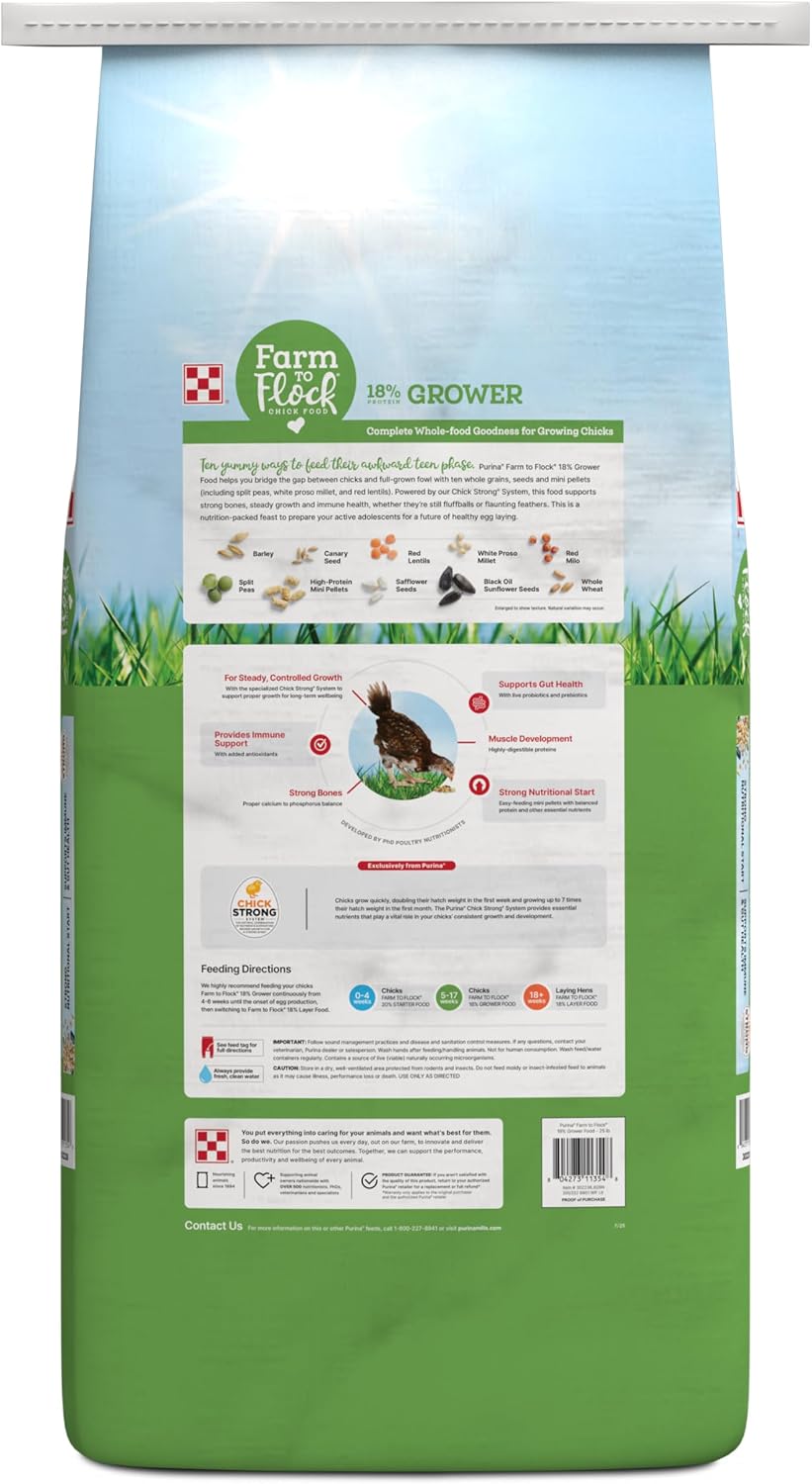
Purina Flock Raiser (20% CP): Positioned as an all-flock and grower option. At 20% CP, it runs high for grower-phase pullets past week 10 — appropriate for meat birds or younger chicks, but the Poultry Site and extension consensus would flag it as excess for a 12-week-old pullet. Calcium is low (around 1%), which is correct for a non-laying bird. Works well for 6–10 week grower phase; consider transitioning down by week 12.
Kalmbach 17% Layer Pellet: Widely used by cost-conscious keepers. Note the name: this is a layer pellet at 3.5%+ calcium, not a grower feed. Using it on non-laying pullets is a common mistake that contributes to the kidney issues the Merck Veterinary Manual flags.
Scratch and Peck Feeds Cluck’n Sea Organic Grower (18% CP): Fishmeal-based for methionine without synthetic supplementation. Certified organic, appropriate for NOP operations. At $55+ per 40 lb bag (typical 2025–2026 retail), the cost premium is real but traceable: you’re paying for organic grain sourcing and the fishmeal protein fraction. For operations marketing certified-organic eggs, this is a defensible input cost.
Modesto Milling Organic Poultry Grower (16–17% CP): A West Coast regional mill option favored by certified-organic small farms. Published specs show calcium in the grower-appropriate 0.9–1.0% range. Frequently available through Azure Standard for bulk buyers in the Pacific Northwest, where per-pound cost comes closer to conventional options at volume.
The Decision Rule
If this is where you are right now — birds in the 6–18 week window and a feed decision pending — here’s the if/then framework:
-
If your pullets are 6–10 weeks, production breed, conventional operation: A 16–18% CP conventional grower (not a layer feed) hits the target. Purina Flock Raiser or a regional mill equivalent works; watch that you’re not running it too long.
-
If your pullets are 10–14 weeks: Target 15–16% CP, calcium under 1%. This is where many commercial “developer” or “grower/developer” bags sit. Confirm the Guaranteed Analysis — don’t assume the product name.
-
If your pullets are 14–18 weeks, organic operation: Switch to a developer or pre-lay formulation and introduce oyster shell free-choice. Scratch and Peck or Modesto Milling organic pre-lay options are the two most available nationally through specialty feed channels as of mid-2026.
-
If you’re seeing pullets laying before 18 weeks and they’re still on a grower: transition to layer immediately — regardless of the calendar.
-
If you’re running dual-purpose breeds (Barred Rock, Buff Orpington, Dominique): Shade all protein targets 1–2 percentage points higher throughout the grower phase. Their frame needs the headroom.
The underlying principle is simple even if the label-reading takes practice: feed the bird in front of you, not the average bird implied by the bag’s marketing copy. A pullet’s nutritional needs move in one direction — through a sequence of specific requirements — and matching your feed to that sequence is one of the highest-leverage inputs in backyard flock management.