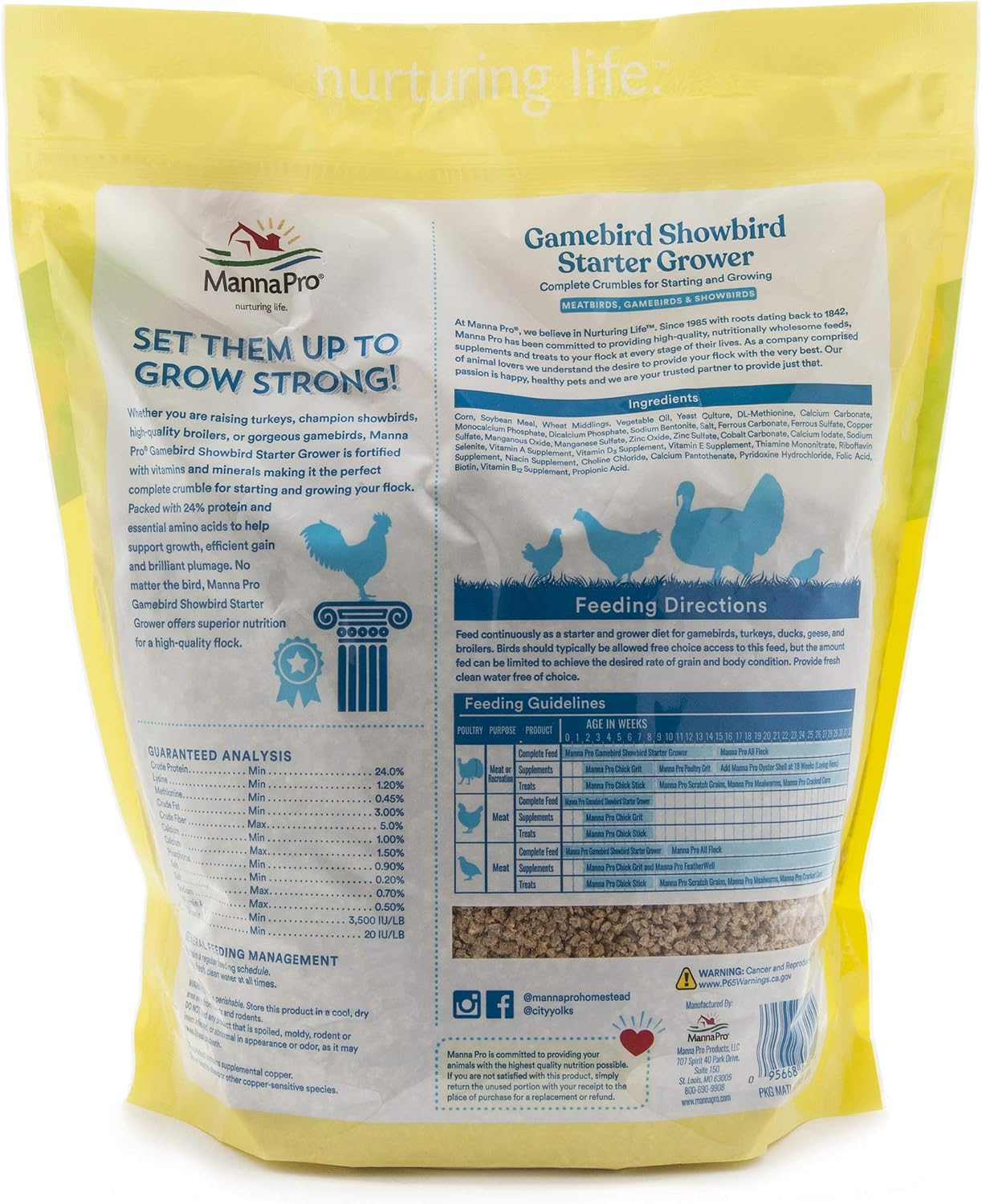
Quail, turkeys, pheasants, and other gamebirds have a nutritional need that sets them apart from the backyard laying hen: they require dramatically more protein, especially when they’re young and growing fast. “Protein percentage” — the share of the feed that is made up of protein — is the single number that most determines whether your specialty birds thrive or struggle to feather out properly. A standard layer pellet (meant for egg-laying chickens) typically runs 16–17% protein. A growing quail chick needs closer to 24–30%. Feed them the wrong product and you’ll see slow growth, poor feathering, and in the case of hatchlings, real health consequences. This guide is for keepers who are past the starter-bag stage and making a deliberate feed decision — comparing formulations, reading guaranteed-analysis panels, and asking whether a single bag can serve multiple species in a mixed flock.
If you’re in that position right now — a bag of Manna Pro Gamebird and Showbird Crumbles in one hand and a bag of All Flock Crumbles in the other, trying to decide which one covers your coturnix quail, your bantam hens, and your turkey poults — this is the breakdown you need.
| EDITOR'S PICKScratch and Peck Feeds | Starte… | Mid-tierManna Pro 7-Grain Ultimate Chic… | Budget pickManna Pro Gamebird & Showbird C… | |
|---|---|---|---|
| Feed type | Grit | Scratch grain | Crumbles |
| Weight | 7 lb | 10 lb | 5 lb |
| Grain blend | ✗ | ✓ | — |
| Vitamins added | — | — | ✓ |
| Bird type | Chickens, ducks | Chickens, hens | Gamebirds, turkeys |
| Price | $18.99 | $15.49 | $9.99 |
| See on Amazon → | See on Amazon → | See on Amazon → |
What “High-Protein Crumbles” Actually Means on the Label
When a feed is called a “crumble,” that refers to physical form: the manufacturer presses a mash into pellets, then breaks those pellets into small, irregular pieces. Crumbles sit between fine mash (dusty, can cause respiratory irritation, harder to manage in wet conditions) and full pellets (too large for hatchlings and small birds to handle comfortably). The Merck Veterinary Manual’s section on poultry nutrition notes that particle size affects feed intake directly — birds that can’t physically manage a piece of feed will sort around it or under-eat.
For gamebirds, the protein source matters as much as the percentage. Look at the ingredient list, not just the guaranteed analysis panel. Menhaden fish meal, soybean meal, and lysine supplements are common protein contributors; fish meal in particular supplies methionine, an amino acid (one of the building blocks of protein that birds cannot synthesize on their own) that is frequently deficient in plant-only rations. The Poultry Site’s guidance on gamebird nutrition flags methionine and lysine as the two amino acids most likely to limit growth in young quail and pheasants when a feed relies entirely on soy.
By the numbers — Protein benchmarks for gamebird life stages:
| Life stage | Recommended crude protein |
|---|---|
| Quail hatchling (0–6 weeks) | 26–30% |
| Quail grower (6–12 weeks) | 20–24% |
| Turkey poult (0–8 weeks) | 28–30% |
| Adult breeding gamebirds | 16–20% |
Source: University of Kentucky Cooperative Extension Service, Small-Flock Turkey Production; The Poultry Site, Feeding Gamebirds.
Manna Pro Gamebird and Showbird Crumbles is formulated at 24% crude protein, which meets the grower-phase requirement for quail comfortably and is adequate for many turkey poult situations, though some extension resources recommend pushing closer to 28% for the first eight weeks of turkey production. It is not a hatchling formula — a point we’ll return to in a moment.
Manna Pro Gamebird Crumbles: What Experienced Keepers and First-Timers Both Report
Across aggregated owner reviews, two distinct user profiles emerge for Manna Pro Gamebird and Showbird Crumbles, and their experiences are worth separating.
Experienced multi-species keepers — people running mixed gamebird operations for three to five years — consistently report it as a reliable, middle-of-the-road workhorse. One long-term user with turkeys and brooding chicks across multiple seasons describes it as the feed they return to precisely because it performs predictably across species without requiring them to stock three separate bags. The 24% protein figure holds up in practice: reviewers note solid feather development timelines and good weight gain in growing birds.
First-time quail keepers are often genuinely surprised. Coturnix quail (the most common backyard species) grow at a pace that shocks newcomers — full adult size in six to eight weeks — and reviewers new to the species frequently attribute healthy feather coverage and fast maturation to finally feeding an appropriate protein level after starting on a layer or flock ration. This is almost certainly not a placebo effect: ATTRA’s sustainable agriculture guidance on poultry feeds explicitly notes that underpowered protein in young gamebirds produces visible, measurable feathering delays.
The hatchling crumble-size problem is real and worth planning for. Multiple reviewers report grinding Manna Pro Gamebird Crumbles further — using a blender or food processor — for newly hatched quail. This is not an indictment of the product; it’s a physical reality of the species. Coturnix hatchlings are tiny, roughly the size of a large bumblebee, and standard crumble sizing can be too large for them to eat effectively in the first week of life. If you’re brooding hatchlings, either plan to grind the crumbles fine for the first five to seven days or source a dedicated gamebird starter mash formulated for the smallest particle size. Penn State Extension’s backyard poultry feeding resources reinforce that particle size in the first week of life is a genuine welfare and survival factor, not just a preference issue.
All Flock Crumbles and the Mixed-Flock Tradeoff
Manna Pro All Flock Crumbles occupies a different position. It runs lower protein than the gamebird formula (typically 18% crude protein), which is not optimal for fast-growing quail or turkey poults but is deliberately formulated to be safe for adult birds of multiple species simultaneously — including roosters, non-laying hens, ducks, and geese, which cannot tolerate the high calcium levels in a dedicated layer pellet.
Bantam and serama owners specifically praise the crumble size. Across reviews from small-bird keepers, the particle size of All Flock Crumbles appears consistently smaller than competitors, which matters enormously for serama chickens (the world’s smallest chicken breed) and bantam hens with proportionally smaller beaks. Reviewers describe this as a rare and practical advantage — most crumble products are sized for standard-breed chickens and simply don’t work well for miniature birds. If your operation includes seramas or bantams alongside other species, this is a real formulation attribute worth factoring into your decision.
But the trade-off is explicit and one reviewer states it plainly: All Flock Crumbles is not optimized for peak-production laying hens. The calcium level is intentionally lower than a layer pellet (to be safe for non-laying birds), which means hens in heavy production may need supplemental calcium — typically offered as free-choice oyster shell alongside the feed — or a separate layer ration. One frank reviewer reports running All Flock Crumbles as the base feed for the whole flock and offering a dedicated layer feed in a separate feeder for hens actively in production. That’s a workable system for mixed flocks, but it does mean you’re managing two feeds rather than one.
The practical decision framework here:
- If your flock is all gamebirds or mixed gamebirds and growing poultry: Gamebird Crumbles at 24% protein is the right tool.
- If you have a genuinely mixed flock — bantams, ducks, roosters, and some hens — and simplicity is the priority: All Flock Crumbles works, with oyster shell offered separately for laying hens.
- If you have hatchling quail: Neither product solves the particle-size problem on its own without grinding.
Grit Sizing: A Genuine Safety Concern for Small Birds
Grit — small, hard particles that birds swallow and use in their gizzard (a muscular stomach organ) to grind food — is not optional for birds eating any solid feed. But not all grit is sized the same, and for small birds, wrong-sized grit is a documented choking hazard.
Scratch and Peck Starter Grit and Mile Four chick grit reviews surface a consistent concern from Call Duck and bantam owners: standard chick grit, which is sized for standard chicken chicks, is too large for very small birds. Call Ducks (a small domestic duck breed) and bantam chickens can choke on grit particles sized for a standard Cornish Cross or Plymouth Rock chick. This is not a fringe worry — multiple reviewers from both product lines describe specifically seeking out the smallest available grit particle size for their small-breed waterfowl and bantams.
If you’re brooding Call Ducks, seramas, or bantam chicks, look for grit labeled for “parakeet” or “finch” sizing, or a product explicitly marketed as suitable for bantams and small waterfowl. Do not assume “chick grit” is universally fine — the category spans a range of particle sizes, and the labeling is inconsistent across brands. ATTRA’s poultry equipment and feeds guidance recommends verifying grit particle size against the bird’s weight class, not just assuming “starter” sizing is small enough.
Frequently Asked Questions
Can I use Manna Pro Gamebird Crumbles as a chick starter for regular chickens?
Technically yes, with a caveat. The 24% protein is higher than the 18–20% a standard meat bird starter delivers and well above the 16% of a layer starter, but it won’t harm growing chicks — excess dietary protein is generally excreted rather than stored. The more relevant question is cost efficiency: gamebird crumbles typically run higher per pound than standard chick starter. For a small batch of laying-breed chicks, it’s a fine short-term solution. For a large broiler operation, the cost difference adds up fast.
What protein percentage do growing quail actually need, and does Manna Pro Gamebird Crumbles meet it?
Growing coturnix quail (six weeks and older) need roughly 20–24% crude protein. Manna Pro Gamebird Crumbles at 24% meets that requirement. Hatchlings (zero to six weeks) ideally need 26–30%; the 24% formulation is adequate but not optimal for the first weeks of life, per University of Kentucky extension guidance on gamebird nutrition.
Do I need to grind gamebird crumbles for newly hatched quail?
Yes, for the first five to seven days. Owner reports are consistent: standard crumble sizing is too large for coturnix hatchlings in the first week. A quick pass through a blender or food processor reduces the crumbles to a manageable particle size without changing the nutritional profile. After day seven, most hatchlings can manage unground crumbles.
Is grit sizing really different for bantams and small ducks, and what should I buy?
Yes, and it’s a genuine hazard, not just a preference. Standard chick grit is sized for standard-breed chickens and can cause choking in Call Ducks, seramas, and bantam breeds. Look for grit explicitly labeled for bantams, small waterfowl, or parakeet/finch-sized particles. When in doubt, go smaller — undersized grit is ineffective but not dangerous; oversized grit in a small bird is a real risk.
Can All Flock Crumbles replace a dedicated layer feed for hens that are still laying?
Not optimally. All Flock Crumbles is intentionally lower in calcium than a layer pellet, which makes it safe for roosters, ducks, and non-laying birds that would be harmed by high calcium. For hens in active production, this means the feed alone won’t supply peak calcium for shell formation. The practical solution is to offer free-choice oyster shell alongside All Flock Crumbles, or to run a separate layer pellet in a dedicated feeder that only hens can access. Either approach works; neither is as simple as a single-feed solution.