Every spring and summer, millions of people pull up to a park pond with the best of intentions and a loaf of bread. The bread disappears in seconds, the ducks seem happy, and it feels like a small, generous act. But bread — even whole-grain bread — provides almost no nutritional value to waterfowl (ducks, geese, and swans), and when fed regularly it can cause real harm. The good news is that better options exist, many of them are inexpensive, some of them float (which matters more than you’d think), and you can keep a small bag in your car without any complicated routine. This article explains what wild park ducks actually need, which commercially available feeds work well for spontaneous or regular pond-side feeding, and how to make a genuinely helpful choice the next time you want to treat the mallards at your local park.
Why Bread Is the Wrong Food — Specifically
“Bad for ducks” is too vague to change anyone’s behavior, so let’s be precise.
Bread is composed almost entirely of refined carbohydrates. It delivers a fast caloric hit with minimal protein, almost no usable fat, negligible vitamins, and no meaningful mineral content — particularly deficient in niacin (vitamin B3), which waterfowl require in significantly higher quantities than chickens or humans. Per the USDA National Agricultural Library’s overview of waterfowl nutritional requirements, ducks and geese need dietary niacin levels roughly three to four times higher than domestic chickens for normal leg development and nerve function.
When a duckling’s diet is chronically low in niacin and protein but high in simple carbohydrates, the result can be angel wing — a wing deformity in which the last joint of the wing twists outward, leaving flight feathers pointing away from the body instead of lying flat. The Merck Veterinary Manual describes angel wing as largely irreversible once ossification is complete, meaning the damage from a summer of bread-feeding can be permanent. Affected birds cannot fly, which makes them permanently dependent on human-supplemented food sources and highly vulnerable to predators.
Beyond the individual bird, high bread input at public ponds creates eutrophication — a process where excess nutrients (mostly from bread-derived waste and droppings) accelerate algae growth, deplete oxygen in the water, and degrade the habitat that wild waterfowl need. Penn State Extension’s guidance on feeding waterfowl at public ponds explicitly notes this cascade as a documented consequence of sustained bread feeding at park sites.
The Wildlife Society’s position statement on waterfowl and human food supplementation takes a similar stance: supplemental feeding isn’t inherently harmful if the food is nutritionally appropriate, but calorie-dense, nutrient-empty foods like bread, crackers, and popcorn actively displace foraging behavior and degrade both individual health and habitat quality.
The tradeoff is simple: bread costs almost nothing and is universally available. The alternative — a small bag of species-appropriate floating waterfowl pellets — costs a few dollars more and requires one trip to a feed store or one online order. The nutritional difference is not marginal. It is categorical.
Floating vs. Sinking: Why Form Factor Actually Matters at a Park Pond
If you’ve read product reviews for duck feeds, you’ve probably noticed that “does it float?” comes up constantly — and not just from backyard flock keepers. Park feeders specifically mention this.
Here’s why it matters: ducks are dabbling feeders by natural behavior. Species like mallards, teals, and most common park pond ducks forage by skimming the water surface or tipping forward (dabbling) to reach food just below the surface. They are not built to dive repeatedly to the bottom of a pond for pellets. When a pellet sinks before a duck can reach it, it either goes uneaten or gets consumed by bottom-feeding fish and invertebrates — which isn’t terrible for the ecosystem but defeats the purpose of feeding ducks.
Floating pellets stay in the strike zone. They sit on the surface long enough for ducks to collect them naturally, which also means less wasted feed and less uneaten organic matter decomposing on the pond floor.
By the numbers:
- Natural Waterscapes Waterfowl Floating Food Pellets: explicitly formulated to float; reviewers at public ponds consistently report the pellets remain on the surface long enough for even hesitant birds to approach
- Purina Duck Feed Pellets: multiple owner reviewers note that these sink relatively quickly in open water — functional for land or contained pond edges, but less ideal for open-water surface feeding
- Manna Pro All Flock Crumbles: smaller particle size; behavior in open water is variable and dependent on wind and current — reviewers using them at ponds report mixed surface retention
For spontaneous park-pond feeding, floating pellets are the practical winner. They’re not a luxury specification; they’re a functional requirement for how dabbling ducks actually eat.
Which Products Park Feeders Are Actually Buying — and What the Reviews Reveal
Something notable emerges when you look at who is actually buying commercially available waterfowl feeds: a significant portion of reviewers are not backyard poultry keepers. They are park visitors, pond neighbors, and grandparents bringing grandchildren to feed mallards. Waterfowl Layer Feed (sold under several labels) draws reviews that read almost entirely like park-feeding dispatches — users describing wild duck families at retention ponds, a pair of swans on a public lake, Muscovy ducks at a neighborhood storm pond.
This is an underserved audience that has figured out, largely on their own, that commercial waterfowl feed is a better choice than bread — and they deserve clear guidance, not just accidental discovery through product listings.
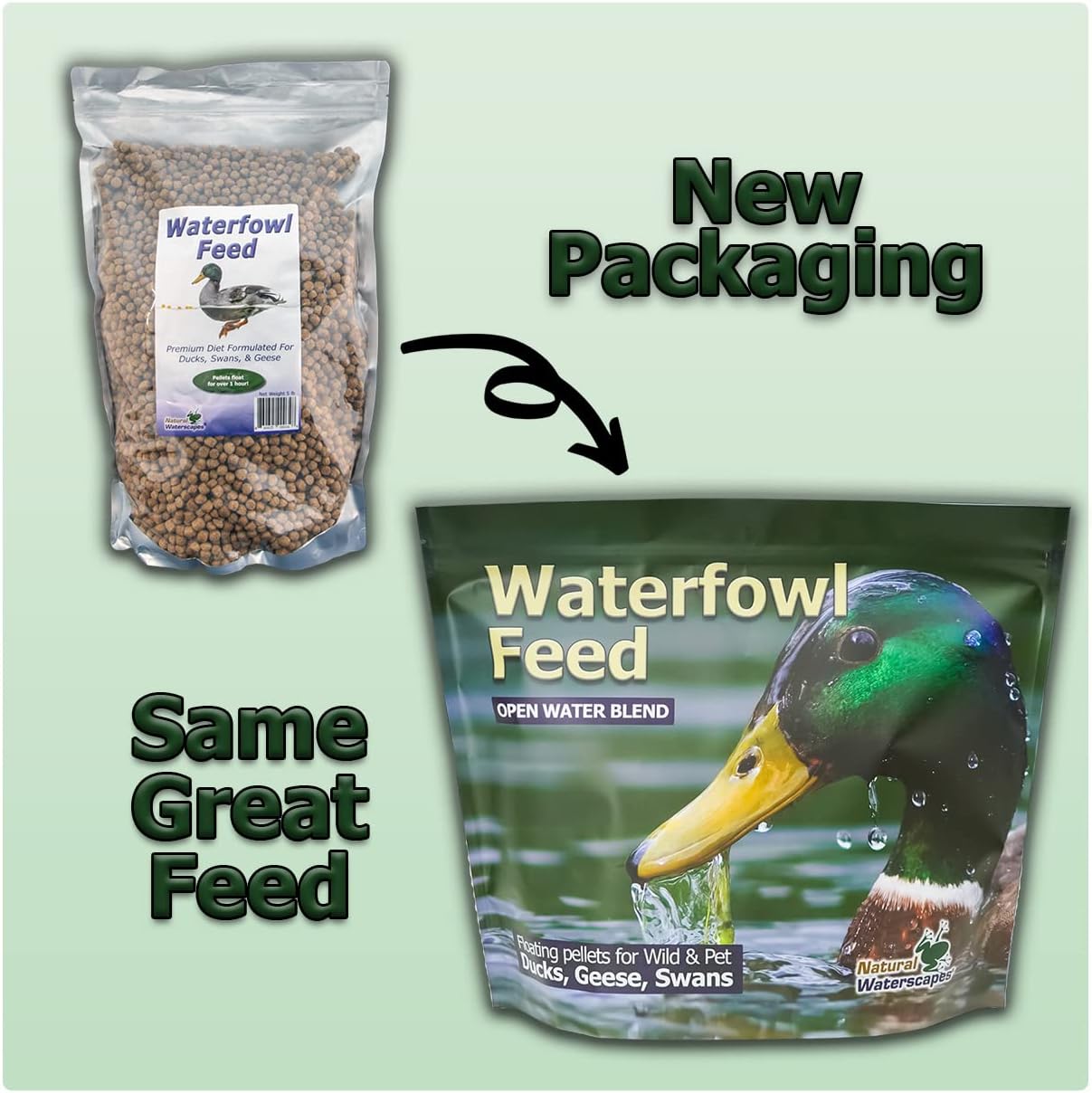
Natural Waterscapes Waterfowl Floating Food Pellets are the product most consistently praised by this exact user group. The floating formula is purpose-built for open-water surface feeding, and reviewers at ponds, docks, and lakesides repeatedly single out the floating behavior as the reason they chose and stuck with this product. The pellets are formulated for waterfowl broadly — not just domestic ducks — which makes them appropriate for the mixed-species populations common at park ponds (mallards, Canada geese, domestic hybrid ducks, occasional swans).
Manna Pro All Flock Crumbles come up frequently in reviews involving rescued or found ducklings, and the formulation covers the broad nutritional bases a young waterfowl needs better than any bread-based diet. One recurring practical note from non-expert owners: moistening the crumbles before feeding dramatically improves intake in young ducklings. This is a genuinely useful tip — dry crumbles can be difficult for very small ducklings to swallow, and adding a small amount of water creates a texture they handle more readily. It is also safer in a feeding context where you cannot supervise closely.
Garden Delight reviews frequently mention park settings — Ventura, CA is cited by name in multiple reviews — and the product draws a notably casual audience using it for spontaneous outdoor feeding rather than flock management.
If you are a committed park feeder who goes regularly, Natural Waterscapes is the clearest recommendation based on aggregate reviewer patterns and the product’s explicit floating design. If you are an occasional feeder or someone who wants a single bag to keep in the car for opportunistic use, Manna Pro All Flock Crumbles are widely available, affordable, and nutritionally far superior to bread — just be aware that open-water surface retention is variable.
Decision Framework: If X, Then Y
| Your situation | Best choice |
|---|---|
| You visit the same park pond regularly and want a dedicated floating feed | Natural Waterscapes Waterfowl Floating Food Pellets |
| You want one bag in the car for occasional spontaneous feeding | Manna Pro All Flock Crumbles (small container, resealable) |
| You found a duckling and need an immediate starter feed | Manna Pro Duck Starter Crumble, moistened with water |
| You’re feeding a mixed pond (ducks + geese + swans) | Natural Waterscapes or any floating waterfowl-specific pellet |
| Budget is tight and you want the most accessible option | Cracked corn + dried peas (scratch-style) — imperfect but far better than bread |
Frequently Asked Questions
What is the best floating food to scatter on a pond or lake for wild ducks?
Floating waterfowl pellets — specifically products formulated to remain buoyant at the surface — are the practical answer for open-water feeding. Natural Waterscapes Waterfowl Floating Food Pellets are consistently recommended by park pond feeders in aggregated reviews for exactly this use case. Avoid generic chicken feed, which is not nutritionally calibrated for waterfowl and often sinks.
Why is bread bad for ducks — what specifically does it do to them?
Bread is high in refined carbohydrates and very low in the protein, niacin, and micronutrients waterfowl need. In ducklings, chronic niacin deficiency combined with high carbohydrate intake contributes to angel wing — a permanent, irreversible wing deformity that prevents flight. In adult birds, bread displaces natural foraging and contributes to poor feather condition and weakened immune function. At the pond level, bread waste accelerates algae blooms and degrades water quality, per Penn State Extension’s waterfowl feeding guidance.
Can I feed Manna Pro All Flock Crumbles to wild ducks and ducklings I find at a park?
Yes, and it’s a meaningful upgrade from bread. Manna Pro All Flock is formulated to support multiple poultry and waterfowl species and covers protein and vitamin needs that bread does not. It is not a perfect waterfowl-specific diet, but it is nutritionally appropriate for short-term supplemental feeding. For ducklings specifically, moisten the crumbles before offering them.
Should I moisten or wet the crumbles before feeding baby ducklings?
Yes — this is a practical tip that comes directly from owner experience with young birds. Dry crumbles can be difficult for very small ducklings to swallow and process. Adding a small amount of water until the crumbles reach an oatmeal-like consistency makes them significantly easier to eat and reduces the risk of choking. This applies whether you’re feeding a found duckling or ducklings at a park pond.
Is it legal and ethical to feed wild ducks and swans at a public pond?
This varies by location. Many municipalities and state wildlife agencies have ordinances restricting or prohibiting feeding of waterfowl at public parks, primarily because of the habitat degradation and habituation risks caused by bread-based feeding. The Wildlife Society’s position statement acknowledges that nutritionally appropriate supplemental feeding, done in moderation, carries far lower ecological risk than bread feeding — but local regulations still apply regardless of what you feed. Check your park’s posted signage or your local wildlife agency’s website before establishing a regular feeding routine.
What should I keep in my car or bag for spontaneous healthy duck feeding on a walk?
A small resealable container or zip bag with Manna Pro All Flock Crumbles or Natural Waterscapes floating pellets is the simplest solution. Both products store well at room temperature, don’t require refrigeration, and are available in sizes small enough to keep in a glove compartment or daypack. Dried peas (plain, no salt) and cracked corn are also widely accepted alternatives in a pinch — not nutritionally complete, but far better than bread and readily available at grocery stores.
The Bigger Picture: You’re Not Just Feeding Ducks
There’s a reason park duck feeding is so persistent: it’s a genuinely connective experience, especially for children. The goal isn’t to eliminate it — it’s to do it better. Switching from a loaf of bread to a bag of floating waterfowl pellets doesn’t change the ritual; it changes the outcome for the birds. The ducks still come. The kids still love it. And the mallard pair that winters at your local retention pond has a better chance of staying healthy through the season.
Per the ATTRA/NCAT overview of small-scale waterfowl feed formulation, even modest improvements in diet quality — reducing empty carbohydrates, introducing species-appropriate protein and niacin levels — produce measurable improvements in waterfowl condition. You don’t need a flock and a feed program to act on that. You just need a better bag in the car.