If you’ve ever watched a newly hatched duckling sprint toward a feed dish and then stop dead — sniffing a dry crumble like it personally offended her — you already know that ducks are not chickens. They’re noisier, wetter, messier, and considerably more opinionated about texture. Feeding ducks well across their life cycle means understanding three distinct nutritional phases (starter, grower, and layer), knowing when and how to transition between them, and picking up a few waterfowl-specific tricks that feed labels almost never mention. This guide walks every stage, names the tradeoffs between specific products on the market right now, and ends with a clear decision framework so you know exactly what to buy next.
Why Duck Nutrition Is Different From Chicken Nutrition (And Why It Matters)
The single biggest biological difference between ducks and chickens — from a feed-formulation standpoint — is niacin. Niacin is a B vitamin (vitamin B3) that ducklings need in significantly higher concentrations than chicks to develop healthy legs and bones. The Merck Veterinary Manual’s poultry nutrition chapter puts the duckling requirement at roughly 55 mg/kg of feed, compared to around 27 mg/kg for broiler chicks. Feed a duckling a chick starter — even a high-quality one — without supplementing niacin, and you risk a condition called niacin deficiency, which shows up as bowed legs, joint swelling, and difficulty walking.
Penn State Extension’s “Feeding Ducks and Geese” fact sheet reinforces this, specifically warning against raising ducklings on chick starter as a primary diet without either choosing a waterfowl-specific formula or adding supplemental niacin (commonly done by dissolving brewer’s yeast into water or sprinkling it over moistened feed at roughly 1 tablespoon per gallon of water).
The second key difference is calcium timing. Laying hens — and laying ducks — need elevated calcium to produce shells. But too much calcium before the reproductive system matures damages kidneys, particularly in ducks, which are already prone to renal stress. This makes the transition from grower to layer feed genuinely consequential, not just a marketing category.
By the numbers:
- Duckling niacin requirement: ~55 mg/kg feed (Merck Veterinary Manual)
- Laying duck calcium requirement: 2.75–3.0% of diet
- Pre-lay grower calcium ceiling: no more than ~1.0%
- Typical layer pellet calcium: 3.5–4.5%
The Three Feed Phases — and What to Actually Buy at Each One
Phase 1: Starter Feed (Hatch to Week 2–3)
Ducklings need high protein — typically 18–22% crude protein — in the first weeks of life to support rapid muscle and feather development. The crumble texture matters enormously here: tiny beaks physically cannot manage a full-sized pellet, and many ducklings will skip a feed entirely rather than struggle with it.
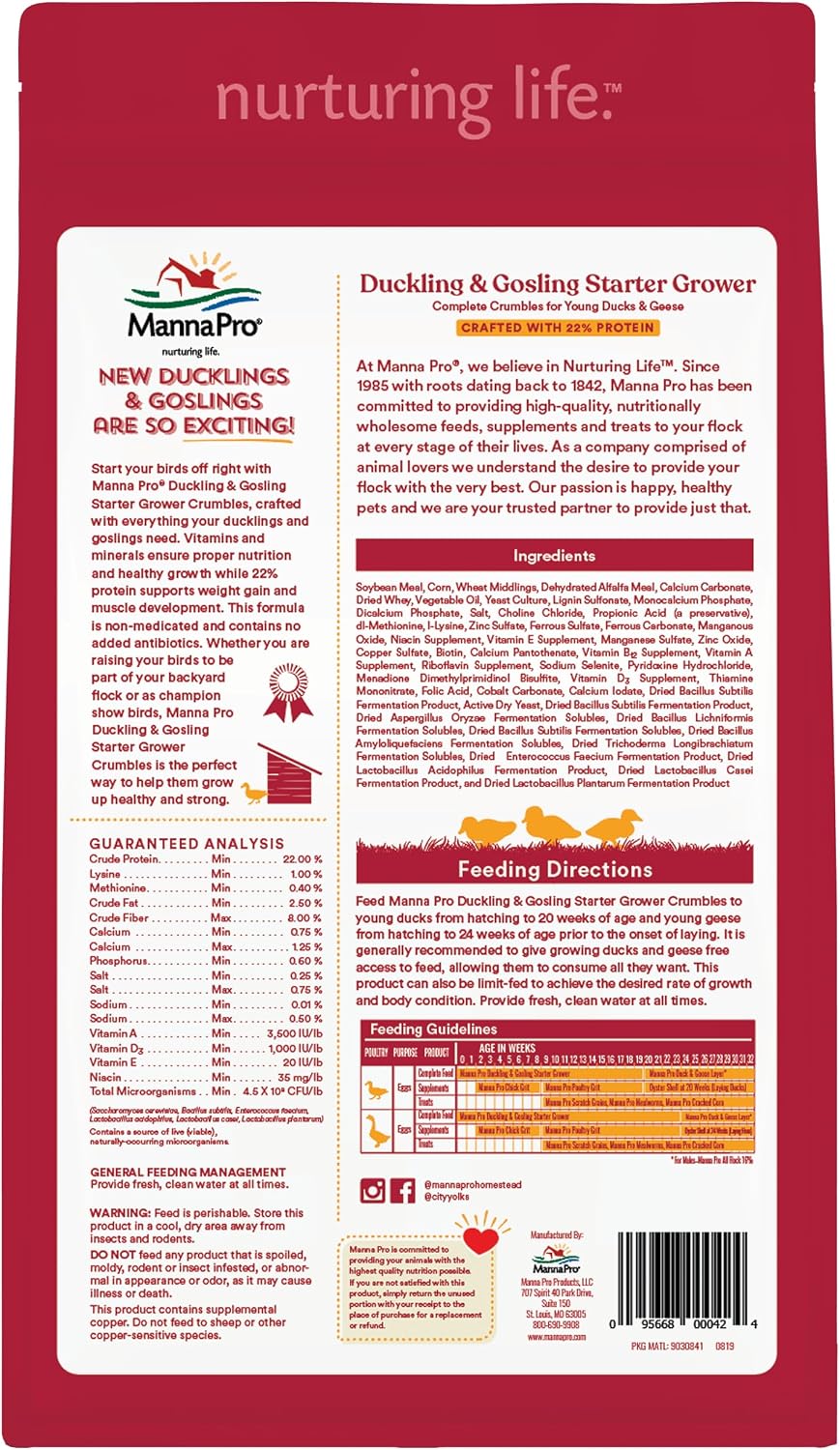
Manna Pro Duck Starter earns consistent praise in owner reviews specifically for crumble size. Multiple reviewers confirm the particle size is genuinely appropriate for newly hatched ducklings, and one detailed owner review notes it works equally well for goslings — a useful data point for anyone running a mixed waterfowl brooder with both species. If you’re starting Pekins, Khaki Campbells, and Toulouse goslings in the same brooder, a confirmed-compatible formula removes one variable from an already complex setup.
The wet-feeding discovery: This is the technique that feed labels almost never mention, but experienced waterfowl keepers treat as standard practice. Several owner accounts describe ducklings that refused dry crumble entirely but ate eagerly once the feed was moistened with a small amount of water into a soft, loose mash. One self-described non-expert duck owner’s review notes their duck “absolutely loved” the crumble once moistened after rejecting the dry version outright. The science behind this is straightforward: ducks evolved to eat aquatic vegetation and soft foods, and their bills are designed to scoop and filter rather than crack. Dry, dusty crumble can stick in the bill and nasal passages. A mash — not soupy, just damp — is more natural and safer.
Wet feeding is safe as long as you do two things: make only what the ducklings will eat in 20–30 minutes (wet feed goes moldy fast, especially in a warm brooder), and clean the dish between every feeding. This is non-negotiable.
Phase 2: Grower Feed (Weeks 3–4 Through Week 18–20)
Once ducklings are past the most rapid early growth phase, protein requirements drop slightly (16–18% is the target range) and the priority shifts to controlled, even development. This is the phase where you want to avoid the high-calcium layer formulas most aggressively.
Purina’s all-life-stages duck feed appears frequently in owner reviews for this middle phase. One notable owner observation: the feed sinks when placed in water, meaning surface-fed pond situations won’t work cleanly — but reviewers consistently note that ducks “are eager to come out of the water to eat,” which means the sinking characteristic is a practical non-issue for most backyard setups where feed is placed on land or in a dish. For pond-edge or river feeding situations, however, this matters.
Natural Waterscapes Waterfowl Feed earns specific reviewer praise for floating, making it the clearest recommendation for true pond-surface feeding scenarios. If your setup involves scattering feed at a pond edge where some portion will inevitably hit the water, a floating formula prevents the waste (and potential water-quality issues) of sinking pellets accumulating on the bottom.
For homesteaders sourcing through organic channels, ATTRA/NCAT’s organic poultry production publication notes that certified organic grower formulas are available through regional mills, and that sourcing regionally milled organic feeds often closes much of the price gap versus national brands when bought in quantity. Modesto Milling offers a certified organic waterfowl option worth pricing against conventional alternatives if organic certification matters to your operation.
Phase 3: Layer Feed (Week 18–20 Onward, Pre-Lay Transition)
The transition to layer feed should be triggered by biology, not calendar — specifically, by the appearance of the first egg or, in breeds you know well, by the physical signs of approaching lay: squatting behavior, pelvic bone widening, and a brightening of the vent. For most domestic duck breeds, this falls somewhere between 18 and 24 weeks. Heavy breeds like Pekins often lay later than lightweight egg breeds like Khaki Campbells.
Layer feed for ducks should target 15–17% crude protein and 2.75–3.0% calcium minimum. The higher-calcium formulas designed for heavy-production chicken layers (often 4%+ calcium) are not ideal long-term for ducks — they can technically work short-term, but duck-specific or waterfowl-specific layer pellets are a cleaner fit.
The if/then decision rule for this phase:
- If you’re running a mixed flock of ducks and chickens: an all-flock feed in the 16–18% protein range is a workable compromise, with oyster shell offered free-choice on the side for laying hens and ducks that need extra calcium.
- If your flock is ducks only: a waterfowl-specific layer or a 17% layer pellet with supplemental oyster shell gives you better species-appropriate targeting.
- If organic certification matters: price out regional mill options quarterly — as of mid-2026, the premium over conventional for certified organic waterfowl layer is typically $12–$22 per 50 lb bag depending on region and channel.
Mixed-Flock Feeding: When All-Flock Formulas Make Sense
One Manna Pro All Flock reviewer describes buying it specifically for a wild Muscovy duck and her ducklings living in a retention pond — a use case that surfaces a genuinely important question: does an all-flock feed adequately meet the needs of a brooding or lactating (in this case, actively mothering) duck?
The honest answer is: it depends on the formula, and you should read the guaranteed analysis. The Poultry Site’s duck nutrition overview notes that brooding ducks have elevated energy and protein demands similar to laying birds, and all-flock feeds vary considerably in how well they bridge waterfowl-specific niacin and protein requirements. A 16–18% all-flock pellet with confirmed niacin levels above 40 mg/kg is a reasonable choice for a mixed-species setup. A lower-protein all-flock feed designed primarily around chicken maintenance is a less confident choice.
The practical solution for true mixed flocks: use the all-flock feed as your base, keep niacin-rich brewer’s yeast available, and offer oyster shell free-choice so each species self-regulates calcium.
Frequently Asked Questions
Can I feed chicken layer pellets to my laying ducks, or do I need a duck-specific formula? Chicken layer pellets will work in a pinch, but they’re not optimally formulated for ducks. The calcium levels in heavy-production chicken layer feeds (sometimes 4–4.5%) run higher than the duck ideal, and niacin levels are often below what ducks need. For short-term gaps, chicken layer is acceptable. For a permanent laying-duck diet, a waterfowl-specific layer pellet or a 17% layer with supplemental brewer’s yeast and free-choice oyster shell is the better long-term choice.
Why does my duckling refuse to eat dry crumble, and is wet feeding safe? This is extremely common and almost never mentioned on feed labels. Ducks’ bills are built for moist, pliable food — dry crumble can stick and cause discomfort. Wetting feed to a loose mash consistency typically resolves refusal immediately. Wet feeding is safe as long as you prepare only what will be eaten in 20–30 minutes and clean the dish between feedings. Wet feed left out in a warm brooder grows mold and bacteria rapidly.
At what age do I transition a duckling from starter-grower to layer feed? Age is a rough guide; biology is the real trigger. Most domestic duck breeds approach laying between 18 and 24 weeks. Watch for physical signs — squatting, pelvic bone widening — or the first egg itself. Begin transitioning from grower to layer feed over 7–10 days once those signals appear, mixing increasing proportions of layer feed into the grower ration to avoid digestive disruption.
Do ducks need supplemental niacin even on a duck-specific feed? A properly formulated duck starter or waterfowl feed should meet niacin requirements on its own — check the guaranteed analysis for niacin levels at or above 55 mg/kg. Where supplementation becomes important: when feeding chick starter instead of waterfowl starter, when using an all-flock feed with lower niacin content, or when a duckling is already showing leg weakness. Per the Merck Veterinary Manual’s poultry nutrition guidance, brewer’s yeast is the most practical supplemental niacin source for backyard keepers.
Can I use the same all-flock feed for ducks, chickens, and geese together? Yes, with caveats. An all-flock feed in the 16–18% protein range can serve as a shared base. Offer oyster shell free-choice separately (laying hens and ducks will take what they need; non-laying birds typically won’t over-consume). Supplement niacin if your all-flock formula doesn’t explicitly address waterfowl requirements. USDA National Agricultural Library poultry feed composition tables confirm that niacin needs vary significantly by species — don’t assume a feed formulated primarily for chickens covers waterfowl adequately.
What should I feed wild ducks at a pond instead of bread? The “better than bread” framing has broad consensus in waterfowl nutrition circles, and for good reason: bread is calorie-dense with minimal nutritional value and contributes to a condition called “angel wing” in growing birds (a wing deformity linked to high-carbohydrate, low-protein diets). Cracked corn, defrosted frozen peas cut in half, leafy greens torn into small pieces, and floating waterfowl pellets are all meaningfully better options. Natural Waterscapes Waterfowl Feed’s floating characteristic makes it a practical choice for pond-edge feeding where some feed will contact the water surface.
The Clear Decision Framework
If you’re standing at a feed decision right now, here’s how to orient:
- Ducklings, 0–3 weeks, any setup: Waterfowl-specific starter crumble, wet-fed. Manna Pro Duck Starter’s crumble size is specifically confirmed by owner reviews to work for newly hatched birds, including goslings in mixed brooders. Supplement with brewer’s yeast if using chick starter as a fallback.
- Ducklings, 3 weeks through pre-lay: Drop to 16–18% protein grower. If feeding near a pond surface, choose a floating formula. If feeding on land or in a dish, format matters less than protein and niacin content.
- Laying ducks, ducks-only flock: Waterfowl-specific layer pellet at 15–17% protein, 2.75–3% calcium, with free-choice oyster shell.
- Mixed flock (ducks + chickens ± geese): 16–18% all-flock pellet, free-choice oyster shell, brewer’s yeast available.
- Organic certification required: Price regional mills quarterly. As of mid-2026, the premium is real but closeable in bulk — ATTRA/NCAT’s organic poultry guidance is a useful starting reference for finding certified regional sources.
Ducks reward keepers who pay attention to the details that feed labels skip. Wet feeding, niacin, and calcium timing are three places where a small amount of knowledge makes a measurable difference in flock health. The rest is just watching your birds — which, let’s be honest, is most of the point anyway.