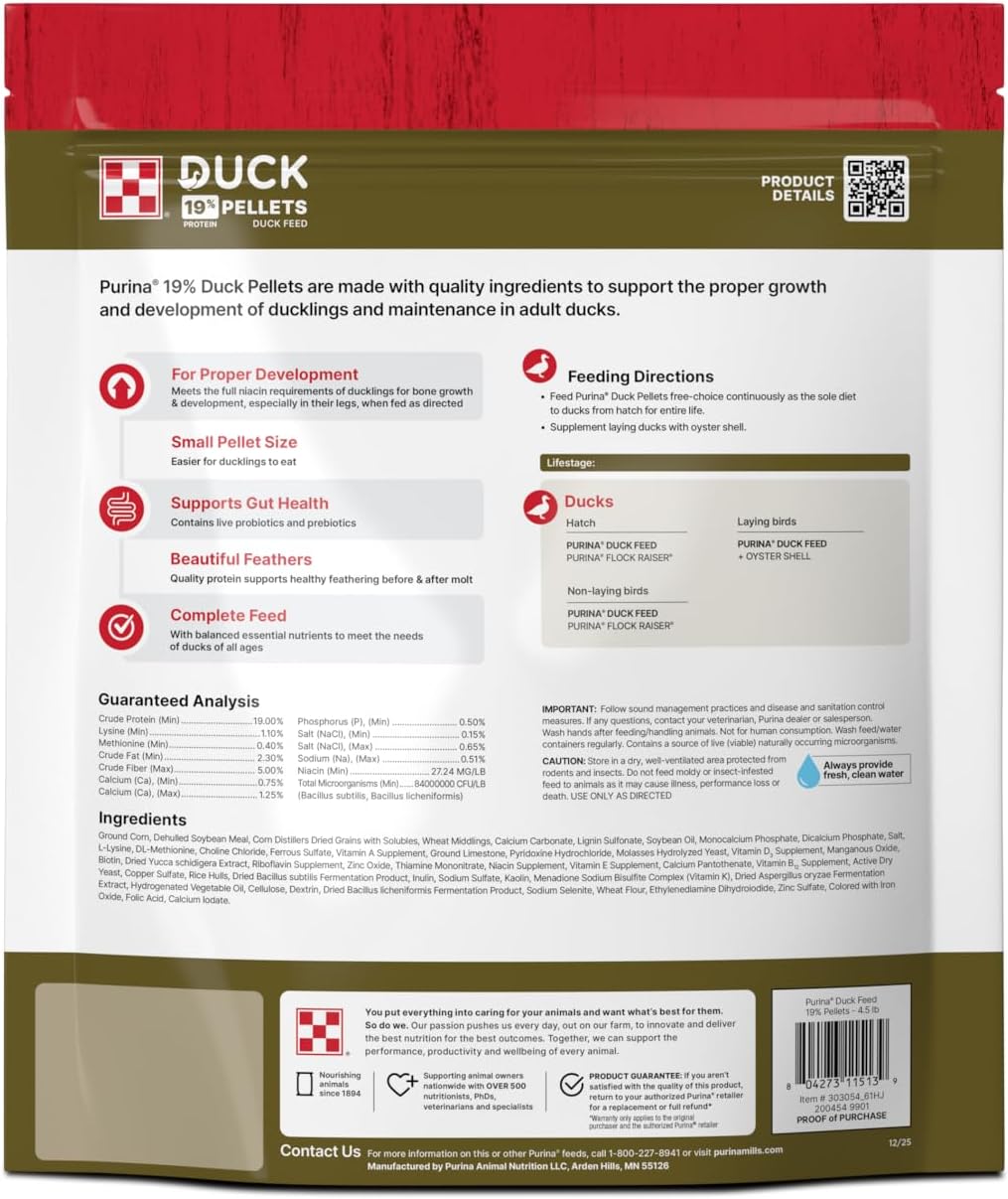
If you’ve recently added ducks to a backyard that previously held only chickens, you’ve probably already noticed that ducks are wetter, messier, and louder than their coopmates. What you may not have noticed yet is that ducks are also nutritionally different — in ways that matter a lot for long-term health. The biggest mistake new duck keepers make is reaching for the same layer pellets (feed formulated to support egg-laying hens, balanced for chicken biology) they’ve been buying all along. That shortcut has real consequences: niacin deficiency, leg problems, and stunted growth in young birds. This guide walks through exactly what ducks need, why standard chicken feed misses the mark, what to look for on a feed label, and which products are worth comparing. By the end, you’ll have a clear decision framework — not just a list of products.
Why Chicken Layer Feed Is the Wrong Starting Point
Let’s be direct: chicken layer feed is not duck feed. The two species share enough overlap that ducks can survive on it, but “survive” is not the goal.
The core issue is niacin — also called Vitamin B3 — a water-soluble vitamin that ducks require at roughly two to three times the concentration that chickens do. Per the NAL USDA publication Nutrient Requirements of Poultry, ducks need approximately 55 mg of niacin per kilogram of diet during growth, compared to roughly 27 mg/kg for broiler chickens at the same life stage. Most commercial chicken feeds are formulated to chicken minimums. Ducks eating that feed are chronically underdosed.
Niacin deficiency in ducks shows up as a clinical syndrome called bowing legs or perosis-adjacent leg weakness — the bones and joints in young ducklings bow outward, making walking painful and eventually impossible. The Merck Veterinary Manual’s section on Nutritional Diseases of Poultry identifies niacin deficiency as one of the most common preventable causes of leg deformity in domestic waterfowl. In adult ducks it presents more subtly — reduced egg production, poor feathering, general unthriftiness — which is exactly why owners on chicken feed sometimes don’t connect the dots until real damage is done.
Beyond niacin, there’s a second misalignment: calcium content. Layer feeds for hens are intentionally high in calcium (typically 3.5–4.5%) to support heavy eggshell production. Laying ducks do need calcium, but at different concentrations and — critically — at different life stages. Feeding high-calcium layer rations to growing ducklings burdens their kidneys and can impair skeletal development. Penn State Extension’s Raising Ducks resource specifically flags this as a reason to stage feed appropriately rather than using an all-purpose chicken layer ration across life stages.
The Niacin Math: What You’re Actually Looking For
Reading a waterfowl or duck feed label for niacin takes a little translation. Here’s the practical cheat sheet:
By the numbers:
- Duckling starter target: ≥ 55 mg niacin/kg of feed (minimum; aim higher if sourcing a non-dedicated formula)
- Growing/finishing duck target: ≥ 40–50 mg niacin/kg
- Chicken layer baseline (for comparison): typically 27–35 mg niacin/kg
- Supplemental niacin (brewer’s yeast, unfortified): 12–16 mg niacin per tablespoon, per manufacturer labeling
If you’re working with a chicken-based feed out of necessity — say, you’re in a rural area where waterfowl-specific feed isn’t available locally — the standard workaround is brewer’s yeast supplementation. ATTRA’s Pastured Poultry Nutrition and Forages guide notes brewer’s yeast as a practical and widely used niacin source for waterfowl on mixed-species rations. The common recommendation is 2–3 tablespoons per cup of feed, though dosing varies by the yeast product’s declared niacin content. This is a stopgap, not a long-term solution.
One important read on labels: niacin may appear as “niacin,” “niacinamide,” or “nicotinic acid” in the ingredient panel. All three are bioavailable forms. What you cannot do is assume the guaranteed analysis is telling you everything — minimum guaranteed analyses on feed bags are legally required minimums, not averages, and manufacturers routinely formulate above those floors. Call or email the mill directly if you need the actual as-formulated number.
Protein Percentages by Life Stage
Protein percentage is the other major lever in duck feed selection, and it’s where species-appropriate staging really earns its keep.
Ducklings (0–2 weeks): Need 20–22% crude protein. This is a higher starting point than most chicken starter feeds, which typically open at 18–20%. The higher protein demand reflects rapid early growth — Pekins, for instance, can reach market weight in 7–8 weeks, an extraordinary growth rate that requires commensurate amino acid availability.
Growing ducks (3–8 weeks): Protein can step down to 16–18%. This is where a well-formulated waterfowl grower pellet earns its place. Pushing high-protein rations past the growth window creates excess nitrogen load without production benefit.
Laying ducks: Target 15–17% crude protein with appropriate calcium (2.75–3.5% is a reasonable waterfowl-appropriate range, lower than the 3.5%+ found in most chicken layer feeds). The Poultry Site’s duck nutrition guidance consistently emphasizes that calcium over-supplementation is as much a concern as deficiency in laying waterfowl.
Comparison shortcut: If you’re holding a bag of chicken layer pellets at 16% protein and 4% calcium, you’re in the right protein window but the wrong calcium window for laying ducks — and you’re almost certainly in a niacin deficit regardless of life stage.
Reading Feed Labels for Waterfowl: What Actually Matters
Once you understand the niacin and protein targets, label reading gets faster. Here’s the decision sequence:
1. Is it formulated for waterfowl or poultry (all-purpose)? A feed labeled specifically for ducks or waterfowl has been formulated to waterfowl niacin requirements. An “all-purpose poultry” label is a red flag — it’s almost certainly built to chicken minimums. “Gamebird” formulas are variable; some run niacin high enough for ducks (they’re often also designed for turkeys, which have elevated niacin needs), and some don’t. Check the guaranteed analysis and call the mill.
2. What’s the niacin level in the guaranteed analysis? Many bags include niacin in the vitamin section of the guaranteed analysis. If it’s not listed, it’s often still present in the formulation — but you’re flying blind. Mills that serve waterfowl keepers seriously will provide a full nutrient sheet on request. Mazuri, for instance, publishes detailed nutrient profiles for its waterfowl and gamebird lines that go well beyond the bag panel.
3. Pellet vs. crumble vs. mash — does it matter for ducks? Yes, mechanically. Ducks are bill feeders, not beak pickers. They scoop and sift rather than crack and swallow. Crumbles and small pellets work well; large pellets can cause gulping and choking without adequate water access. Mash tends to compact and foul in the bill-dipping waterfowl environment. Most experienced duck keepers land on a small-diameter pellet (⅛” or 3mm) with constant water access nearby. Several duck-specific feeds are offered in this format precisely because of waterfowl feeding mechanics.
4. Is there a medicated version, and should you avoid it? Medicated chick starter — which contains amprolium, a coccidiostat (a drug that prevents a parasitic intestinal disease called coccidiosis) — is sometimes the only starter available locally. Ducks are not susceptible to coccidiosis the way chickens are, so the medication provides no benefit. Worse, ducks eat more volume than same-age chicks to meet their niacin and protein needs, and consuming elevated amprolium levels through that higher intake has been associated with thiamine interference. Use unmedicated feed for ducks whenever possible.
Products Worth Comparing (and What to Expect to Pay)
The dedicated waterfowl feed market is thinner than the chicken feed market, but it’s not empty. Here’s a working comparison frame as of mid-2026:
Mazuri Waterfowl Maintenance Diet sits at the premium end of the accessible market — typically $30–$45 for a 25 lb bag depending on channel and region. It’s formulated specifically for waterfowl with declared niacin levels appropriate for the species. Owners keeping ornamental ducks and show breeds consistently cite it as a reliable year-round maintenance option. It is not a starter/grower formula; Mazuri also offers a Waterfowl Starter for young birds.
Purina Flock Raiser (20% protein, unmedicated, all-flock formula) is the most commonly recommended bridge product for duck keepers who can’t source a waterfowl-specific feed locally. It runs approximately $22–$28 for a 50 lb bag at Tractor Supply. It is not a dedicated duck formula — niacin levels are formulated to a general poultry standard — but it avoids the calcium over-supplementation problem of layer feed and lands in the right protein window. Supplemental brewer’s yeast is advised if this is your primary ration.
Kalmbach Feeds All Flock is a regional brand with strong distribution in the Midwest and Mid-Atlantic; pricing tends to run slightly below Purina at similar bag weights. The same bridge-formula caveat applies: it’s not waterfowl-optimized, but it’s a better starting point than any dedicated layer feed.
Scratch and Peck Feeds Organic Layer Feed is sometimes asked about in duck contexts because of its clean ingredient profile and organic certification. Owners of organic-certified operations will find it attractive on sourcing grounds, but the name itself signals its limitation: it’s a layer formula, built for hens, and carries the calcium and niacin gaps described above. For organic duck operations, Scratch and Peck’s Organic Grower Mash is a closer fit during the grow-out phase, and the company publishes nutrient data that makes verification possible.
The Decision Framework
If you’ve read this far, here’s the clean “if X, then Y” you came for:
If you’re raising ducklings from hatch: Source a dedicated waterfowl starter (Mazuri Waterfowl Starter is the clearest benchmark) or an unmedicated 20%+ protein all-flock crumble with brewer’s yeast added at 2–3 tbsp per cup. Do not use medicated chick starter. Do not use layer feed.
If you’re feeding growing ducks (3–8 weeks): Step down to a 16–18% protein grower or all-flock pellet. Supplement niacin if the formula isn’t waterfowl-specific. At this stage, cost-per-pound matters more — this is where a 50 lb bag of Flock Raiser at $22–$28 makes financial sense for most operations.
If you’re feeding laying ducks: Find a waterfowl layer formula or use an all-flock feed at 15–17% protein with supplemental calcium offered separately (crushed oyster shell in a side dish) rather than baked into the feed. This gives laying females access to calcium on demand without forcing it on males or non-layers in a mixed flock.
If you’re running a mixed chicken-and-duck flock: The least-bad single formula is an unmedicated all-flock feed at 16–18% protein, with oyster shell on the side for laying hens and brewer’s yeast supplementation for ducks. It’s a compromise — neither species is getting a fully optimized ration — but it’s nutritionally defensible in a way that chicken layer feed simply isn’t.
The bottom line: duck feed is not a niche concern or an upsell. It’s the difference between a thriving flock and a vet bill for preventable leg deformities. The labels tell you what you need to know — once you know what to look for.