If you’ve ever stood in the treat aisle at a farm store holding one bag labeled black soldier fly larvae (BSFL) and another labeled dried mealworms, wondering whether they’re basically the same product, you’re not alone. Both are dried insects. Both look like protein-dense snacks your hens will absolutely lose their minds over. But under the feed label — the small-print section that lists the guaranteed analysis, meaning the minimum percentages of protein, fat, fiber, and moisture the manufacturer promises — these two insects are telling very different stories. Protein is only half the question. Calcium, the mineral laying hens need in serious quantities to build strong eggshells, is where the comparison gets genuinely interesting. This article walks through the numbers on both supplements, explains the tradeoffs, and gives you a clear decision framework so you can choose the right one — or the right combination — for your flock’s actual needs.
| EDITOR'S PICKHatortempt Bulk Dried Mealworms… | Mid-tierScratch and Peck Feeds | Grubs… | Budget pickEaton Pet and Pasture Premium G… | |
|---|---|---|---|
| Weight | 5 lb | 3.5 lb | 1 lb |
| Insect type | Mealworms | BSFL | BSFL |
| Grown in USA | — | ✓ | ✓ |
| High protein | ✓ | — | — |
| High calcium | — | ✓ | ✓ |
| Price | $39.99 | $34.99 | $17.99 |
| See on Amazon → | See on Amazon → | See on Amazon → |
The Nutritional Profiles: What the Labels Actually Say
Before interpreting the numbers, it helps to put them side by side. The ranges below reflect typical guaranteed analysis figures printed on commercially available dried insect supplements, expressed on a dry matter basis.
Dried black soldier fly larvae — typical guaranteed analysis:
- Crude protein: 37–42%
- Crude fat: 26–35%
- Calcium: 5–8%
- Phosphorus: 0.6–0.9%
Dried mealworms (Tenebrio molitor) — typical guaranteed analysis:
- Crude protein: 48–56%
- Crude fat: 28–33%
- Calcium: 0.05–0.15%
- Phosphorus: 0.5–0.7%
The protein headline favors mealworms. A bag of dried mealworms commonly prints 53% crude protein; a comparable BSFL bag might print 40%. If you stopped reading there, mealworms win. But the calcium column reverses the ranking dramatically. According to FAO — Edible Insects: Future Prospects for Food and Feed Security, published by the Food and Agriculture Organization of the United Nations, BSFL accumulate calcium in their exoskeleton at rates far exceeding most other commercially raised insects, including mealworms. The magnitude of that gap — often described in compositional literature as 40 to 50 times higher — is not a rounding difference. It is a category difference.
Why does this matter for your hens? The Merck Veterinary Manual, in its poultry nutrition chapter, notes that a laying hen producing one egg per day requires approximately 4–5 grams of calcium daily. Roughly 2 grams of that comes from skeletal reserves; the remainder must come from feed and supplements. A standard production-layer pellet is already formulated to supply dietary calcium at around 3.5–4%. But if a hen is in heavy lay during summer heat — when feed intake drops while egg production stays high — or if your base pellet has quietly shifted in formulation, a calcium-bearing supplement becomes meaningful insurance. Mealworms, at roughly 0.1% calcium, offer almost none of that. BSFL, at 6–7%, contribute meaningfully even at modest treat quantities.
The Feeding Math: How Much Are You Actually Delivering?
Both insects are treats, not base feeds. The practical ceiling for insect supplementation in a backyard flock is roughly 10% of total daily intake by dry weight — anything higher starts displacing the balanced amino acid profile in a properly formulated layer pellet. Penn State Extension, in its Feeding Backyard Chickens guidance published through the Penn State College of Agricultural Sciences, makes this point clearly: scratch grains, treats, and supplements beyond 10% of diet dilute the careful formulation of a complete feed and can push hens toward nutrient imbalances over time.
A standard 5-pound laying hen eating roughly 0.25 lb (about 110 grams) of feed per day has a 10% treat budget of about 11 grams — roughly a small palmful of dried insects.
Calcium contribution at an 11-gram daily treat dose:
| Supplement | Calcium % | Calcium delivered (mg) |
|---|---|---|
| Dried BSFL (6% Ca) | 6.0% | ~660 mg |
| Dried mealworms (0.1% Ca) | 0.1% | ~11 mg |
| Oyster shell (free-choice, ~500 mg avg daily intake) | 38% | ~190 mg |
That BSFL figure — 660 mg — is genuinely material. It represents roughly 13–16% of a laying hen’s total daily calcium requirement delivered through a single treat. Mealworms, at 11 mg, round to nutritional noise. The ATTRA National Sustainable Agriculture Information Service, in its Poultry: Production Practices and the Market guide published by NCAT, notes that calcium under-supplementation during peak lay is a far more common concern than over-supplementation, particularly for hens on pasture or in backyard settings where feed intake varies.
Comparing the Two Supplements Across Buyer Tiers
Understanding which supplement fits your situation depends on flock size, budget, and how much nutritional work you need the treat to do. The three sections below address each tier directly.
Budget-Tier Flocks: Small Backyard Keeper, Cost Is Primary
For keepers running four to eight hens and buying in 1- to 2-lb bags at Tractor Supply or similar mass-market channels, the price landscape as of mid-2026 looks like this:
- Budget dried mealworms (often imported, large-scale production): $8–$14 per pound, typically printing 50–53% crude protein and near-zero calcium.
- Entry-level dried BSFL: $11–$15 per pound for 5-lb bags from brands with established retail presence.
At this scale, the cost-per-pound difference between mealworms and BSFL is small — often $2–$4 per pound — but the nutritional return per dollar diverges sharply because of calcium. If your hens already have access to free-choice oyster shell and are consuming it reliably, budget mealworms get the job done as a protein-enrichment treat. If your shell station goes largely ignored (a common reality), BSFL delivers calcium and protein in one product your hens will actually eat.
The Merck Veterinary Manual’s poultry nutrition guidance is clear that calcium deficiency in laying hens leads to thin-shelled eggs, increased breakage, and eventually medullary bone depletion — consequences that compound quickly in heavy-lay periods. For a budget-tier keeper whose primary concern is shell quality, BSFL is the stronger value even at a slight price premium.
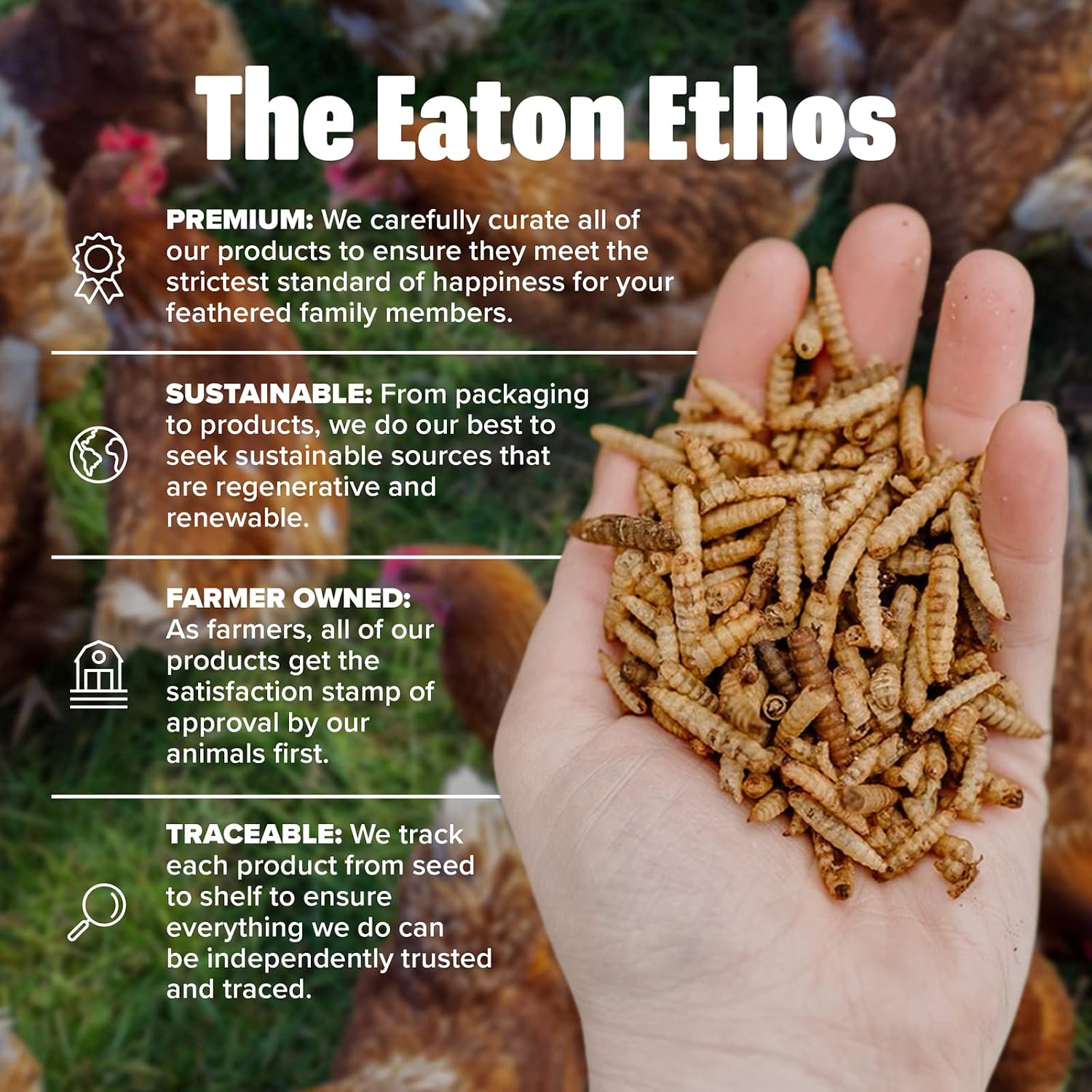
Eaton
$17.99
In stock on Amazon
Check price on AmazonMid-Tier Flocks: 10–30 Hens, Supplement Stack Optimization
At this scale, keepers are typically buying 5- to 10-lb bags on a recurring basis and thinking more systematically about supplement interactions. The questions that matter here are slightly different: Does your current layer pellet already hit 3.8–4% calcium reliably? Are you feeding a separate grit and shell station? Are you managing molt cycles deliberately?
For mid-tier flocks on a well-formulated complete layer pellet — Purina Layena, Kalmbach 17% Layer, or equivalent — with consistent free-choice oyster shell access, mealworms’ higher crude protein (48–56%) can serve a genuine purpose during molt or post-illness recovery, when protein demand spikes and calcium demand temporarily drops. The ATTRA Poultry: Production Practices and the Market guide acknowledges that protein recovery during molt is a legitimate supplementation goal distinct from year-round calcium management.
However, for mid-tier keepers who have observed soft shells, noticed their hens cycling off the oyster shell station, or are entering summer peak-lay, rotating toward BSFL as the primary treat makes nutritional sense. The calcium contribution at treat-level dosing is real and additive to whatever the base pellet provides.
A practical mid-tier strategy: keep both on hand and rotate. Use mealworms as the primary treat during molt (October–December in most Northern Hemisphere flocks) and BSFL as the primary treat from March through September when lay rates and calcium demand peak.
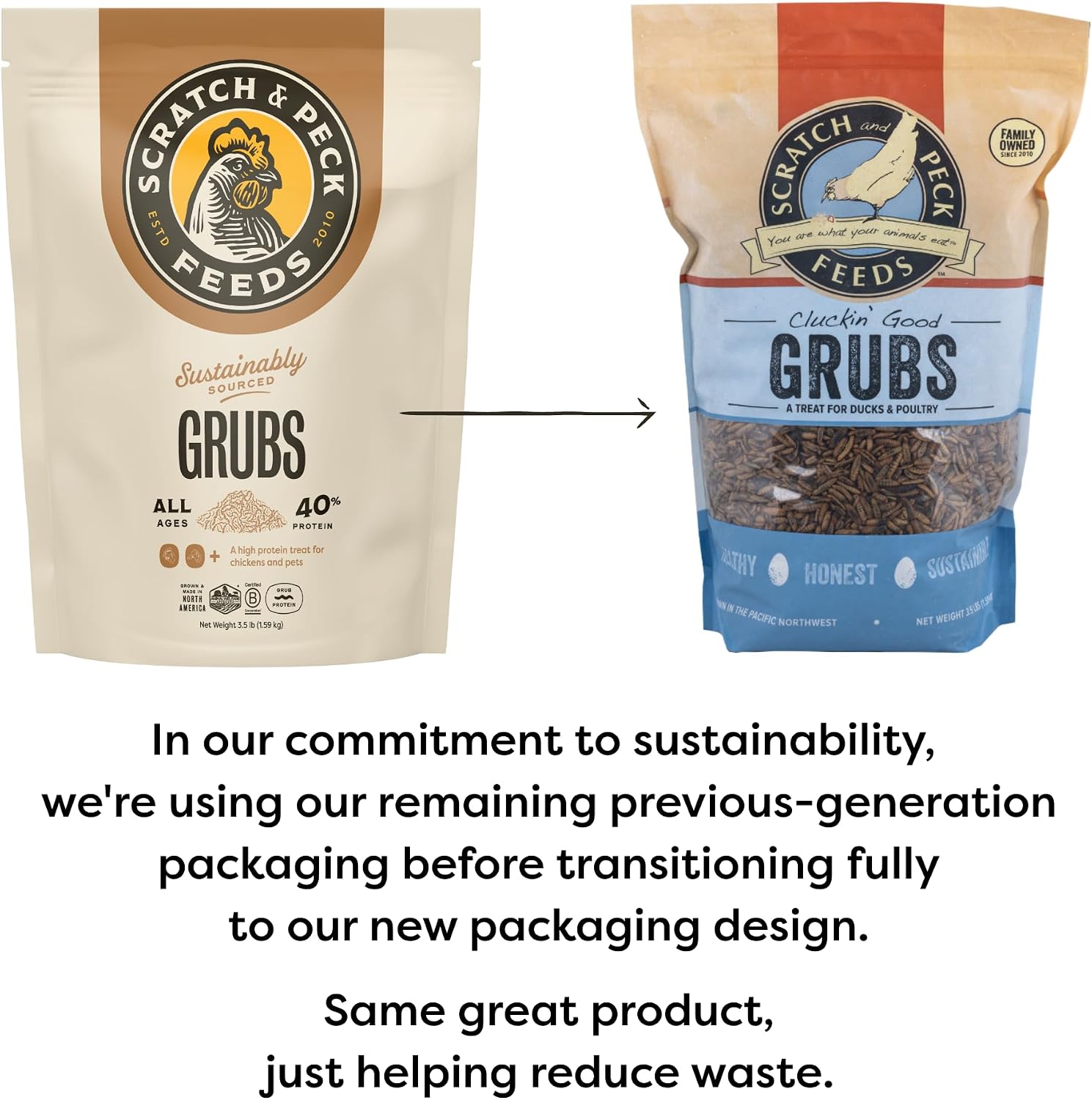
Scratch
$34.99
In stock on Amazon
Check price on AmazonPremium-Tier and Small-Farm Operations: 50+ Hens, Volume Purchasing
At small-farm scale — 50 to 200 hens, buying in 25-lb bags or arranging direct supply — the economics shift enough to warrant running the actual cost-per-gram-of-calcium calculation on your specific products before committing to a volume purchase.
The Poultry Site, in its coverage of calcium nutrition in laying hens, notes that calcium content in BSFL specifically can vary based on larval substrate — what the larvae were fed before harvesting. Operations using higher-calcium substrates produce larvae with measurably higher calcium levels; operations that shifted to lower-calcium grain-based substrates have seen calcium content drop. At premium-tier purchasing volumes, this substrate variability means you should request the current lot’s guaranteed analysis from your supplier rather than relying on the number printed during a previous production cycle.
Domestic and EU-origin BSFL operations — which have expanded capacity significantly since 2024 — typically offer better traceability documentation than imported mealworm products. For small-farm operators making purchasing decisions that affect flock performance over a full production year, that traceability has practical value beyond marketing language.
At 50+ hens, free-choice oyster shell remains the cheapest per-gram calcium source by a wide margin ($8–$12 for 5 lbs delivers far more calcium than any equivalent weight of BSFL). The case for BSFL at scale is therefore less about calcium economics and more about combined protein-and-calcium delivery in a single high-palatability treat that actually gets consumed uniformly across the flock. Mealworms at scale are a reasonable protein supplement where calcium is fully covered elsewhere; BSFL is the better choice where shell quality needs active support.
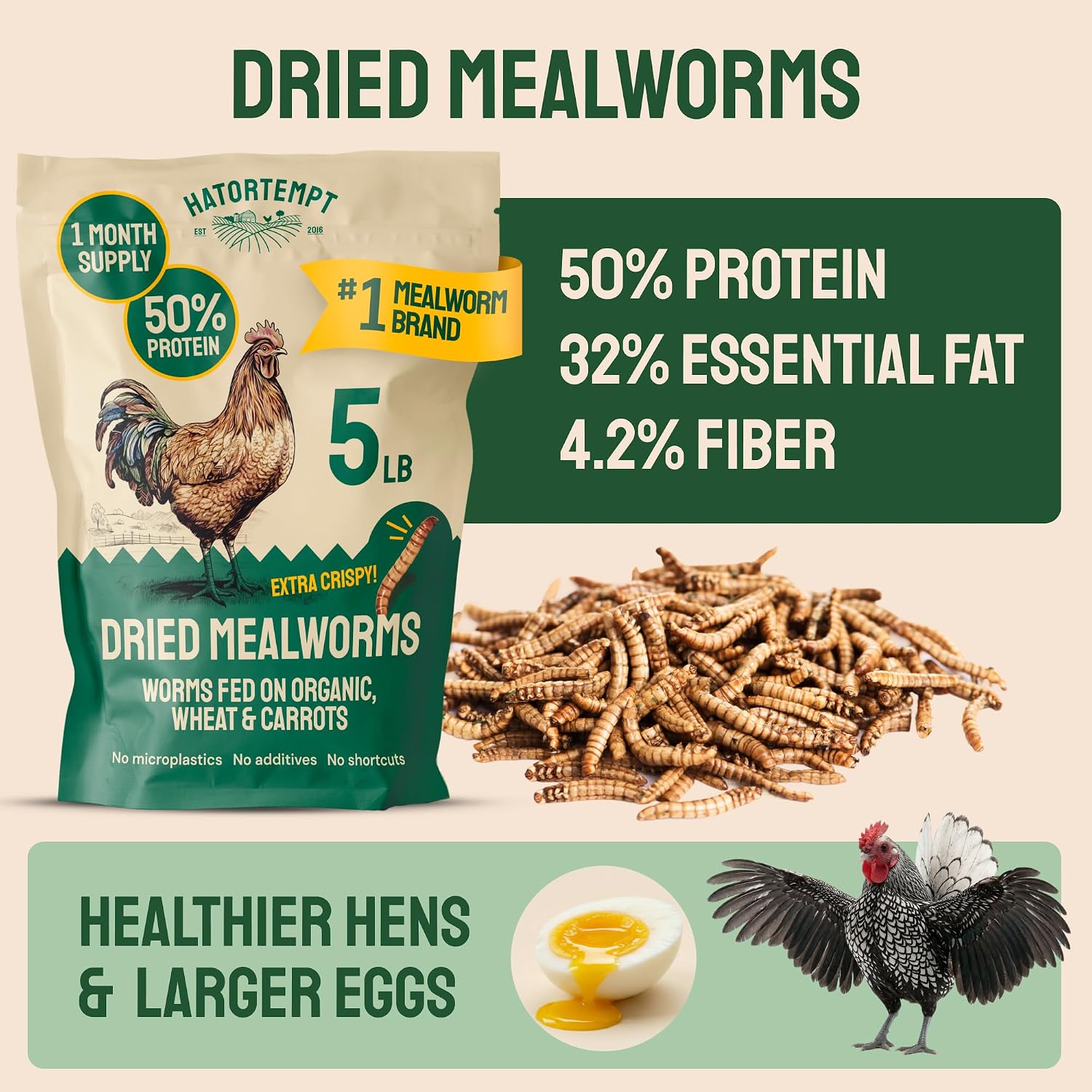
Hatortempt
$39.99
In stock on Amazon
Check price on AmazonProtein Quality: Why Crude Protein Isn’t the Whole Story
Mealworms’ higher crude protein looks like a decisive win until you examine amino acid composition. Crude protein is a calculated value based on nitrogen content — it does not directly measure how well-matched the protein is to a chicken’s requirements. The Merck Veterinary Manual’s poultry nutrition chapter identifies lysine, methionine, and threonine as the three amino acids most likely to be limiting in poultry diets.
Published compositional data reviewed in FAO — Edible Insects: Future Prospects for Food and Feed Security shows that BSFL carry a favorable methionine-to-crude-protein ratio and a well-balanced essential amino acid profile overall. Mealworms also score well on this measure. Both insects meaningfully outperform most plant protein sources in methionine availability, which is the most commonly limiting amino acid in grain-based poultry rations.
For practical purposes at treat-level dosing — that 11-gram palmful — the protein quality difference between BSFL and mealworms is unlikely to be detectable in egg production metrics for a backyard flock. Where amino acid composition matters more is if you’re considering insect meal as a partial replacement for soybean meal in a custom-milled ration, which is a conversation relevant to small-farm operators running pastured layers at scale. At that level, consulting a feed nutritionist and referencing the FAO compositional database directly is the appropriate step.
For the backyard keeper buying 1- to 5-lb bags at retail: the protein quality difference between these two insects is real but functionally small at treat quantities. The calcium difference is large and practically significant.
Decision Rule: Which Supplement Fits Your Situation
The nutritional data and feeding guidance consistently support the following framework:
If your hens are in peak lay, your base pellet runs under 3.5% calcium, or you’ve seen soft shells recently → BSFL is the higher-value supplement. The calcium contribution at treat-level dosing is meaningful. Protein is slightly lower than mealworms but still well above plant alternatives.
If you’re supplementing for protein recovery — molt, post-illness, chicks transitioning off starter — and calcium is already well-managed through reliably consumed free-choice shell → Mealworms’ higher crude protein makes them a reasonable choice, and they are often cheaper per pound at budget tiers.
If you want to simplify your supplement stack → BSFL handles both protein enrichment and calcium contribution in one product. Mealworms are effectively protein-only at practical calcium levels.
If you’re raising both layers and meat birds → The calcium distinction matters far less for meat birds, which do not face the high daily calcium demand of egg production. Mealworms’ higher protein-per-dollar is a better fit in that context.
If you’re at small-farm volume → Run the cost-per-gram-of-calcium calculation on your specific current-lot products before committing. Request the supplier’s current guaranteed analysis, because substrate-driven variability in BSFL calcium content is well-documented, as covered by The Poultry Site in its calcium nutrition reporting.
One final scenario where both insects earn a permanent place: flocks with individual variation in treat acceptance. Some birds that ignore BSFL eat mealworms enthusiastically, and vice versa. Keepers managing a larger mixed flock sometimes rotate supplements specifically to ensure all birds are actually consuming the intended nutrition — not just the dominant hens at the treat station. That is a legitimate strategy, not overcomplication.
The bottom line is straightforward: mealworms won the protein headline. Black soldier fly larvae won the nutrient-density round. For most laying flocks, BSFL is the stronger all-purpose supplement — but only if you verify the calcium number on the current label, not the bag you bought eighteen months ago.