Walk into any aquatic pet shop or farm supply aisle and you’ll find a wall of fish pellet bags making nearly identical promises: “complete nutrition,” “vibrant color,” “healthy growth.” But if you flip those bags over and actually compare the guaranteed analyses — the percentages of protein, fat, and fiber that manufacturers are legally required to print — and the ingredient panels, the differences become stark fast. A pellet is, at its core, a compressed blend of protein sources, fats, binders, and micronutrients. How those ingredients are chosen, in what proportions, and whether the pellet sinks or floats determines whether your fish thrives or just survives. This guide walks through the formulation logic behind aquarium fish pellets, explains the tradeoffs between sinking and floating styles, and gives you a clear decision framework for choosing the right bag — whether you’re stocking a 55-gallon cichlid tank, a backyard koi pond, or a tilapia aquaculture system.
| EDITOR'S PICKXtreme Cichlid Peewee 1.5 mm Pe… | Mid-tierHikari Sinking Carnivore Pellet… | Budget pickFluval Bug Bites Tropical Fish… | |
|---|---|---|---|
| Format | Pellets | Pellets | Granules |
| Target fish | Cichlids | Carnivores | Tropical |
| Sinking | — | ✓ | — |
| Protein source | — | — | Insect-based |
| Size | 1.5 mm | — | Small |
| Made in USA | ✓ | — | — |
| Price | $32.99 | $10.79 | $5.94 |
| See on Amazon → | See on Amazon → | See on Amazon → |
Why Ingredient Order Is the Most Important Line on the Label
The ingredient panel on a fish pellet bag is regulated by AAFCO (the Association of American Feed Control Officials) guidelines and must list ingredients in descending order by weight before processing. That single rule makes ingredient order your most powerful analytical tool — and it’s the one most buyers ignore.
The first ingredient is the dominant protein source. If that slot reads “fish meal,” you’re looking at a marine-protein-led formula with a robust amino acid profile suited to carnivorous and omnivorous species. If it reads “soybean meal” or “corn gluten meal,” you’re holding a plant-protein-led formula, which costs less to produce but delivers a different amino acid distribution — and that difference matters significantly for certain species.
Fish meal quality is not uniform. The USDA National Agricultural Library’s Aquaculture Information Center documents that fish meal can vary substantially in protein digestibility depending on rendering temperature and source species. “Anchovy fish meal” or “menhaden fish meal” listed by species name signals a more traceable, typically higher-grade ingredient than generic “fish meal.” The same logic applies to “salmon meal” vs. “marine protein blend” — the latter is a catch-all term that communicates almost nothing about digestibility.
Watch for protein ingredient splitting. A common formulation tactic is listing several plant proteins separately — “soybean meal, wheat gluten, pea protein concentrate” — so that no single plant ingredient occupies the first slot, even though their combined weight exceeds the fish meal. If you see three plant proteins in the first five ingredients alongside one fish meal, the effective protein matrix is plant-dominant regardless of what the front panel implies. The FAO Fisheries and Aquaculture Department, in its technical publications on aquaculture feeds and feeding strategies, specifically identifies this splitting practice as a factor that complicates consumer evaluation of fish feed quality.
Practical read: In a high-quality carnivore pellet designed for oscars, predatory catfish, or trout, you want to see a named marine or freshwater fish meal in slot one, a secondary animal protein — shrimp meal, krill meal, or squid meal — in slots two or three, and plant proteins appearing later as energy and binder sources rather than as primary protein carriers.
Floating vs. Sinking: This Is a Species Decision, Not a Quality Decision
One of the most persistent misconceptions in aquarium feeding is that floating pellets are “premium” and sinking pellets are “budget.” Neither is inherently superior. The right buoyancy type depends entirely on where your fish naturally feed in the water column.
Floating (surface) pellets are physically expanded — usually via steam extrusion, which puffs the starch matrix so the pellet is less dense than water. They suit surface-feeding species including goldfish, koi, most cichlids, large tetras, and gouramis. They also serve any setup where visual confirmation of feeding is useful; koi pond keepers in particular rely on surface feeding observation as an early health indicator.
The tradeoff is water quality: floating pellets that go uneaten dissolve and begin releasing nutrients into the water column, accelerating ammonia spikes and algae growth. In high-density systems, uneaten surface feed is a meaningful water-quality liability.
Sinking (slow-sink or fast-sink) pellets are either cold-pressed or produced at lower extrusion pressures to maintain density. They are the correct choice for bottom-feeders including corydoras, plecos, loaches, and most catfish; mid-water column species such as discus, angelfish, and large schooling fish; deep pond feeding where surface temperatures swing seasonally; and aquaculture systems where water quality control is a management priority.
The Merck Veterinary Manual’s fish nutrition section notes that bottom-dwelling species in both aquaculture and hobby settings are frequently underfed or improperly fed when surface pellets are the only option offered, because the fish’s natural foraging behavior does not bring them to the surface in competition with mid-water species. Sinking pellets delivered via a feeding ring or targeted placement correct this.
Semi-floating and slow-sinking pellets occupy a middle ground well suited to mid-water omnivores — bettas on a varied diet, medium cichlids, and rainbowfish — and are worth the price premium for community tanks with mixed feeding zones.
Buoyancy and formulation differences at a glance:
- Moisture: floating pellets typically 8–10%; sinking pellets 10–12% (affects shelf life)
- Starch and carbohydrate content: floating pellets often 15–25% (required for extrusion expansion); sinking pellets can run 8–15%
- Integrity window: a floating pellet not consumed within 10–15 minutes begins to waterlog and leach nutrients; most sinking pellets maintain structural integrity for 30–45 minutes
Protein Percentage vs. Protein Quality: The Number That Misleads
The guaranteed analysis on a fish pellet will declare a crude protein percentage — “Min. 40% Crude Protein,” for example. That number is not a complete picture. Crude protein is measured by nitrogen content using the Kjeldahl method, which reflects total nitrogen, not bioavailable amino acids.
This distinction has real practical consequences. The ATTRA National Sustainable Agriculture Information Service, in its publication Aquaponics: The Integration of Hydroponics with Aquaculture, notes that fish fed high-crude-protein diets built on poorly digestible plant proteins can show feed-conversion numbers on paper comparable to fish on a lower-crude-protein but highly digestible marine-protein diet — while achieving inferior growth and generating higher ammonia excretion, because undigested protein is excreted rather than metabolized.
The amino acids that matter most for fish:
- Lysine — growth-limiting in many plant-protein formulas; look for it listed as an added amino acid (“L-lysine”) in the ingredient panel when the protein base is plant-heavy
- Methionine — sulfur-containing amino acid critical for immune function; “DL-methionine” supplementation in the ingredient list is a positive sign in a plant-forward formula
- Arginine — essential for many carnivorous fish; marine-protein diets typically supply adequate arginine without supplementation
The USDA National Agricultural Library’s Aquaculture Information Center documents that digestibility coefficients for marine animal proteins consistently exceed those for soybean and corn-based plant proteins across the most commonly cultured finfish species. That gap is what separates crude protein percentage from effective nutritional value in practice.
Comparing Budget, Mid-Range, and Premium Pellets
Pellet quality divides broadly into three tiers. Rather than ranking specific products in isolation — context and species requirements matter too much for that — the framework below maps formulation architecture to realistic use cases. Each tier is evaluated against the label-reading principles covered above.
Budget Pellets: Entry-Level Formulations for Low-Demand Setups
Budget pellets in the roughly $8–$18 range for 1–3 lb bags typically place soybean meal or corn gluten meal in the first ingredient slot. Crude protein percentages commonly land between 28% and 36%, with fat in the 4–8% range. Artificial colorants and synthetic preservatives appear frequently in the ingredient panel’s later positions.
For low-demand, non-breeding omnivores — common goldfish, feeder guppies, basic community tropicals — keepers running these diets long-term report acceptable results in aggregated hobbyist discussions. The formulation is not suited for carnivorous species, breeding conditioning programs, or aquaculture operations where feed conversion efficiency has a direct effect on profitability. The FAO’s aquaculture feeds guidance explicitly identifies plant-protein digestibility limitations as a key constraint in cost-optimization decisions for commercial producers, and the same logic applies at small scale.
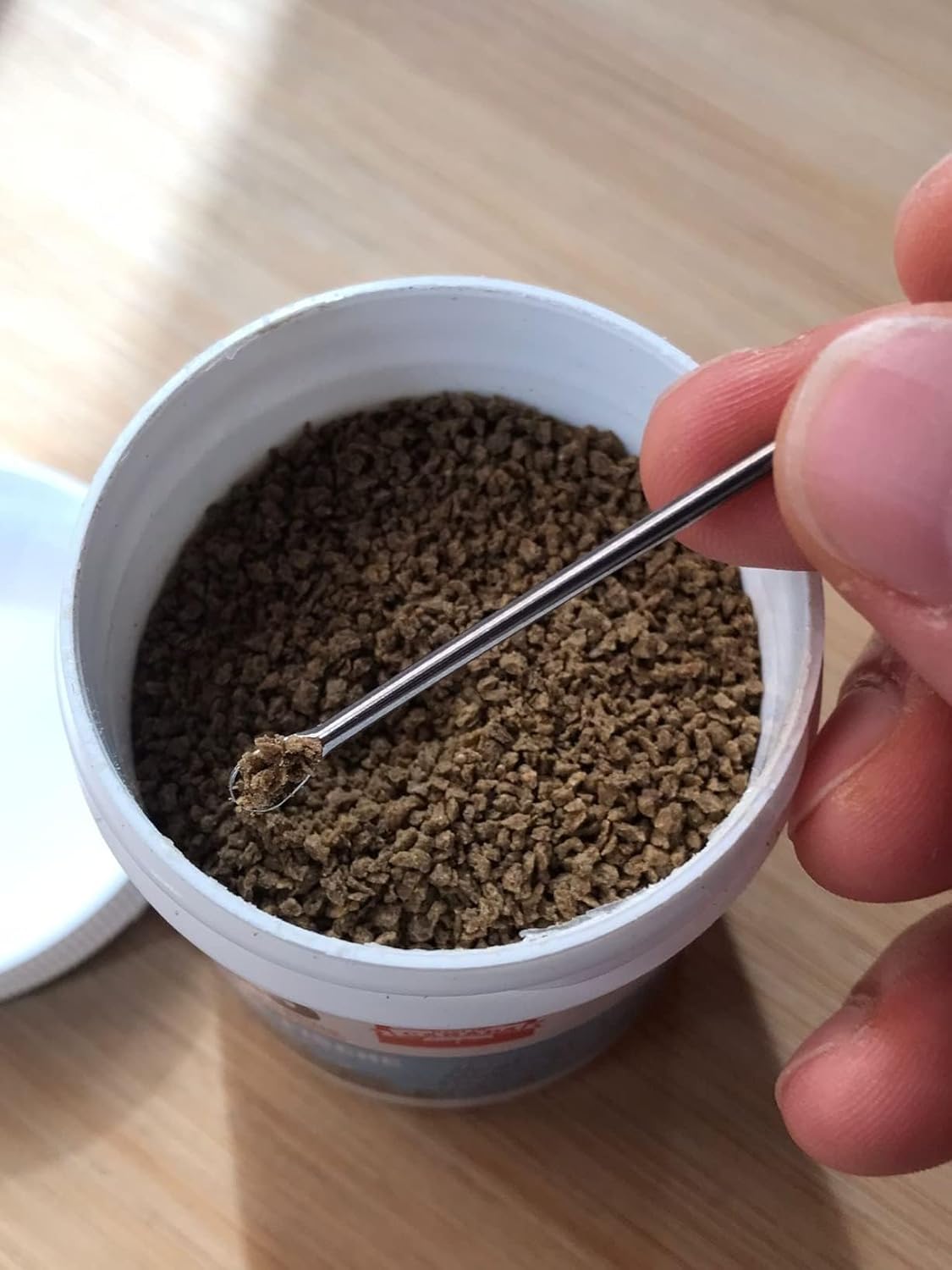
Fluval
$5.94
In stock on Amazon
Check price on AmazonMid-Range Pellets: The Workhorse Tier for Serious Hobbyists
Mid-range pellets in the $18–$40 range for 1–5 lb bags represent the most significant formulation improvement per dollar spent. Fish meal moves into the first or second ingredient slot; plant proteins appear as secondary and tertiary ingredients rather than anchoring the formula. Crude protein typically runs 38–45%, fat climbs to 6–12%, and the ingredient panel often includes stabilized vitamin C and astaxanthin — the carotenoid pigment responsible for color enhancement in koi and salmonids.
The Merck Veterinary Manual’s fish nutrition overview identifies astaxanthin inclusion as particularly relevant for ornamental species and for broodstock conditioning, where pigmentation and reproductive performance are linked. Mid-range formulas meeting this profile are appropriate for the serious hobbyist running a planted cichlid tank through a full seasonal cycle, a koi pond, or a small-scale tilapia or catfish grow-out system.
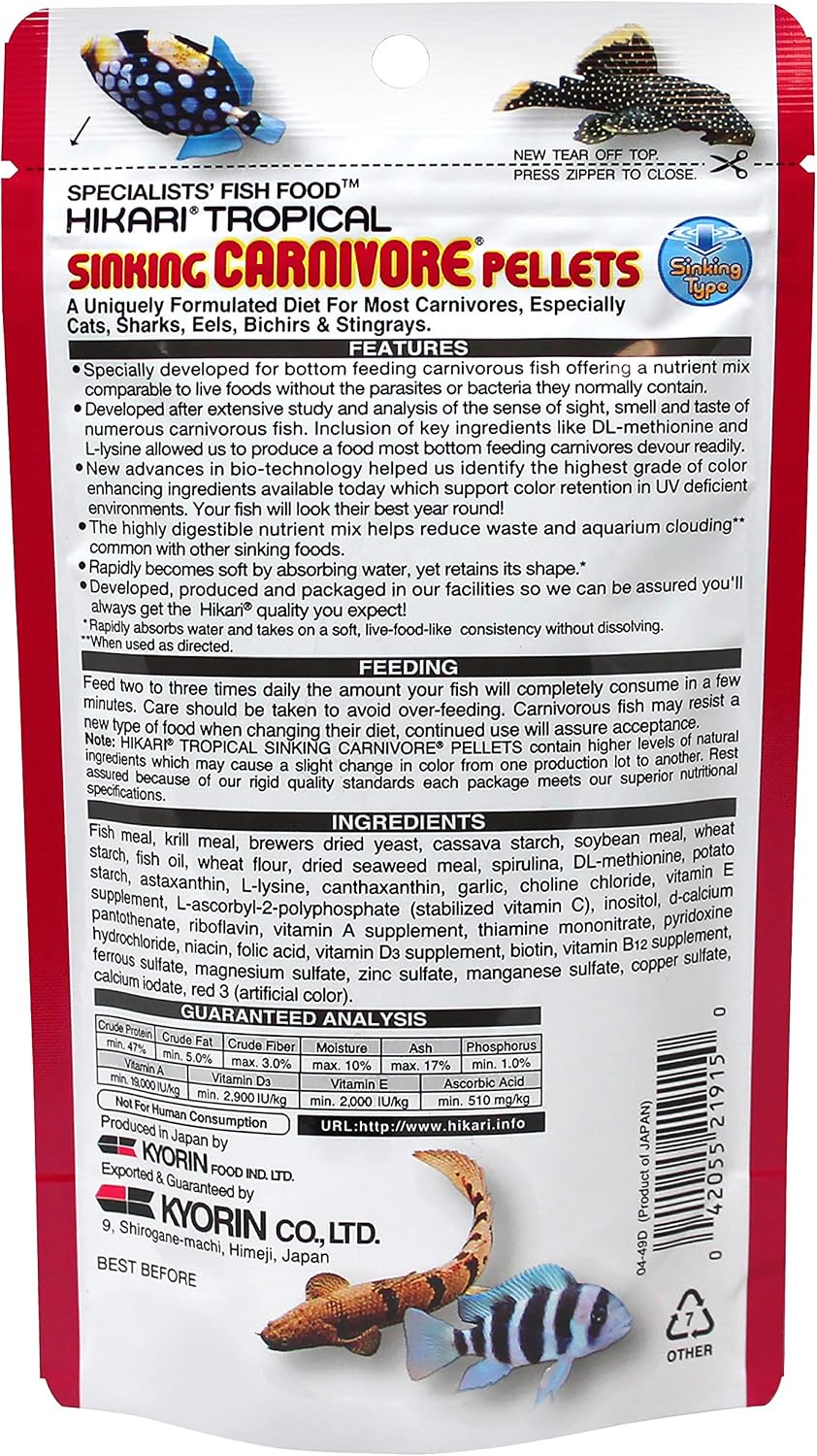
Hikari
$10.79
In stock on Amazon
Check price on AmazonPremium and Specialty Pellets: High-Digestibility Formulations for Demanding Species
Premium pellets in the $40–$120+ range per bag place named marine protein sources — anchovy meal, salmon meal, krill meal — in the first two or three ingredient slots. Amino acid supplementation is explicit in the ingredient panel rather than implied by protein percentage. Crude protein for carnivore-specific diets runs 45–55%+, and lipid profiles are optimized for species-specific metabolic needs: high DHA omega-3 content for marine ornamental species, different fatty acid ratios for warm-water tropical carnivores.
The Merck Veterinary Manual specifically supports high-DHA omega-3 inclusion as significant for marine ornamental species health and for broodstock conditioning programs. The USDA National Agricultural Library’s aquaculture resources attribute meaningfully higher digestibility coefficients to marine-protein-dominant diets compared to plant-protein-dominant diets — which means that the feed conversion ratio advantage of a premium formula can partially offset its higher per-bag cost in aquaculture contexts where feed cost is a real P&L line. Products in this tier include commercially available trout diets from regional aquaculture feed mills, aquatic-species lines from established zoo-nutrition manufacturers, and specialty small-batch formulas designed for specific carnivore profiles.
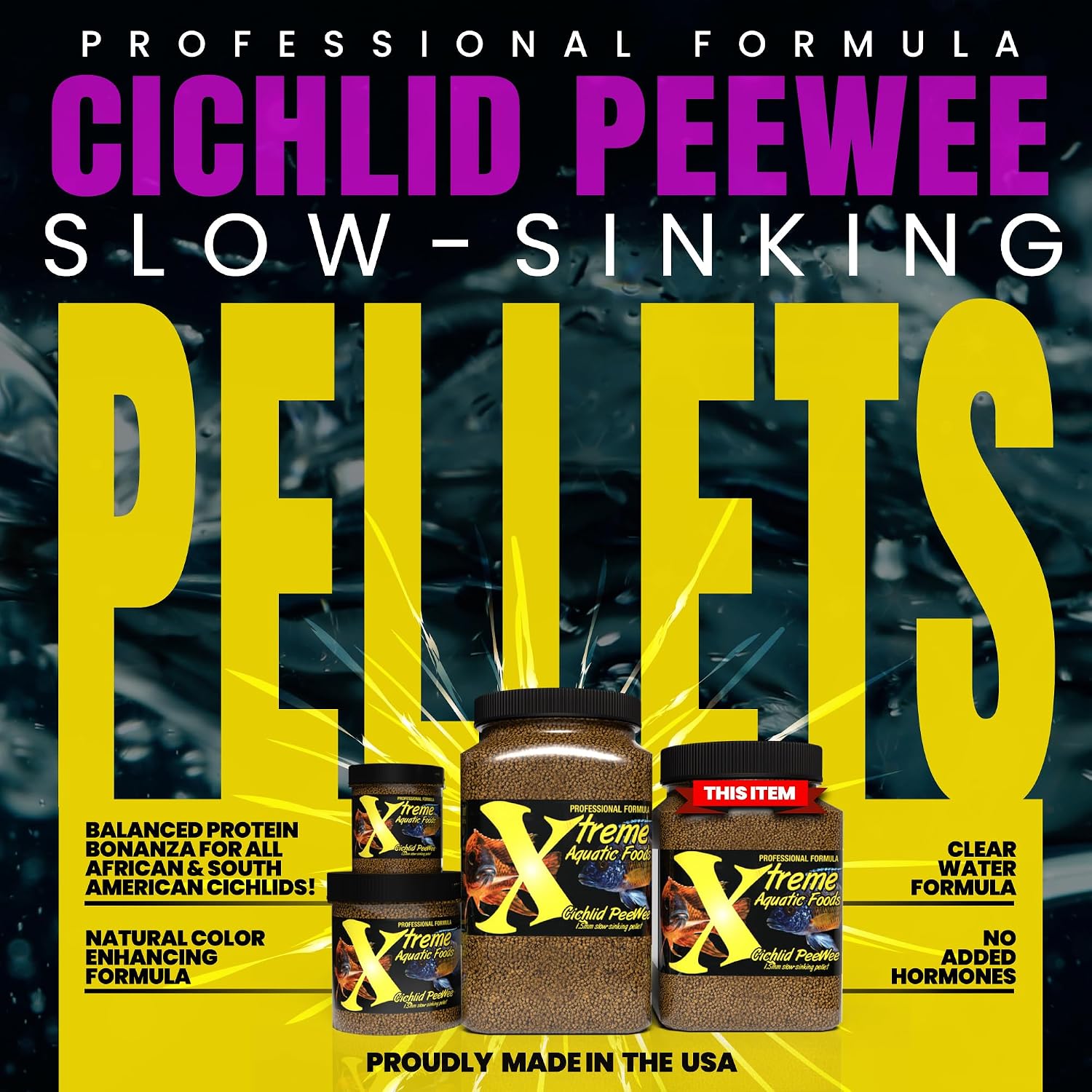
Xtreme
$32.99
In stock on Amazon
Check price on AmazonThe Decision Rules: If X, Then Y
Run through these before you buy:
If your fish are mid-water or bottom-dwelling omnivores in a community tank → choose a mid-range sinking or slow-sink pellet with fish meal in slot one. Crude protein at 38–42% is sufficient. Prioritize pellet water stability and sinking rate over the highest available protein percentage.
If you’re running a carnivore-dominant tank — cichlids, oscars, large catfish, predatory oddballs → choose a premium sinking pellet with named marine proteins in slots one and two, crude protein 45%+, explicit lysine and methionine supplementation, and no soy in the top five ingredients. The formulation cost is justified by the growth rate, color, and long-term health outcomes that distinguish high-digestibility animal-protein diets for obligate carnivores.
If you’re feeding koi or goldfish in an outdoor pond → use floating pellets during active feeding season when water temperature is reliably above 55°F; surface feeding makes appetite monitoring easy. Shift to a wheat germ-based sinking pellet in shoulder seasons when metabolism slows and digestibility of high-protein diets drops. The FAO’s aquaculture feeds and feeding strategies publications specifically address seasonal protein adjustment as a key management practice for pond fish, noting that high-protein diets fed at low water temperatures generate excess ammonia load relative to metabolic benefit.
If you’re running a small-scale tilapia or trout aquaculture system where feed cost is a real variable → calculate cost-per-pound of digestible protein delivered, not cost-per-bag. A 40% crude protein soybean-led pellet at $1.20/lb may appear cheaper than a 45% fish meal-led pellet at $1.80/lb, but if the digestibility coefficient advantage documented by the USDA National Agricultural Library’s Aquaculture Information Center for marine proteins holds in your system, the feed conversion ratio may favor the premium option on a net basis.
If you’re new to aquarium keeping and working through your first bag of a mass-market staple → that is a perfectly reasonable starting point. Use the ingredient-order framework in this article the next time you shop, compare the first three ingredient slots between your current bag and the next tier up, and make one informed upgrade at a time. The label tells you everything you need to know once you know how to read it.
The ingredient panel and guaranteed analysis on a fish pellet bag are the manufacturer’s commitment to you, printed in regulatory ink. Reading them with this framework — ingredient order first, protein source quality and amino acid completeness second, buoyancy matched to species feeding behavior third — turns a wall of nearly identical bags into a clear and differentiated choice. The fish can’t read the label. That part is yours.