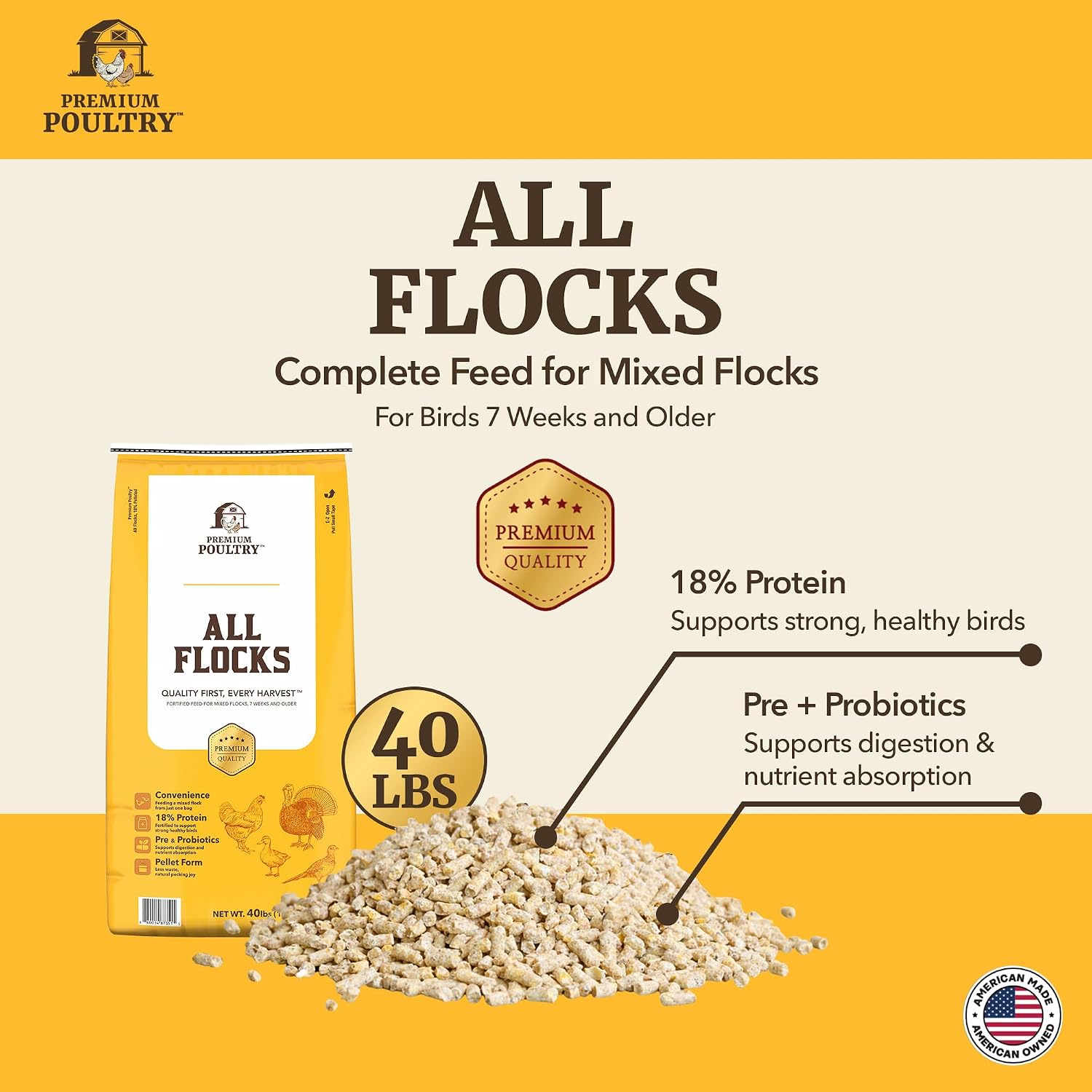
If you’ve ever stood in the feed aisle holding two different bags — one for chickens, one for ducks — and thought, there has to be a simpler way, you’re not alone. “All-flock feed” is exactly what it sounds like: a single formulation designed to meet the nutritional needs of multiple poultry species housed together. Instead of juggling separate rations for your laying hens, your Pekin ducks, and your heritage tom turkeys, you run one bag through one feeder. Simple in theory. But the tradeoffs are real, and getting the choice wrong means one species quietly underperforms while the others thrive. This guide walks through the nutritional math, the labeling decisions that actually matter, and the product categories worth comparing — so you can make a confident call for your specific flock mix.
| EDITOR'S PICKScratch and Peck Feeds | Layer… | Mid-tierAll Flock Feed | Budget pickManna Pro All Flock Crumbles | |
|---|---|---|---|
| Form | Mash | Whole Grain | Crumbles |
| Protein | 16% | — | 16% |
| Certifications | Organic, Non-GMO | — | — |
| Additives | — | — | Probiotics |
| Bag Size | 40 lb | 10 lb | 8 lb |
| Price | $64.99 | $25.99 | $15.49 |
| See on Amazon → | See on Amazon → | See on Amazon → |
Why “All-Flock” Is a Compromise — and Why That’s Okay
Let’s be direct: no single feed formulation is the biological optimum for every species in your barnyard simultaneously. A laying hen in peak production needs roughly 16–18% crude protein and tightly controlled calcium (around 3.5–4.5% in the diet when calcification rates are high). A mature turkey in maintenance needs 14–16% protein but is more sensitive to certain mineral ratios. Ducks — especially egg-laying breeds like Khaki Campbells — need higher niacin (vitamin B3) than chickens and are actually harmed by the elevated calcium in dedicated layer pellets if they’re consuming it chronically.
All-flock feeds resolve this by targeting a middle-ground specification that avoids the extremes that injure any one species. The design logic, consistent across major formulations reviewed by the ATTRA/NCAT publication Pastured Poultry Nutrition and Forages, is generally:
- Protein: 16–18% crude protein — enough for laying hens, not excessive for turkeys
- Calcium: 1.0–1.5% — well below the 3.5–4.5% in dedicated layer pellets, safe for waterfowl and turkeys
- Niacin: elevated relative to standard chicken layer, typically 30–50 mg/kg, to cover duck requirements
- Phosphorus: balanced to complement the lower calcium ceiling
The tradeoff you’re accepting: your laying hens will need a separate free-choice calcium source (crushed oyster shell, offered in a side dish — never mixed into the feed itself) to hit peak shell quality. Without it, shell quality degrades over 6–8 weeks. That’s the only non-negotiable management step the all-flock approach adds. Everything else simplifies.
The Label Numbers That Actually Drive the Decision
When you’re standing in front of a stack of bags at Tractor Supply or scrolling through an Azure Standard bulk order, here are the four guaranteed analysis numbers that determine whether a bag is genuinely all-flock-safe or just labeled that way:
By the Numbers
| Nutrient | Layer Pellet (typical) | All-Flock Target | Risk if Wrong |
|---|---|---|---|
| Crude Protein | 16–18% | 16–18% | Low protein → poor production |
| Calcium | 3.5–4.5% | 0.9–1.5% | High Ca → kidney damage in ducks, turkeys |
| Niacin | 10–15 mg/kg | 30–55 mg/kg | Low niacin → leg weakness in ducks |
| Phosphorus | 0.4–0.5% | 0.4–0.6% | Imbalanced ratio → bone issues |
Sources: Merck Veterinary Manual Nutrition: Poultry; The Poultry Site Duck Nutrition and Feeding; Penn State Extension Feeding Turkeys.
The calcium number is the binary filter. If a bag says “All Flock” on the front but lists calcium at 2.5% or higher in the guaranteed analysis panel, put it back. That formulation was built around laying hen calcium needs and relabeled. The Poultry Site’s overview of duck nutrition specifically flags chronic high-calcium intake as a contributor to visceral gout in waterfowl — a painful, often fatal kidney condition. You will not see symptoms until significant damage has occurred.
Niacin is the second screen, especially if ducks are in your mix. Ducklings famously require 2–3× the niacin of chicks (Penn State Extension’s feeding guides put duck niacin minimums at roughly 55 mg/kg during growth), but adult ducks on maintenance still need more than a standard chicken layer delivers. A well-formulated all-flock feed accounts for this. If niacin isn’t listed on the label (many bags omit it), contact the manufacturer directly — any mill confident in their formulation will provide a full vitamin assay on request.
Product Categories and What Owners Report
The all-flock segment has expanded meaningfully since 2023, with regional mills entering alongside the established national brands. Here’s how the main product tiers behave in practice, based on published spec sheets and aggregated owner reports across homesteading forums and specialty poultry communities:
Entry-level / mainstream all-flock pellets ($18–$28 per 50 lb bag): Brands like Purina Flock Raiser and Dumor All Flock (Tractor Supply’s house brand) sit in this tier. Published specs generally show calcium around 0.9–1.0%, protein at 18–20%, and the formulations are reliably consistent batch-to-batch — a meaningful advantage if you’re buying 10+ bags at a time. Owners running mixed chicken-duck flocks consistently report solid egg production once oyster shell is offered free-choice, and duck leg issues are rarely reported at these calcium levels. The tradeoff is conventional grain sourcing and no organic certification.
Mid-range and regional formulations ($30–$45 per 50 lb bag): This is where the decision gets interesting. Kalmbach Feeds, for example, offers an All-Flock Grower/Finisher with published protein at 18% and calcium around 1.0%, using a more transparent ingredient deck than entry-level competitors. Scratch and Peck Feeds’ Cluck’n Sea All Flock Organic (available in the $38–$55 range depending on channel) uses USDA-certified organic grains and kelp meal — an ingredient choice that adds iodine and trace minerals relevant to waterfowl thyroid function. Owners in long-run reviews note notably better feather quality in ducks on the Scratch and Peck formulation, though whether that’s the kelp, the organic grain sourcing, or the overall vitamin load is hard to isolate from label data alone. If organic certification matters for your homestead operation — either for your own standards or because you’re marketing eggs or meat — this tier is where the cert-to-price ratio is most defensible.
Premium and specialty formulations ($50–$80+ per 50 lb bag): Modesto Milling’s Organic Multi-Flock formula and comparable small-batch mill products target operations where the feed spec genuinely needs to support show birds, heritage breeds with specific amino acid sensitivities, or certified organic production. At this price tier, you’re paying for non-GMO verified grain, third-party organic certification overhead, and in some cases, methionine supplementation from natural sources (DL-methionine vs. synthetic — a meaningful distinction for certified organic status). The NAL/USDA’s poultry nutrient requirement documentation notes that methionine is typically the first limiting amino acid in grain-based poultry rations; premium all-flock formulations that address this explicitly (either in the guaranteed analysis or via a published amino acid profile available from the mill) are worth the premium for operations where feather quality and reproductive performance are commercial concerns.
Turkey-Specific Considerations: The Often-Missed Variable
Chickens and ducks get most of the attention in mixed-flock feeding discussions, but turkeys introduce a constraint that’s easy to overlook until you have a problem: copper sensitivity.
Turkeys are substantially more sensitive to elevated dietary copper than chickens. Penn State Extension’s turkey feeding guidance specifically warns against feeding standard broiler or layer rations to turkeys long-term because they’re often formulated with copper sulfate levels that turkeys metabolize poorly. Most dedicated all-flock feeds are formulated at copper levels safe for turkeys (typically 5–8 mg/kg vs. the 15–25 mg/kg sometimes found in broiler rations), but this is not universal. If turkeys are in your flock, check the copper level with the manufacturer before committing to a new bag. It won’t be on the standard guaranteed analysis panel — you’ll need to call or email the mill for their full mineral assay.
The second turkey variable is protein timing. Heritage turkey breeds going through a growth phase — poults from hatch to roughly 8 weeks — need 28% protein, dropping to 20–22% through 16 weeks, then settling to a maintenance 14–16% as adults. An all-flock feed at 18% is appropriate for adult turkeys in a mixed flock but is insufficient for growing poults. If you’re running poults alongside adult birds, the practical solution most experienced operators use is a separate brooder run for the first 12 weeks with a higher-protein starter/grower, then integrating into the main flock on all-flock rations. Attempting to use all-flock feed as a sole ration for growing poults produces stunted growth — a documented outcome consistent across extension literature.
Channel and Pricing Reality in 2026
Pricing for all-flock feeds has stabilized somewhat after the grain price volatility of 2023–2024, but the channel spread remains meaningful:
- Tractor Supply / farm stores: Reliable stock, no minimum order, but retail markup runs 15–25% above direct-mill pricing. Convenient for 1–3 bag purchases.
- Chewy Autoship: Competitive on mainstream brands (Purina, Nutrena). Autoship discounts of 5–10% apply, and the subscription model works well for consistent monthly usage. Less useful for regional or specialty mills not carried on the platform.
- Azure Standard: Strong for organic and specialty formulations. Quarterly drop pricing can represent 10–20% savings over farm store retail on brands like Scratch and Peck. Minimum order thresholds apply; best for operations buying 200+ lbs per month.
- Direct from regional mills: Best unit pricing, but requires minimum order quantities (often 500 lb or 1-ton minimum), and freshness dating matters — all-flock pellets have a practical shelf life of 90–120 days before fat-soluble vitamins (A, D, E) degrade meaningfully.
The Decision Rule
If you keep chickens, ducks, and turkeys together and want one feed bag, here’s the clear framework:
- If calcium is above 1.5% on the guaranteed analysis → reject the bag regardless of front-label claims. This protects your ducks and turkeys.
- If ducks are a significant part of your flock → verify niacin is 30+ mg/kg. Call the mill if the label doesn’t list it.
- If turkeys are present → confirm copper is under 10 mg/kg. Again, call the mill.
- Once you’ve cleared those three screens: choose your tier based on whether organic certification, non-GMO sourcing, or natural amino acid supplementation matters to your operation or your marketing.
- Always offer oyster shell free-choice in a separate dish. This is non-negotiable for laying hen shell quality on any all-flock ration.
One bag for everyone is genuinely achievable. The formulations exist, the price tiers cover every budget, and the management add-on (oyster shell on the side) is trivial. What trips people up is trusting front-label marketing over the guaranteed analysis panel. Flip the bag. Read the numbers. The right choice for your flock is three rows down on that nutrition label — not on the front.